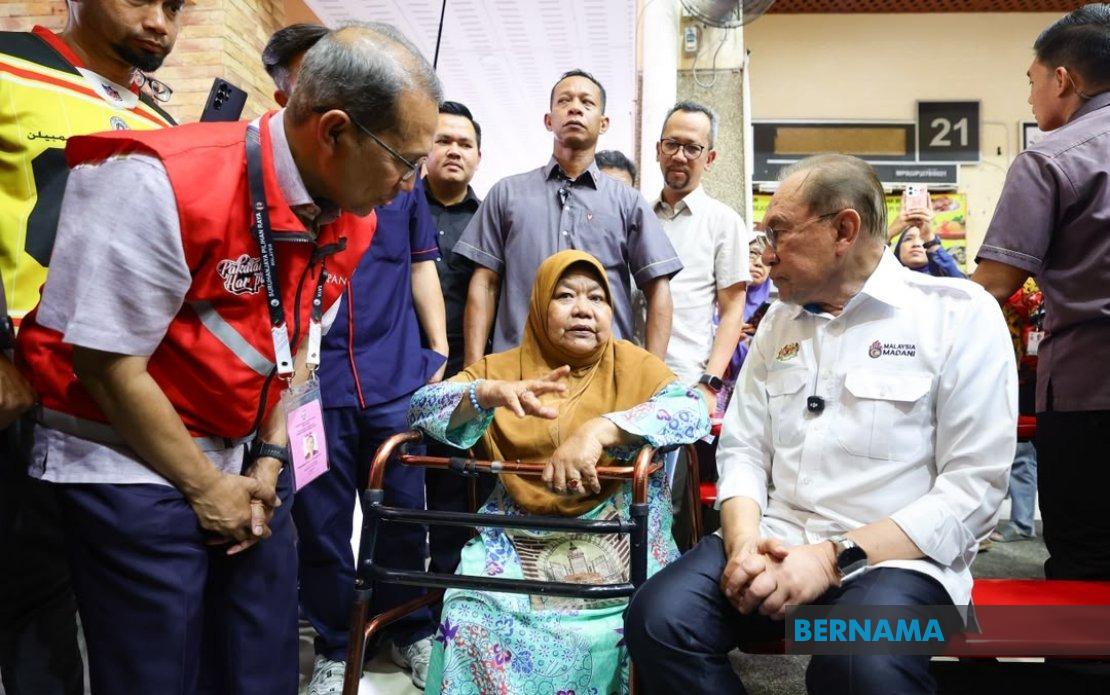
Prime Minister Datuk Seri Anwar Ibrahim has cited infrastructure initiatives in Negeri Sembilan as a demonstration of the Pakatan Harapan-led state government's ability to manage public resources responsibly and channel benefits directly to communities. Speaking at a grassroots engagement event in Seremban on July 22, Anwar pointed specifically to river widening and deepening schemes implemented across several localities as tangible proof that development can proceed while maintaining accountability to the people.
The reciprocal approach that underpins these projects represents a departure from traditional development models. Rather than treating infrastructure work as a standard expenditure, the methodology allows the Negeri Sembilan government to extract sand from the rivers during widening and deepening operations, then sell or repurpose the material to generate revenue. These funds are subsequently reinvested in maintaining and improving the same river areas and surrounding infrastructure, creating a self-sustaining cycle of development.
The Ampangan area serves as the concrete case study Anwar highlighted during his visit. Beyond the immediate objective of flood mitigation—a persistent challenge for communities in the Klang Valley and Selangor's surrounding regions—the project exemplifies governance that moves beyond rhetoric about people-centric development. By managing sand extraction transparently and linking revenue generation directly to community benefit, the administration demonstrates that resource management can simultaneously address environmental and social concerns while generating income for further improvements.
For Malaysian voters accustomed to development narratives that often prioritize grand announcements over incremental, locally-visible improvements, this framing carries particular resonance. Anwar's emphasis on integrity-based governance suggests a deliberate positioning against perceptions of state inefficiency or corruption that have historically plagued development projects nationwide. The contrast he drew by referencing his own involvement in negotiating a hotel development in Port Dickson—where considerations for local fishing communities, their education, and housing improvements were explicitly factored into planning—underscores an evolving approach to balancing commercial interests with community welfare.
The timing of these remarks carries strategic significance as Negeri Sembilan approaches its 16th state election, scheduled for August 1 with early voting on July 28. As PH chairman, Anwar's presence and advocacy in the state serves multiple purposes: reinforcing party messaging about delivery on governance promises, building momentum for the 36 contested seats, and framing the electoral choice as fundamentally about trustworthiness and competent stewardship. The distribution of candidacies—16 from PKR, 11 from DAP, and nine from Amanah—reflects the coalition's internal power dynamics while presenting unified governance credentials.
Anwar's appeal to voters to support candidates selected for their integrity rather than their ethnicity represents an attempt to transcend divisive racial narratives that have traditionally dominated Malaysian electoral contests. His statement that "there are many good Malays, many good Indians and many good Chinese who have dignity" redirects the conversation from identity politics toward capability and moral character. This rhetorical strategy acknowledges Malaysia's multicultural composition while suggesting that development quality and honest governance supersede communal considerations in determining electoral choices.
For Southeast Asian observers, Negeri Sembilan's reciprocal infrastructure approach offers a template worth monitoring. Several countries in the region struggle with managing development revenue transparently and ensuring that resource extraction genuinely benefits local populations. The scheme's mechanics—extracting valuable materials and reinvesting proceeds locally—potentially addresses frustrations in communities where natural resources are exploited without corresponding improvements to their immediate surroundings. Whether this model proves scalable to larger projects and other states remains an open question.
The emphasis on transparent resource management also reflects a broader regional trend where governance capacity and anti-corruption credentials have become electoral currency. In Thailand, Indonesia, and the Philippines, governments have increasingly promoted infrastructure projects with explicit transparency mechanisms and community oversight elements, partly in response to voter demands for accountability. Malaysia's positioning within this trend suggests that constituencies across the region increasingly expect development projects to demonstrate visible community benefit rather than simply generating GDP growth statistics.
However, the effectiveness of these messaging efforts depends substantially on execution. Communities across Malaysia possess growing capacity to distinguish between rhetorical commitments to transparency and actual implementation. The Ampangan river project, while illustrative of an improved approach, remains relatively modest in scale. Translating this model into comprehensive state management that visibly improves living standards across diverse communities represents the substantive challenge facing the PH administration in Negeri Sembilan and, by extension, across other states where the coalition governs.
Anwar's framing of the election choice as fundamentally about selecting trustworthy leaders rather than pursuing sectarian interests positions the election outcome as carrying implications beyond state-level governance. A decisive victory for PH would validate the coalition's revival after the 2020-2022 internal conflicts that fractured its credibility, while potentially strengthening Anwar's position as the consensus choice for national leadership. Conversely, setbacks would reignite questions about the coalition's capacity to sustain voter support and execute governance promises at the state level.
The river infrastructure initiatives, properly executed, represent the kind of incremental but visible improvement that shapes voter perceptions over time. Unlike mega-projects that capture headlines but may take years to materialize, localized flooding mitigation and river maintenance affect daily community experiences almost immediately. This focus on tangible, neighborhood-level benefits rather than grand developmental symbolism reflects a potentially significant evolution in how Malaysian politicians present their governing records and electoral mandates.

