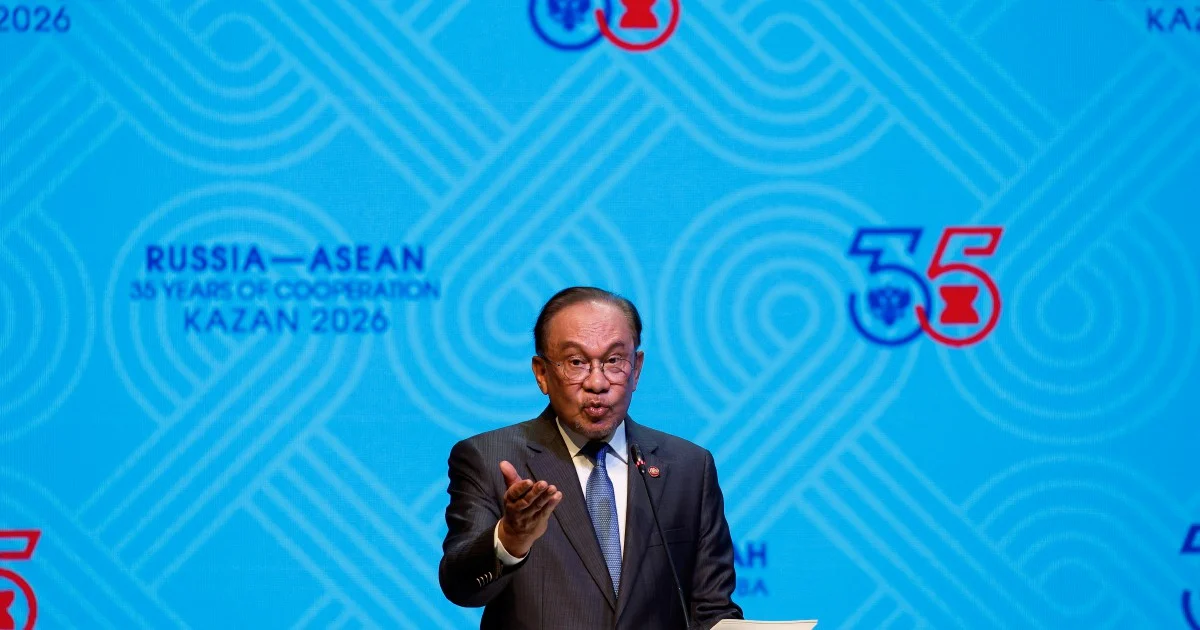
Prime Minister Datuk Seri Anwar Ibrahim has expressed optimism about the completed Asean-Russia Strategic Programme on Trade and Investment Cooperation 2026-2035, characterising the agreement as a pivotal moment for expanding economic partnership between the 10-member Southeast Asian bloc and Moscow. Speaking in Kazan, the premier indicated that the framework represents substantial momentum in bilateral relations, marking a deliberate step toward stronger commercial and investment linkages across the decade ahead.
The finalisation of this strategic document carries particular significance for Malaysia and the broader Asean region, which has sought to diversify economic partnerships beyond traditional Western markets. Russia, despite international sanctions and geopolitical tensions, remains a substantial player in energy markets, commodities, and defence procurement—areas where Asean nations maintain strategic interests. The 2026-2035 roadmap provides a structured platform through which member states can explore opportunities in these sectors while adhering to their individual foreign policy commitments.
However, Anwar's cautionary note regarding an "enabling environment" underscores a fundamental reality facing the proposed framework. The implementation of trade agreements between large blocs often encounters obstacles rooted in regulatory divergence, logistics infrastructure, and currency stability. For Southeast Asian exporters, accessing Russian markets typically involves navigating complex customs procedures and currency conversion challenges, particularly given the rouble's volatility and the impact of Western sanctions on Russian banking systems.
The roadmap's emphasis on trade and investment cooperation aligns with Asean's broader strategic autonomy doctrine, which seeks balanced relationships with major powers. For Malaysia specifically, enhanced ties with Russia could facilitate closer cooperation in sectors where the two nations possess complementary interests, including palm oil exports, defence cooperation, and technology transfer. The framework potentially opens avenues for Malaysian small and medium enterprises to explore opportunities in Russian markets, though practical barriers will require sustained attention from both governments.
From Russia's perspective, the agreement addresses Moscow's pivot toward Asia-Pacific markets in response to Western economic isolation. Asean's combined market of over 600 million people represents a substantial economic anchor, and deepening commercial ties with the bloc serves Russia's strategy of cultivating strategic partnerships beyond Europe. The timing of this finalisation suggests both parties view expanded economic engagement as essential during an era of geopolitical realignment.
The investment cooperation component of the roadmap holds particular relevance for the region. Russian capital, particularly in energy infrastructure and mining ventures, could supplement existing foreign direct investment flows into Asean countries. However, such investments typically require robust legal frameworks, transparent governance standards, and political stability—conditions that vary significantly across the 10 member states. Harmonising investment protocols across diverse economies will represent a substantive challenge during implementation.
Anwar's observation that the framework requires an enabling environment reflects awareness that agreements alone do not automatically generate economic benefits. Translating the roadmap into tangible trade growth demands coordinated action across multiple dimensions: harmonisation of standards, reduction of non-tariff barriers, development of transport corridors, and establishment of mechanisms to resolve commercial disputes. Without these foundations, the strategic programme risks becoming a ceremonial document disconnected from ground-level commercial reality.
The geopolitical context surrounding this agreement cannot be overlooked. While Asean maintains its traditional non-alignment stance, deepening economic ties with Russia inevitably carries implications for its relationships with Western partners and China. Malaysia, as a moderate voice within Asean, will need to navigate these complexities carefully, ensuring that expanded Russian cooperation complements rather than undermines its existing partnerships and standing within the international community.
Looking forward, the success of the 2026-2035 programme will depend substantially on sustained political commitment from both Asean leadership and the Kremlin. Trade growth rarely emerges organically; it requires proactive facilitation through business councils, tariff negotiations, logistics investment, and regular high-level dialogue to resolve emerging obstacles. Malaysian policymakers should view this framework as initiating a process rather than achieving a destination, with implementation demanding consistent focus and resource allocation over the coming decade.
The announcement from Kazan represents a meaningful signal of intent from both Asean and Russia to broaden their economic partnership during a period of shifting global alignments. For Malaysian readers, the framework offers potential opportunities in specific sectors while simultaneously highlighting the reality that benefiting from such agreements demands active engagement from private sector stakeholders, government agencies, and regional institutions. The coming years will reveal whether this strategic programme proves transformative or remains an aspirational blueprint overshadowed by practical implementation challenges.