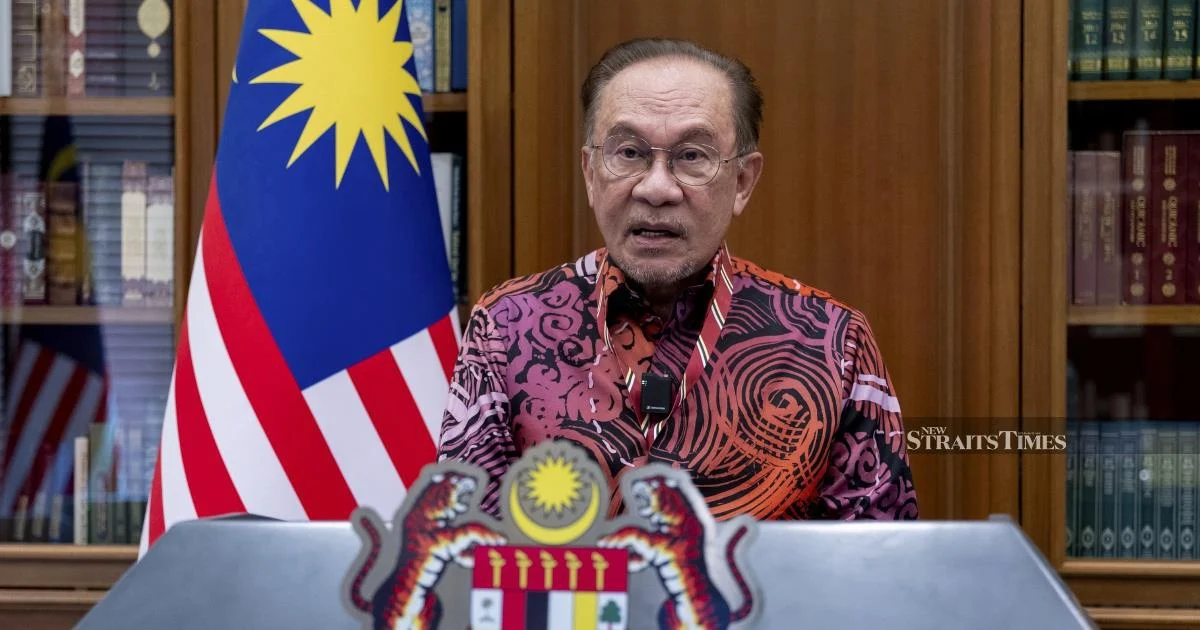
Malaysia's Prime Minister Datuk Seri Anwar Ibrahim has formally congratulated the Chinese government on the occasion of the 105th anniversary of the Chinese Communist Party, underscoring the enduring diplomatic relationship between the two nations and the significance Kuala Lumpur places on its engagement with Beijing across political, economic, and cultural dimensions.
The gesture represents a continuation of Malaysia's long-standing practice of recognising major milestones in China's political calendar, a custom that has become increasingly important as the two countries have deepened their economic interdependence. Such ceremonial acknowledgements serve as touchstones of goodwill between governments and reflect the broader strategic partnership that has evolved over decades, particularly since Malaysia established formal diplomatic relations with the People's Republic of China in 1974.
Anwar's congratulatory message arrives at a critical juncture for Malaysia-China relations. The bilateral economic relationship has expanded significantly, with China remaining Malaysia's largest trading partner and a crucial source of foreign direct investment. Trade volumes between the nations have consistently grown, spanning diverse sectors from manufacturing and technology to palm oil and petrochemicals, making the health of this relationship vital to Malaysia's economic stability and prosperity.
The timing of such official communications carries weight beyond mere ceremony. In an increasingly multipolar regional landscape where Southeast Asian nations carefully calibrate their relationships with major powers, Malaysia's continued emphasis on cordial engagement with China demonstrates its commitment to maintaining balanced diplomacy. This approach allows Malaysia to benefit from Chinese investment and partnership while managing broader geopolitical complexities in the Indo-Pacific region.
Under Anwar's leadership, Malaysia has sought to position itself as a pragmatic actor capable of managing relationships with multiple powers. The government has pursued policies aimed at attracting Chinese investment in infrastructure projects, technology development, and manufacturing while simultaneously maintaining strong ties with other regional and global partners. This balancing act reflects the sophisticated diplomatic strategy required of a middle-power nation navigating great power competition.
The Communist Party's 105 years of rule represent a significant span in modern Chinese history, encompassing periods of transformation that have reshaped China from a developing nation into the world's second-largest economy. Malaysia, as a neighbour sharing maritime boundaries with China and serving as a hub for regional commerce, has directly benefited from China's economic rise and technological advancement. The relationship extends beyond commerce to include cultural exchanges, educational programmes, and people-to-people connections that have strengthened mutual understanding.
China's significance in the Southeast Asian context cannot be overstated. As the dominant power in the region, with territorial interests in the South China Sea that affect regional stability, China's internal stability and policy directions have implications for all neighbouring states, including Malaysia. Regular diplomatic courtesies help maintain channels of communication and reduce misunderstandings at a crucial time when maritime boundaries and resource management remain sensitive issues.
For Malaysia's government, recognising significant occasions in China's political calendar also serves domestic purposes. The nation's substantial ethnic Chinese population, comprising approximately 23 per cent of the population, maintains cultural and emotional ties to China, making Malaysia's diplomatic approach toward Beijing a matter of domestic political significance. Anwar's message, therefore, resonates not only internationally but also within Malaysia's multicultural society.
The investment dimension warrants particular attention. China has been instrumental in funding Malaysia's infrastructure modernisation, including projects linked to the Belt and Road Initiative and other bilateral arrangements. Recent years have seen continued Chinese participation in developing Malaysia's renewable energy sector, semiconductors, and digital economy, areas that Anwar's government has prioritised for long-term economic diversification and growth.
Looking ahead, the Malaysia-China relationship appears poised for continued expansion. Anwar's administration has signalled openness to deepening cooperation on climate change, digital transformation, and regional security matters. The government has also sought to enhance Malaysia's attractiveness as an investment destination for Chinese corporations seeking to diversify supply chains away from traditional manufacturing hubs, positioning the nation as an alternative within the region.
The broader context includes Malaysia's navigation of complex regional dynamics involving the United States, India, Japan, and other powers with significant interests in Southeast Asia. By maintaining warm relations with China while preserving partnerships with Western nations and other Asian powers, Malaysia demonstrates its commitment to regional stability and non-alignment with any single bloc, a principle that has guided Malaysian foreign policy for decades.
Anwar's congratulatory message ultimately exemplifies the calculated diplomacy required in contemporary international relations, where recognition of significant milestones serves both symbolic and practical functions. For Malaysia, sustaining constructive engagement with China remains essential for advancing national economic interests while contributing to the broader stability and prosperity of Southeast Asia.

