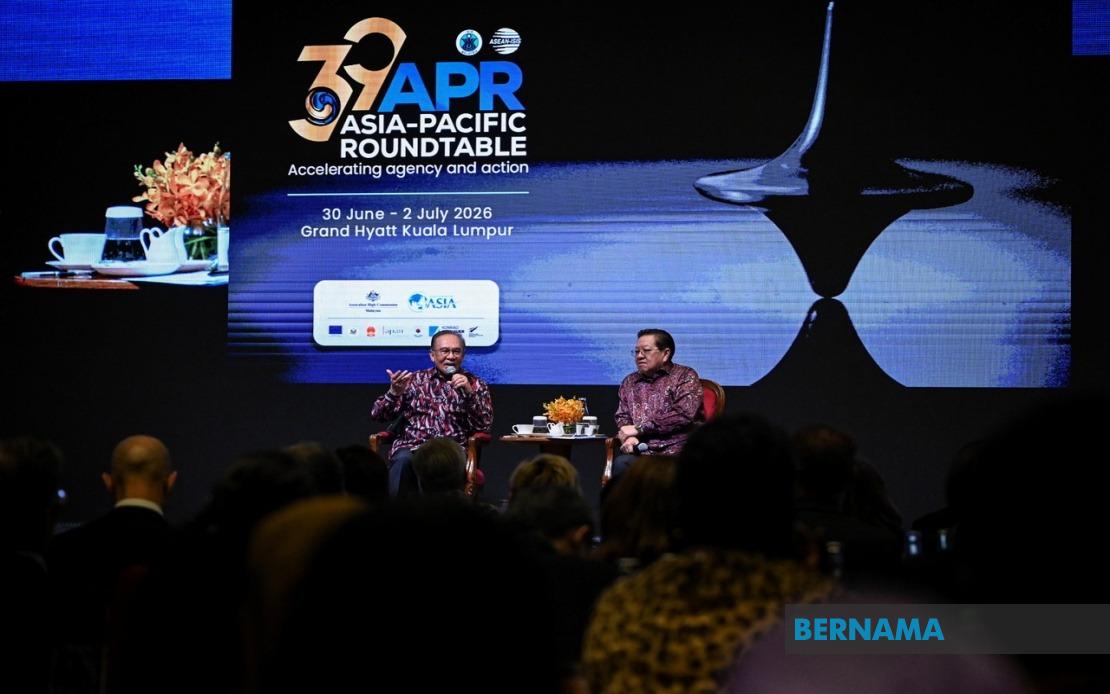
Prime Minister Datuk Seri Anwar Ibrahim has pushed back against apocalyptic framings of the South China Sea dispute, declaring during the 39th Asia-Pacific Roundtable in Kuala Lumpur that conflict in the waterway is neither inevitable nor the defining challenge facing the region. Speaking in response to questions on Thursday, Anwar articulated a notably optimistic assessment of Malaysia's bilateral relationship with China despite well-documented maritime tensions, suggesting that sensationalism about potential military confrontation obscures the reality of productive diplomatic engagement occurring beneath the surface of ongoing territorial disagreements.
The Prime Minister's remarks represent a deliberate recalibration of Malaysia's public messaging on South China Sea affairs at a time when regional anxieties remain elevated. Rather than dismissing the existence of competing maritime claims, Anwar acknowledged that jurisdictional differences persist but contended they have not translated into destabilizing friction with Beijing. His characterization of Malaysian-Chinese relations as unmarred by "one major question or issue that would cause tension" signals confidence in the efficacy of bilateral channels and suggests satisfaction with how both capitals have managed potential flashpoints that have elsewhere triggered more combative responses.
Anwar's confidence partly derives from his direct engagement with senior Chinese leadership. He cited conversations with President Xi Jinping and Premier Li Qiang as evidence that rapport at the highest levels translates into restraint and mutual understanding when disputes arise. This personal relationship-driven diplomacy reflects the Asian approach to conflict management, where informal channels and trust-building between leaders frequently accomplish what formal mechanisms cannot. For Malaysian audiences and policymakers, such assurances from the top address lingering concerns about whether territorial disputes could spiral into confrontation, a prospect that would severely jeopardize regional stability and economic prosperity.
Crucially, Anwar positioned China as supportive of the existing international legal framework governing maritime conduct. He highlighted Beijing's endorsement of the United Nations Convention on the Law of the Sea (UNCLOS) and its commitment to ongoing negotiations on the ASEAN-China Code of Conduct, both of which provide structured mechanisms for managing disagreements without resorting to coercion. By emphasizing China's engagement with these processes rather than its occasional assertiveness on the water, Anwar sought to counter narratives that portray Beijing as fundamentally uninterested in rules-based resolution of disputes. This framing is particularly significant for Southeast Asian nations that depend heavily on freedom of navigation and predictable maritime conduct.
The Prime Minister's caution against inflammatory rhetoric and doomsday scenarios reflects a broader ASEAN consensus that language shapes reality. When regional leaders habitually predict conflict, they unconsciously lower thresholds for competitive behavior and create self-fulfilling prophecies. Anwar's insistence that the region focus instead on diplomacy and engagement represents an attempt to reset the psychological terrain on which the South China Sea question is debated, steering away from zero-sum framings toward cooperative problem-solving. This approach carries particular weight from Malaysia, a nation with significant economic interests in both regional stability and robust China ties.
Anwar attributed ASEAN's success in maintaining peace over recent decades to the strength of relationships among member leaders and their habit of direct communication to defuse tensions before they metastasize. This institutional memory is instructive, suggesting that the bloc's enduring value lies less in formal agreements than in the web of personal relationships and consultation networks that allow leaders to resolve differences quietly. For a region facing multiple pressure points—the South China Sea, Myanmar's instability, economic competition—this reliance on leadership-level dialogue underscores ASEAN's vulnerability to generational change and shifts in political personalities.
The Prime Minister extended his dialogue-focused approach to other regional border disputes, welcoming Cambodia and Thailand's commitment to continued negotiations on their longstanding frontier disagreements. Anwar reframed such disputes as historical artifacts of colonialism rather than contemporary security threats, implying that patient diplomatic engagement can eventually reconcile even deeply rooted territorial claims. This perspective offers hope that disputes inherited from the colonial partition of Southeast Asia need not permanently poison regional relations if handled with sufficient forbearance and flexibility.
Anwar's remarks also contain a subtle critique of the Western-centric security narratives that sometimes dominate international discourse about Asia. By rejecting what he termed "phobia" about South China Sea threats, he implicitly pushes back against frameworks that emphasize confrontation between great powers and instead prioritizes Southeast Asian agency in shaping regional outcomes. This assertion of autonomy is politically important for Malaysia and other ASEAN members seeking to maintain balanced relationships with major powers rather than being pulled into opposing blocs.
Looking forward, the Prime Minister signaled that Malaysia and ASEAN remain committed to advocating for reforms of global multilateral institutions including the United Nations and World Trade Organisation. This agenda reflects frustration with institutional structures that many developing nations perceive as outdated and unresponsive to contemporary realities. For Malaysia particularly, efforts to strengthen multilateral frameworks offer a pathway to codifying peaceful dispute resolution mechanisms that might constrain larger powers and protect smaller states' interests.
Anwar's emphasis on mutual trust as essential to peace carries implicit recognition that technical agreements and legal frameworks alone cannot prevent conflict. Trust must be built deliberately through consistent demonstration of restraint, transparency in intentions, and willingness to accommodate others' legitimate concerns. Whether Malaysia's experience of trust-building with China can be replicated across the South China Sea region—where historical grievances, strategic competition, and nationalist sentiments run deep—remains an open question that will test the Prime Minister's optimistic vision in coming years.

