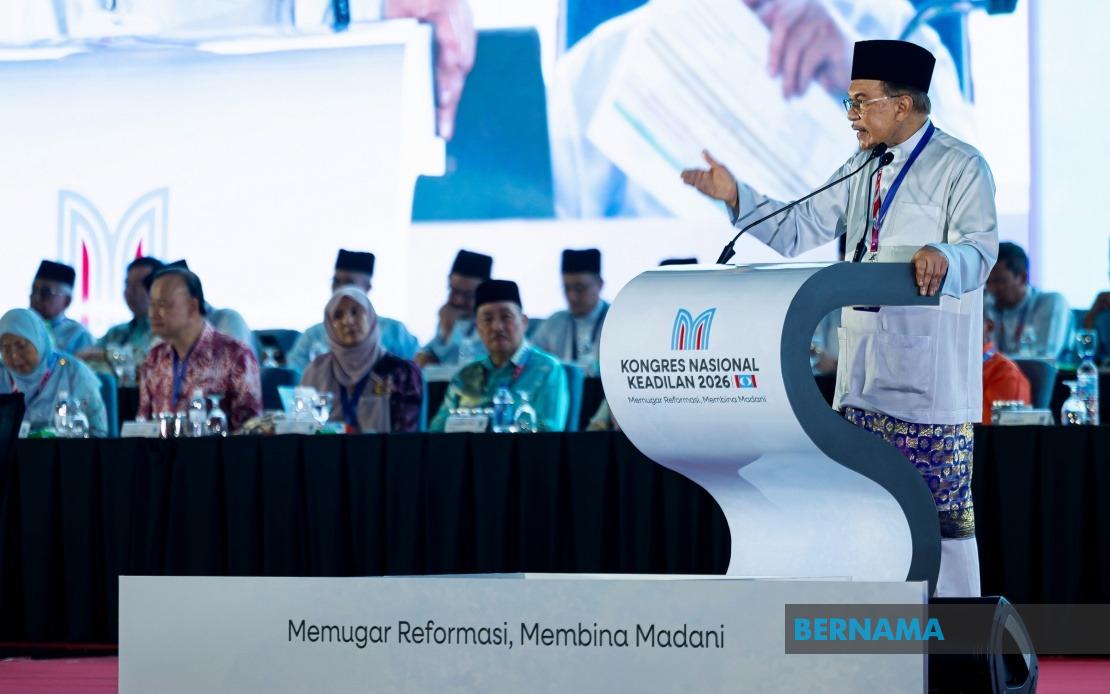
Prime Minister Datuk Seri Anwar Ibrahim moved swiftly to counter growing speculation about tensions within Malaysia's coalition government, publicly affirming that his professional relationship with Deputy Prime Minister Datuk Seri Dr Ahmad Zahid Hamidi remains on solid ground. Speaking in Melaka on August 15 after addressing the 2026 PKR National Congress at the Melaka International Trade Centre, Anwar sought to dispel recent commentary suggesting cracks in the top tier of the administration, framing the debate as a fundamental disagreement over how one interprets political developments.
The Prime Minister's intervention came days after Khairy Jamaluddin, the former UMNO Youth chief and former Rembau Member of Parliament, suggested that trust between Anwar and Ahmad Zahid had reached its weakest point since the Unity Government took shape in 2022. Khairy attributed this claimed erosion to mounting friction between the coalition's two largest components, Barisan Nasional and Pakatan Harapan, particularly following Barisan Nasional's controversial decision to align with Perikatan Nasional in the Negeri Sembilan state elections.
Anwar's response was characteristically philosophical, positioning himself as an advocate for conciliatory governance while implicitly critiquing his predecessor's more combative style. He argued that Khairy's assessment reflected a lens through which the former youth leader habitually views political dynamics—one premised on conflict and confrontation rather than consensus-building. By contrast, Anwar presented his own approach as rooted in dialogue and peaceful resolution, a distinction he underscored in his remarks to assembled journalists.
Crucially, the Prime Minister referenced his own address to the PKR congress earlier that day, noting that he had publicly thanked Ahmad Zahid and UMNO for their pivotal role in stabilising Malaysia's political landscape immediately following the 15th General Election. That foundational support, Anwar suggested, remains worthy of acknowledgment and has not been undermined by subsequent disagreements over tactical decisions such as Barisan Nasional's flirtation with Perikatan Nasional in state-level contests.
The timing and substance of Anwar's clarification reflect broader anxieties about the durability of Malaysia's three-year-old power-sharing arrangement. The Unity Government emerged from the highly fragmented outcome of GE15, which produced no outright majority for any single bloc and forced an unprecedented coalition between ideological adversaries. That the partnership has survived this long—navigating personality clashes, policy differences, and shifting regional alignments—is itself noteworthy, yet it remains perpetually vulnerable to rupture should either Pakatan Harapan or Barisan Nasional calculate that electoral prospects have shifted in their favour.
Barisan Nasional's recent pivot toward Perikatan Nasional in state elections appears to represent a recalibration of electoral strategy rather than a definitive break with the federal coalition. Yet such moves inevitably raise hackles among Pakatan Harapan leadership, who view Perikatan Nasional as a rival ideological project. Anwar's measured response—acknowledging differences while insisting they remain manageable through dialogue—attempts to reassure both the government's supporters and international observers that Malaysia's political system has not fundamentally destabilised.
The ideological tension between Anwar and his coalition partners extends beyond day-to-day governance. Pakatan Harapan, particularly its PKR and DAP components, remains committed to a secular, multi-racial vision of Malaysia, whereas Barisan Nasional's UMNO is primarily concerned with preserving Malay-Muslim interests within a federal structure. These competing visions periodically surface in cabinet deliberations, budget allocations, and legislative priorities. That such tensions have not yet fractured the government speaks to the mutual recognition that alternatives could be worse for either side.
Khairy's assertion that trust between the Prime Minister and Deputy Prime Minister has eroded to historic lows warrants scrutiny. Within coalition governments, low-level friction is endemic and often productive—it prevents one partner from dominating the other and forces genuine negotiation. What would be genuinely alarming would be public denials of working relationships combined with private legislative obstacles, ministerial resignations, or symbolic gestures of withdrawal. None of these have materialised, suggesting that Anwar's characterisation of the situation may be more accurate than doom-laden assessments.
Moreover, Ahmad Zahid's continued presence as Deputy Prime Minister and UMNO's role within the cabinet apparatus indicate that both leaders have compelling reasons to maintain the status quo. Ahmad Zahid faces ongoing legal challenges, and withdrawal of federal protection would invite prosecutorial action. Conversely, Anwar depends on Barisan Nasional's parliamentary numbers to sustain his government, making a rupture mutually destructive. These structural incentives may matter more than affective trust.
The broader Southeast Asian context adds another dimension. Malaysia's neighbours, particularly Singapore and Thailand, have shown keen interest in the stability of Malaysian governance given the region's interconnected economic ties and security architecture. Prolonged political uncertainty could undermine investor confidence and embolden rivals. This external perspective likely influences both Anwar and Ahmad Zahid's calculus regarding the public presentation of their relationship, encouraging rhetorical smoothing of differences even where substantive disagreements exist.
Looking ahead, the durability of the Unity Government will ultimately depend less on whether Anwar and Ahmad Zahid genuinely trust one another than on whether the structure incentivises cooperation over defection. State elections, including the Negeri Sembilan contest that sparked recent anxieties, may continue to produce misalignment between federal and regional strategies. Such divergences need not be terminal if managed transparently and resolved through established coalition protocols. Anwar's insistence on dialogue as the path forward, rather than confrontation, at least provides a framework for navigating these recurring tensions.

