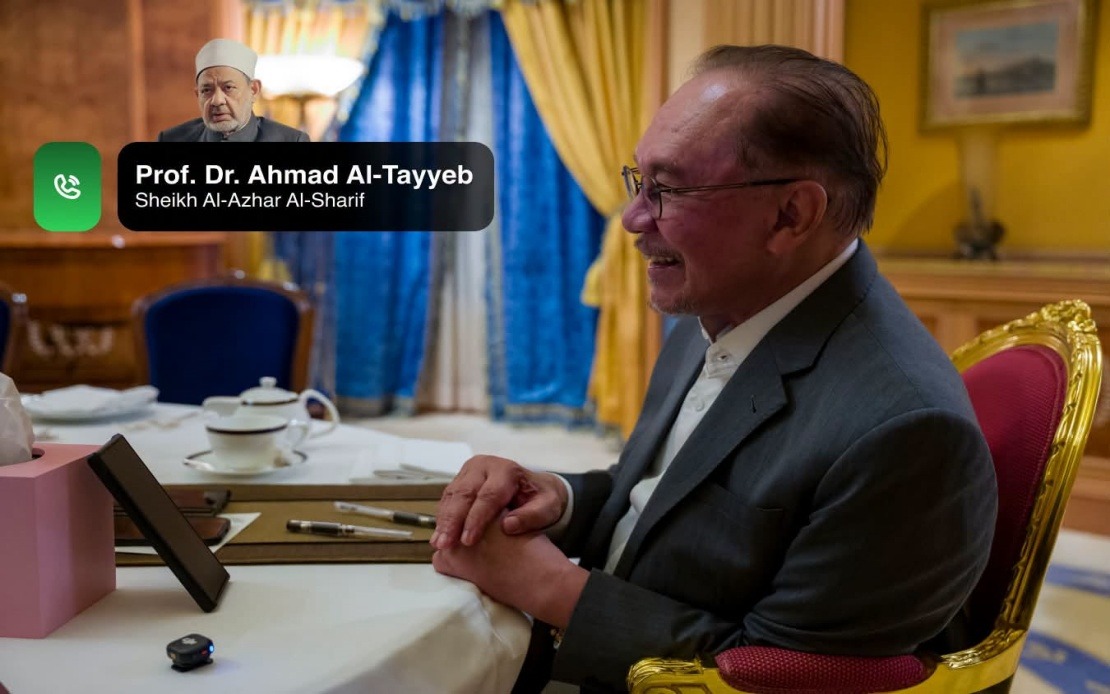
Prime Minister Datuk Seri Anwar Ibrahim has engaged in substantive conversations with Sheikh al-Azhar al-Sharif Prof Dr Ahmad al-Tayyeb, one of Sunni Islam's most influential theological authorities, regarding the expansion of Islamic knowledge and religious outreach across communities. The phone conversation took place after Anwar's recovery from surgery, with the prominent Egyptian cleric reaching out to inquire about the Malaysian leader's health and convey well-wishes during the convalescence period.
During their exchange, the two leaders focused on the continuation and strengthening of dakwah—the Islamic concept of calling people toward faith—alongside broader efforts to deepen understanding of Islamic teachings. Anwar expressed gratitude for the Sheikh's concern and prayers, noting that his surgical procedure proceeded without complications and that recovery is progressing favourably. This communication underscores the significance Malaysia places on maintaining strong ties with prestigious Islamic institutions and figures of global standing, particularly those based in Cairo where al-Azhar University operates as one of the world's oldest and most respected centres of Islamic learning.
The Malaysian Prime Minister highlighted Sheikh al-Azhar al-Sharif's previous visit to Malaysia, characterising it as having made a profound and lasting impression on the country's Muslim population. This reference reflects how visits by internationally acclaimed Islamic scholars carry considerable weight in strengthening bonds between nations and communities united by faith. Anwar expressed optimism about future in-person meetings, whether in Cairo or Kuala Lumpur, to continue collaborative efforts in advancing religious knowledge and fostering understanding that would benefit society broadly.
In a related development, Anwar also connected with Mohamed Abdelsalam, Secretary-General of the Council of Muslim Elders (Majlis Hukama Muslimin), another important body in the Muslim world. During this interaction, Abdelsalam similarly inquired about the Prime Minister's health and offered prayers. The conversations reveal a pattern of international Islamic leadership extending personal concern toward Anwar, reflecting the respect he commands within broader Muslim circles and his positioning as a significant voice in articulating moderate, progressive Islamic perspectives.
Anwar reciprocated the concern shown by Abdelsalam by asking about his wife's health, as she is currently undergoing hospital treatment. This personal dimension to diplomatic and religious dialogue demonstrates how leaders integrate human compassion within formal discussions of doctrine and strategy. Such gestures strengthen personal bonds that underpin institutional relationships between Malaysia and international Islamic organisations.
The discussions also touched upon Sheikh al-Azhar al-Sharif's interest in visiting Malaysia again, signalling strong momentum toward deepening engagement between al-Azhar and Malaysian Islamic institutions. Beyond ceremonial visits, both leaders emphasised new collaborative initiatives aimed at fortifying Malaysia's relationship with the historic Cairo institution and promoting what they characterised as straightforward, accessible, and authoritative Islamic teaching. This framing—emphasising simplicity, freedom from obscurantism, and scholarly rigour—aligns with Malaysia's broader positioning of itself as a centre for moderate Islamic thought and practise in a region often stereotyped in Western discourse as religiously rigid.
For Malaysian readers and policymakers, these interactions carry several implications. They signal the government's commitment to engaging with globally recognised Islamic authorities to shape theological discourse in ways that support social cohesion and modernisation. Al-Azhar's endorsement of Malaysian approaches to Islam can lend international credibility to efforts to position the country as a model for how Muslim-majority nations balance religious observance with economic development and pluralistic governance. Given Malaysia's multicultural composition and its role as a regional economic powerhouse, demonstrating alignment with prestigious international Islamic scholarship serves to legitimise the Malaysian model both domestically and internationally.
Anwar took occasion to acknowledge his wife, Datuk Seri Dr Wan Azizah Wan Ismail, for her steadfastness and sacrifice throughout his decades-long political struggle. This public recognition within the context of international Islamic dialogue reflects how personal and political dimensions of leadership intersect, particularly in societies where family bonds carry significant cultural weight. Her characterisation as an exemplary woman carries weight in societies where women's roles in supporting Islamic scholarship and community welfare remain subject to ongoing theological and social debate.
The Prime Minister concluded his remarks by expressing confidence that these collaborative efforts would be sustained and strengthened, framed within an explicitly universal vision of benefiting communities and advancing global well-being. This rhetorical move positions Malaysia's Islamic engagement not as parochial or exclusionary, but as part of broader humanitarian and knowledge-sharing endeavours. Such framing matters significantly in Malaysia's international positioning, particularly as the country seeks to maintain relevance in a competitive regional environment where Thailand, Indonesia, and other nations also assert claims to Islamic leadership and influence.
The convergence of these discussions reflects a strategic diplomatic approach wherein personal relationships between leaders, concern for mutual well-being, and substantive intellectual exchange are woven together to advance national interests. For Malaysia, proximity to globally esteemed Islamic institutions and scholars amplifies the country's soft power, particularly among Muslim-majority nations and Muslim diaspora communities worldwide. As geopolitical competition intensifies across Southeast Asia and beyond, such cultural and intellectual diplomacy constitutes a valuable asset complementing traditional economic and strategic engagement.

