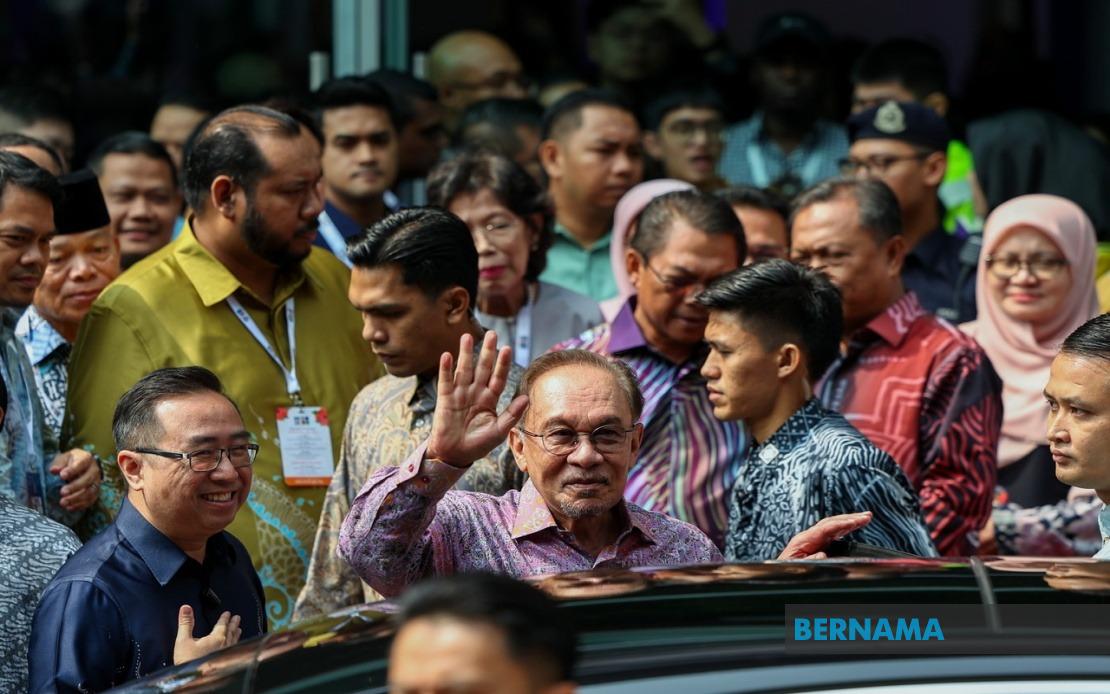
Prime Minister Datuk Seri Anwar Ibrahim has distanced himself from reports of an invitation extended to former PKR deputy president Datuk Seri Mohamed Azmin Ali to rejoin the party, claiming he received no prior notification of such an approach. Speaking at the National Innovation and Commercialisation Expo (NICE) 2026 at the Kuala Lumpur Convention Centre (KLCC) on August 27, Anwar responded with apparent surprise when questioned about the matter, stating plainly that he had not been informed of any such initiative.
The statement represents an unusual public clarification from the PKR president and reflects the somewhat chaotic nature of party organisational activities, where recruitment efforts appear to be proceeding without clear coordination from the top leadership. Anwar's response suggests either a breakdown in internal communication channels within PKR or an effort to create distance from initiatives that might prove politically sensitive or counterproductive. The comment also raises questions about the degree of central control Anwar exercises over party structures, particularly during a period when PKR is actively attempting to rebuild its membership base.
Azmin, now serving as secretary-general of Parti Pribumi Bersatu Malaysia (Bersatu), had reportedly dismissed any possibility of returning to PKR earlier in the week, even while acknowledging that invitations were being circulated to former party members. His categorical rejection of such overtures underscores the enduring fractious relationship between Anwar and Azmin, whose political relationship deteriorated significantly following their 2020 split. The divergence between the two figures remains one of the most consequential personal rifts in contemporary Malaysian politics, with implications that extend well beyond the confines of PKR itself.
PKR's current recruitment campaign reflects the party's efforts to consolidate its position ahead of future electoral contests and to strengthen its parliamentary presence. The party has successfully attracted several high-profile returnees in recent months, demonstrating that not all former members have permanently departed. Among those who have confirmed their intention to rejoin is former PKR vice-president Datuk Dr Xavier Jayakumar, who made his commitment to returning to the party public.
Additionally, two former parliamentarians have reportedly received invitations or expressions of interest regarding their return to PKR. Datuk Kamarudin Jaffar, who previously represented Bandar Tun Razak, and Datuk Mansor Othman, the former Nibong Tebal MP, have both been mentioned in connection with these recruitment efforts. Their potential return would represent significant gains for PKR in terms of parliamentary experience and established constituency networks, particularly given the importance of experienced legislators in policy formulation and political credibility.
The timing of Anwar's statement is noteworthy, occurring as PKR navigates the complex political landscape following the 2023 general election and the subsequent realignment of coalition politics. PKR remains a key component of the Pakatan Harapan alliance and plays a central role in the current government structure. Any significant shifts in party membership or leadership dynamics carry implications not only for PKR's internal stability but also for the broader coalition's cohesion.
Anwar's apparent lack of awareness regarding overtures to Azmin may be strategic, positioning the party leader as removed from tactical party management decisions. This approach allows subordinate figures to conduct negotiations without direct attribution to the prime minister, providing plausible deniability should such initiatives prove unpopular or unsuccessful. Alternatively, the statement could genuinely reflect the decentralised nature of party operations, where mid-level party officials pursue recruitment activities without necessarily clearing them through the most senior leadership.
The Azmin question remains symbolically important within PKR's internal politics. His departure in 2020 and subsequent alignment with Bersatu represented a significant blow to PKR's standing and contributed to the party's fragmentation during that tumultuous period. The circumstances surrounding his exit, which involved accusations and political manoeuvring from multiple directions, continue to cast a shadow over intra-party relationships. Publicly pursuing his return while he remains in a competitor party and holds a significant position within Bersatu would likely generate controversy within PKR's rank and file.
The broader context of Malaysia's political landscape suggests that PKR's recruitment drive responds partly to competitive pressures from other coalitions and partly to the natural tendency of parties to seek to recover lost ground and influence. With electoral contests potentially looming and political realignments continuing across the peninsula, parties are keen to strengthen their organisational capacity and parliamentary numbers. PKR's focus on recruiting former members represents a relatively low-risk strategy compared to attempting to poach members from other established parties.
Anwar's careful distancing from the Azmin question also reflects the peculiar challenge facing a prime minister who simultaneously holds the presidency of a political party. Maintaining the appearance of impartiality in national governance while actively managing party political interests creates inherent tensions. Public statements that suggest confusion or lack of communication regarding party activities can undermine confidence in overall leadership coherence, yet direct acknowledgment of party-building activities can invite criticism of inappropriate conflation of governmental and partisan roles.
The trajectory of these membership movements will merit continued observation, as they signal the ongoing consolidation and reconfiguration of Malaysia's political parties in the post-2023 electoral period. PKR's success in attracting returning members while processing departures to rival parties reflects the dynamic nature of contemporary Malaysian politics, where party allegiances remain fluid and the calculation of political advantage continues to drive strategic decisions. The Azmin question, whether resolved affirmatively or allowed to remain in limbo, will continue to symbolise the unhealed wounds within the broader reformist political movement that PKR represents.

