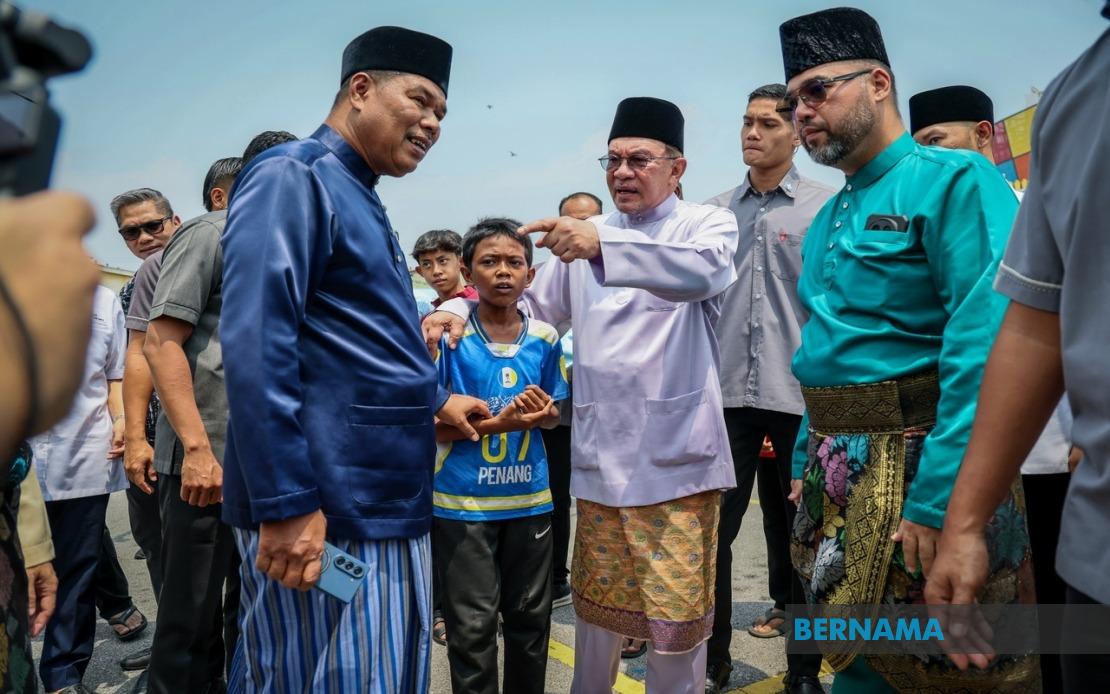
Prime Minister Datuk Seri Anwar Ibrahim has drawn a clear line between his political role and the judicial process, declaring that all investigative and prosecutorial matters involving former Human Resources Minister Datuk Seri M. Saravanan belong squarely within the purview of law enforcement and legal authorities. Speaking to journalists after Friday prayers at Masjid Sembilang in Butterworth on August 28, Anwar emphasised that once cases reach the stage of formal investigation or legal proceedings, they move beyond his remit and into the hands of independent bodies designed to handle such matters.
The Prime Minister's remarks came in response to media questions about a recent letter Saravanan had addressed to him. Clarifying the nature of that correspondence, Anwar stressed that he would not entertain interventions in cases already being pursued by the Malaysian Anti-Corruption Commission or the Attorney-General's Chambers. This stance reflects established conventions around political neutrality in legal matters and demonstrates Anwar's intention to maintain separation between executive authority and the independence of anti-corruption and prosecutorial institutions—a principle he has emphasised since taking office.
Saravanan himself had previously clarified that his letter to the Prime Minister was not an appeal for interference or case dismissal, but rather an opportunity to present his perspective on the allegations facing him. This distinction is significant, as it suggests the former minister was attempting to communicate his position through proper channels rather than seeking political favour. Nevertheless, Anwar's response indicates that such communications, regardless of their intent, do not alter the fundamental principle that legal proceedings must be allowed to proceed without executive influence.
The charges against Saravanan, which he faced at the Kuala Lumpur Sessions Court on the same day, carry considerable weight. The Tapah MP pleaded not guilty to three counts of corruption involving RM1.097 million, with the alleged misconduct connected to approvals granted for foreign worker quotas. These charges represent serious allegations affecting both public administration and the proper management of Malaysia's foreign worker programme, an area of significant economic and social importance to the nation.
The case highlights the broader context of Malaysia's anti-corruption efforts under the current administration. Since Anwar's return to political prominence and his appointment as Prime Minister, there has been renewed focus on addressing high-level corruption within government. By publicly maintaining distance from the Saravanan matter and reaffirming the autonomy of MACC and the AGC, Anwar is signalling his commitment to allowing these institutions to function without political interference—a commitment that observers have scrutinised closely given Malaysia's historical struggles with selective prosecution and political influence over legal matters.
The handling of high-profile corruption cases involving government ministers carries significant implications for public confidence in the independence of Malaysia's legal system. When former ministers face charges, the manner in which such cases are managed—and the visibility of political figures stepping back from involvement—becomes a measure of institutional integrity. Anwar's explicit statement that he will not concern himself with the Saravanan case once it reaches the investigation and prosecution stage represents a public commitment to this principle, one that extends to other similar cases that may arise during his tenure.
For regional observers, Malaysia's approach to corruption among its own political leadership carries weight. Southeast Asia continues to grapple with questions of governance and accountability, and Malaysia's handling of such cases contributes to regional perceptions about the rule of law and institutional independence. The Prime Minister's clear deference to MACC and the AGC, communicated so publicly, serves to reinforce the notion that no individual—regardless of political position—is exempt from investigation or prosecution when evidence warrants such action.
The foreign worker quota system, at the heart of the allegations against Saravanan, remains a contentious and economically significant aspect of Malaysian governance. Any impropriety in the management of this system could affect both Malaysia's relationship with labour-sending countries and the integrity of a programme that involves substantial economic activity. This context adds gravity to the charges and underscores why allowing independent authorities to pursue the matter thoroughly is essential for maintaining both the system's credibility and Malaysia's international standing.
Moving forward, the Saravanan case will likely proceed through the courts without further public commentary from the Prime Minister's office, barring extraordinary circumstances. This approach maintains the separation of powers while allowing the judicial process to unfold according to established legal procedures. For other government officials who may be watching developments, Anwar's stance sends a dual message: allegations of misconduct will be pursued vigorously by the appropriate authorities, and the political leadership will not shield individuals from accountability regardless of their previous position or profile.
The broader significance of Anwar's position extends beyond the immediate case to questions about institutional reform and governance culture. By consistently reinforcing that corruption investigations are matters for MACC and the AGC, the Prime Minister is attempting to embed a practice of institutional independence that, if sustained across multiple administrations and cases, could strengthen Malaysia's long-term governance trajectory. However, such cultural shifts require sustained commitment and cannot be taken as guaranteed, particularly given Malaysia's complex political history and the ever-present temptation for those in power to influence legal proceedings in their favour.

