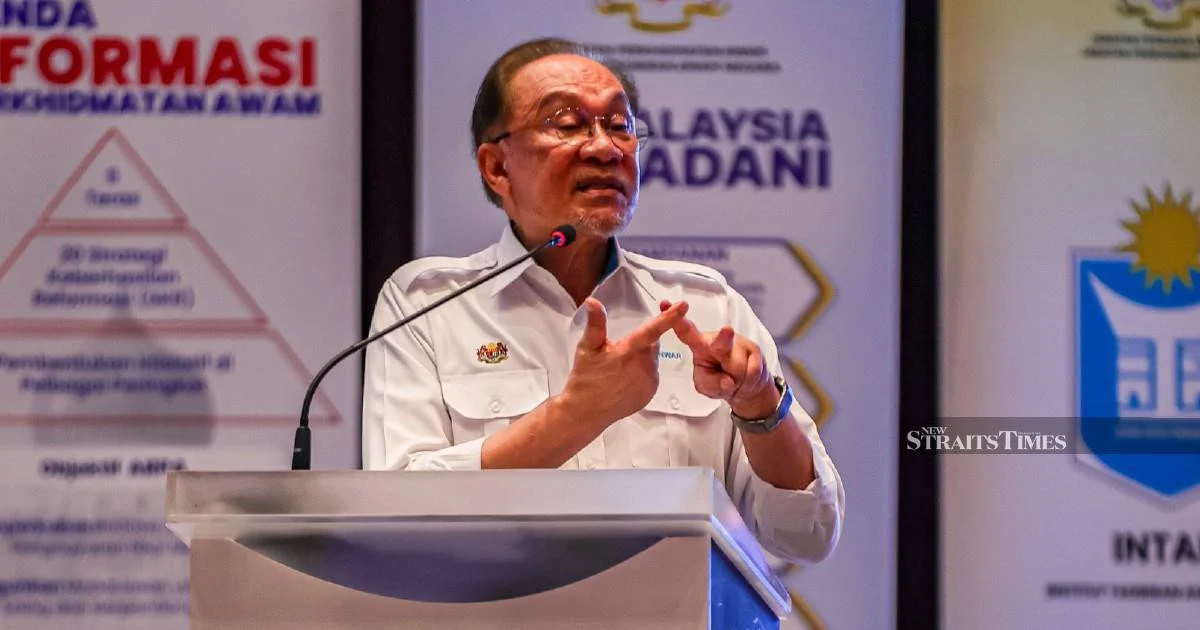
Prime Minister Datuk Seri Anwar Ibrahim moved to defuse tensions within the ruling Pakatan Harapan coalition on Thursday, characterising remarks made by Amanah president Datuk Seri Mohamad Sabu as misunderstood rather than deliberately provocative. Speaking in Alor Gajah, Anwar sought to reassure other coalition members that Mat Sabu's comments during Friday's candidate announcement ceremony in Tangkak were not intended to demean or ridicule any political partner.
The intervention underscores the delicate balancing act required to maintain cohesion within Malaysia's multi-party ruling alliance. Pakatan Harapan comprises distinct political entities with competing interests and constituencies, making it vulnerable to friction when senior figures make statements that can be construed as critical or dismissive. Such episodes, if left unaddressed, threaten to erode the trust necessary for the coalition to function effectively during an election cycle when every seat and voter calculation matters significantly.
Mat Sabu's role as Amanah president places him in a sensitive position within the broader coalition structure. Amanah, which broke away from the larger PAS party, occupies a distinctive ideological space and maintains its own base of support. Any perceived slight from its leadership toward other coalition members could trigger defensive responses that complicate the unified front PH seeks to project to voters. Anwar's quick clarification suggests heightened awareness within the Prime Minister's office of how quickly misunderstandings can metastasise into larger disputes.
The timing of these remarks during a candidate announcement ceremony carries particular weight. Such events represent opportunities for coalition parties to demonstrate solidarity and shared vision before the electorate. When comments made during these occasions generate controversy rather than consensus, they undermine the intended messaging and create space for opposition critics to question coalition stability. Media coverage of internal disagreements inevitably shifts public attention away from policy platforms that parties wish to emphasise.
For Malaysian observers, coalition cohesion directly affects governance capacity and policy implementation. A fragile alliance struggling with internal tensions may struggle to advance legislative priorities or maintain fiscal discipline. Coalition partners distracted by managing mutual grievances have less bandwidth to address citizen concerns about cost of living, infrastructure development, or public service efficiency. The ripple effects of unresolved disputes extend far beyond political theatre into everyday governance.
Anwar's diplomatic response reflects experience gained through previous coalition management challenges. He has navigated factional disputes within his own party, worked across ideological differences with PAS previously, and overseen uneasy partnerships between parties with competing visions for Malaysia's future. His intervention suggests calculated judgment that a low-key clarification served coalition interests better than allowing the incident to escalate into recriminations and public positioning between partners.
The broader context involves Amanah's relatively vulnerable position within the coalition hierarchy. Smaller than PKR, DAP, and other major PH components, Amanah's influence depends partly on maintaining positive relationships and demonstrating that it contributes distinctive value to the partnership. Comments perceived as mocking or dismissive of coalition colleagues could be weaponised against Amanah as evidence that it lacks commitment to collective interests or respect for partners who command larger parliamentary representation.
Democratic coalitions inherently generate friction because participating parties retain separate identities, memberships, and electoral interests. In Malaysia's context, where coalitions form and dissolve with relative frequency and partners occasionally defect to opposition, maintaining trust becomes paramount. Anwar's quick clarification serves the practical function of reminding coalition members that disagreements, when they arise, should be managed through private dialogue rather than public escalation.
The incident also reflects evolving communication challenges in modern politics. Comments made at public events are instantly captured, circulated, and interpreted through multiple lenses by audiences predisposed toward different readings. What one listener hears as lighthearted banter, another perceives as disrespectful jab. Coalition partners, already alert to potential slights given competitive dynamics, may interpret ambiguous remarks in worst-case scenarios. Anwar's intervention essentially offered coalition members permission to interpret Mat Sabu's words charitably rather than combatively.
Looking forward, managing coalition dynamics will remain essential for PH's electoral prospects. Malaysian voters increasingly demonstrate willingness to punish coalitions perceived as divided or pursuing narrow party interests over broader agendas. Opposition parties actively exploit any sign of internal discord to suggest that PH lacks the cohesion necessary for effective governance. For Amanah specifically and the coalition generally, maintaining visible unity requires constant effort and occasional damage control through statements like Anwar's clarification.
The Prime Minister's measured approach also signals confidence in coalition resilience. Rather than treating Mat Sabu's remarks as evidence of fundamental misalignment, Anwar characterised them as a simple misunderstanding susceptible to clarification. This framing allows all parties involved to move forward without loss of face or escalating defensive posturing. Whether this approach successfully quiets internal tensions or merely postpones addressing deeper coalition friction remains to be seen as the political cycle progresses.