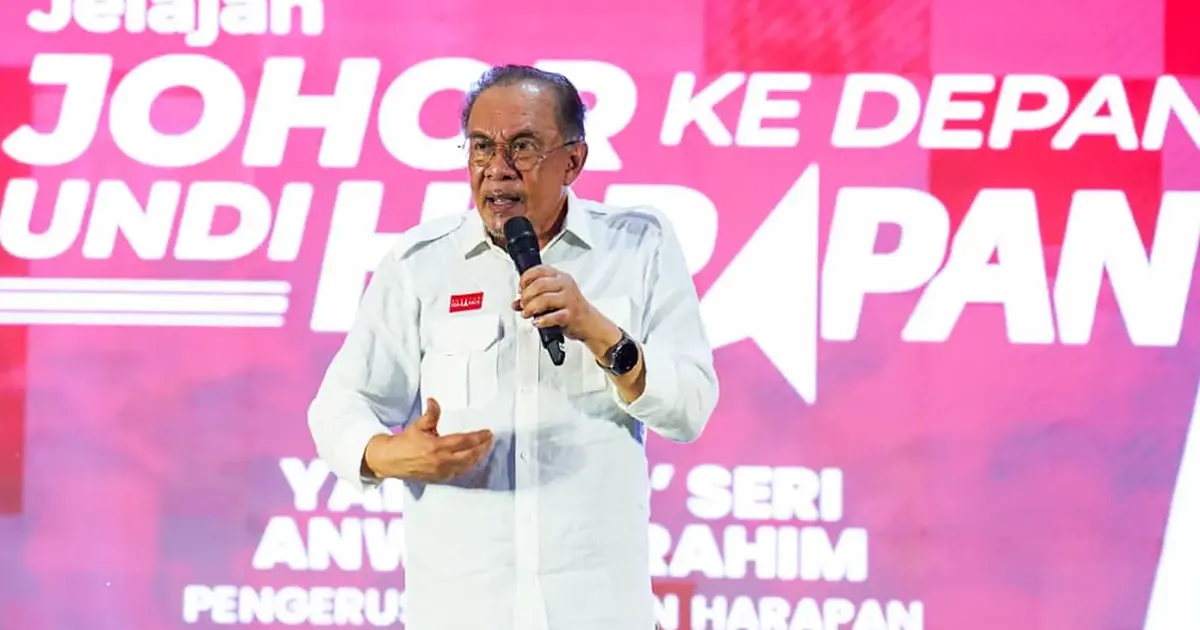
Prime Minister Anwar Ibrahim has sought to clarify the federal government's approach to allocating development resources across Malaysia's states, responding to what appears to be criticism regarding the treatment of Kedah under PAS leadership. Anwar's remarks underscore ongoing tensions within Malaysia's complex federal-state political landscape, where divergent party control at different government levels can create friction over resource distribution and developmental priorities. The prime minister's statement addresses a fundamental question about governance equity: whether political affiliation determines how federal funds and programmes flow to states.
Anwar's position centres on a principle of developmental universalism—the idea that federal programmes and investments should benefit all Malaysians regardless of where they live or which party controls their state government. This reflects a constitutional framework where certain functions, particularly those requiring substantial capital investment, remain primarily federal responsibilities. Infrastructure development, major healthcare initiatives, and educational programmes often require coordination and funding mechanisms that necessarily involve the federal level, creating potential friction points when different political coalitions control Canberra and state capitals.
The invocation of Kedah's situation carries particular significance within Malaysia's political economy. As a northern state with a PAS government, Kedah has been governed by an Islamist party while the federal government operates under Anwar's leadership through Pakatan Harapan. This arrangement mirrors similar dynamics across several Malaysian states where ruling coalitions differ between state and federal levels. Such arrangements can generate questions about whether development flows equitably or whether political considerations influence resource allocation, particularly when states controlled by opposition parties might feel marginalised in budget cycles and infrastructure planning.
Anwar's assertion that he and his government have actively supported Kedah's development directly addresses this concern, though his reference to whether Menteri Besar Muhammad Sanusi Md Nor is aware of these efforts suggests an underlying communication gap or political misalignment. The rhetorical question carries weight: if Kedah's leadership is not fully cognisant of federal support reaching the state, it raises questions about transparency in intergovernmental relations and whether state governments are adequately informed about or engaged in shaping how federal programmes operate within their jurisdictions.
This dynamic reflects broader challenges in Malaysia's federal system. When different parties control the federal government and state administrations, bureaucratic channels sometimes become clogged or politicised. State leaders may prioritise highlighting areas where they feel neglected rather than acknowledging federal initiatives, while federal authorities might expect state cooperation in implementing programmes that they view as straightforward development matters. Neither side has particularly strong incentives to publicise collaborative success, whereas disputes become politically leveraged.
The specific mention of Kedah warrants examination of what development initiatives might be at stake. The northern corridor encompassing Kedah and nearby states has long been identified as economically significant in Malaysian planning frameworks. Port facilities, manufacturing zones, agricultural modernisation, and transport connectivity projects all carry potential for federal involvement. Whether such initiatives are progressing adequately, whether adequate funding flows to them, and whether state and federal governments share vision for Kedah's economic trajectory are questions that Anwar's statement implicitly addresses.
Anwar's framing of the issue—emphasizing that development must benefit all Malaysians—attempts to elevate discussion beyond partisan positioning. He suggests that questioning whether his government supports certain states reflects a misunderstanding of how federal governance should operate. The underlying logic is that professionalism and constitutional obligation, not political calculation, should drive development decisions. However, Malaysian political history provides sufficient examples of development being distributed according to political loyalties that such reassurances, however well-intentioned, often require demonstration rather than declaration.
The statement also reflects Anwar's broader political strategy of positioning himself as a unifying national figure rather than a partisan operator. By emphasising equitable development across all states, he counters narratives that his government might be neglecting states controlled by opposition parties. This messaging becomes particularly important when building coalition governments or seeking electoral support in states where rival parties hold sway, as equitable treatment arguments can persuade voters that federal resources will not be weaponised for partisan purposes.
Forward-looking implications of Anwar's position extend to intergovernmental relations more broadly. If the federal government and Kedah's administration are to work effectively despite different political parentage, clearer communication channels and better coordination mechanisms seem necessary. The apparent gap between what Anwar believes his government has done for Kedah and what Sanusi's administration perceives or acknowledges suggests operational friction that affects the state's citizens regardless of political allegiances. Residents of Kedah deserve development outcomes, not political theatre about whether those outcomes represent adequate federal effort.
Ultimately, Anwar's assertion that federal development support extends across all states regardless of political control presents a governance principle that, if genuinely implemented, should be verifiable through budgets, project timelines, and visible developmental outcomes. The test of whether Kedah receives equitable federal support will ultimately reside in concrete evidence rather than political declarations. Both the federal government and state leadership would serve constituents better by moving beyond public insinuation toward transparent discussion of development priorities, funding mechanisms, and implementation timelines.

