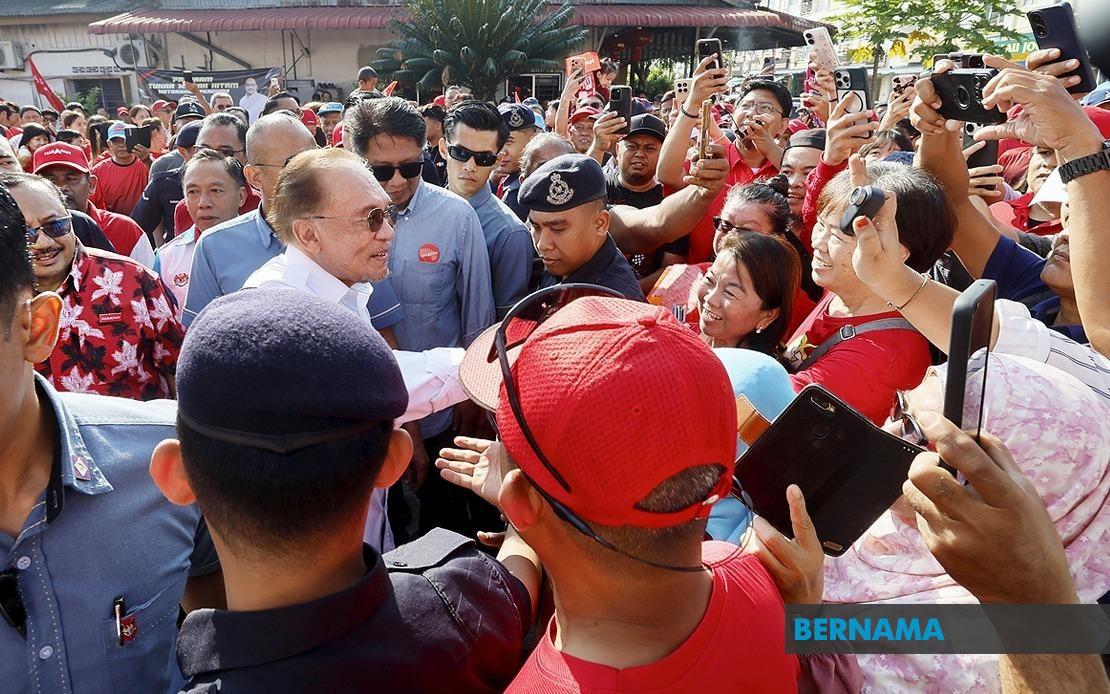
Prime Minister Datuk Seri Anwar Ibrahim has reiterated that the federal government under his administration maintains an unwavering commitment to equitable development across Malaysia, irrespective of whether states are governed by ruling coalition or opposition parties. Speaking at a campaign event in Batu Pahat on July 9, Anwar emphasised that his government prioritises the welfare and well-being of all Malaysians, with development initiatives and infrastructure projects spanning the nation as proof of this non-partisan approach.
The assertion comes amid intense political competition ahead of the 16th Johor state election, where the ruling Pakatan Harapan coalition is actively mobilising support. Anwar's comments represent an attempt to counter opposition narratives that suggest the federal government favours only states aligned with the ruling coalition, a persistent criticism that has characterised Malaysian politics for decades. By explicitly naming Johor, Kelantan, and Kedah—states with varying degrees of political alignment—Anwar sought to demonstrate a pattern of consistent federal investment regardless of state-level political configurations.
A significant example cited by Anwar was the Johor-Singapore Special Economic Zone, a mega-project that represents substantial federal commitment to one of Malaysia's economically vital regions. This strategic initiative, designed to enhance regional economic integration and competitiveness, underscores how large-scale infrastructure planning transcends political boundaries at the federal level. The JS-SEZ is positioned as a catalyst for economic growth not merely for Johor but for Southeast Asia more broadly, reflecting how development considerations often supersede partisan concerns when national strategic interests are involved.
Flood mitigation efforts constitute another tangible illustration of the government's allocation priorities. The federal government's approval of billions of ringgit for flood mitigation projects in Segamat and Muar addresses a genuine infrastructure deficit that affects thousands of residents across multiple constituencies. These investments respond to recurring natural disasters that have devastated communities, claiming lives and destroying livelihoods in recent years. By highlighting this commitment, Anwar addressed voter concerns about basic public safety and disaster preparedness, issues that resonate across political divides.
The timing of these remarks during campaign activities introduces an inherent complexity to interpreting Anwar's claims about impartiality. While federal governments typically do maintain mechanisms ensuring some degree of nationwide coverage in development spending—partly due to constitutional obligations and practical governance requirements—the explicit linking of these statements to election campaigning suggests political calculation is not absent from the equation. Nevertheless, the projects cited do represent measurable federal investment that can be independently verified, providing some substantive basis for the government's assertions beyond rhetoric.
The coalition's presence at the event, including Communications Minister Datuk Fahmi Fadzil and candidates for the Senggarang, Semerah, and Penggaram seats, reflected a coordinated strategy to consolidate support in Johor. This approach mirrors broader patterns in Malaysian electoral politics where federal leaders campaign actively in state elections, leveraging national government resources and messaging to influence outcomes. For Malaysian voters evaluating competing claims about governance fairness, such events provide opportunities to assess government accountability while remaining cognisant of their inherently political nature.
Historically, questions about resource allocation between states governed by different coalitions have triggered significant controversies. Previous federal administrations faced sustained criticism from opposition-ruled states regarding perceived disparities in development funding and infrastructure investment. These disputes have occasionally escalated to legal challenges and formal complaints to oversight bodies. Anwar's explicit statement thus addresses a perennial concern that affects administrative trust and political stability across Malaysia. The credibility of such assurances depends substantially on sustained, transparent implementation and public documentation of spending patterns over electoral cycles.
Packatan Harapan's framing of development as non-discriminatory carries particular weight given the coalition's own history. Having previously governed from opposition benches and currently navigating a complex parliamentary coalition including previously competing parties, the administration's approach to federal resource allocation symbolises broader questions about coalition stability and the sustainability of Malaysia's democratic institutions. Voter perceptions of governmental fairness directly influence electoral outcomes and broader political legitimacy, making such statements functionally important beyond their campaign context.
For Malaysian readers and regional observers, Anwar's emphasis on equitable treatment reflects ongoing tensions within Malaysia's federal structure. The distribution of resources between federal and state governments, and the political considerations shaping such distributions, remains a fundamental governance challenge. Whether federal policies genuinely transcend political affiliation or merely employ rhetoric to mask partisan preferences ultimately depends on sustained scrutiny of actual spending data, project implementation records, and comparative analysis across constituencies and time periods. The Johor state election will provide voters with an opportunity to evaluate whether such stated commitments translate into tangible benefits within their respective constituencies.

