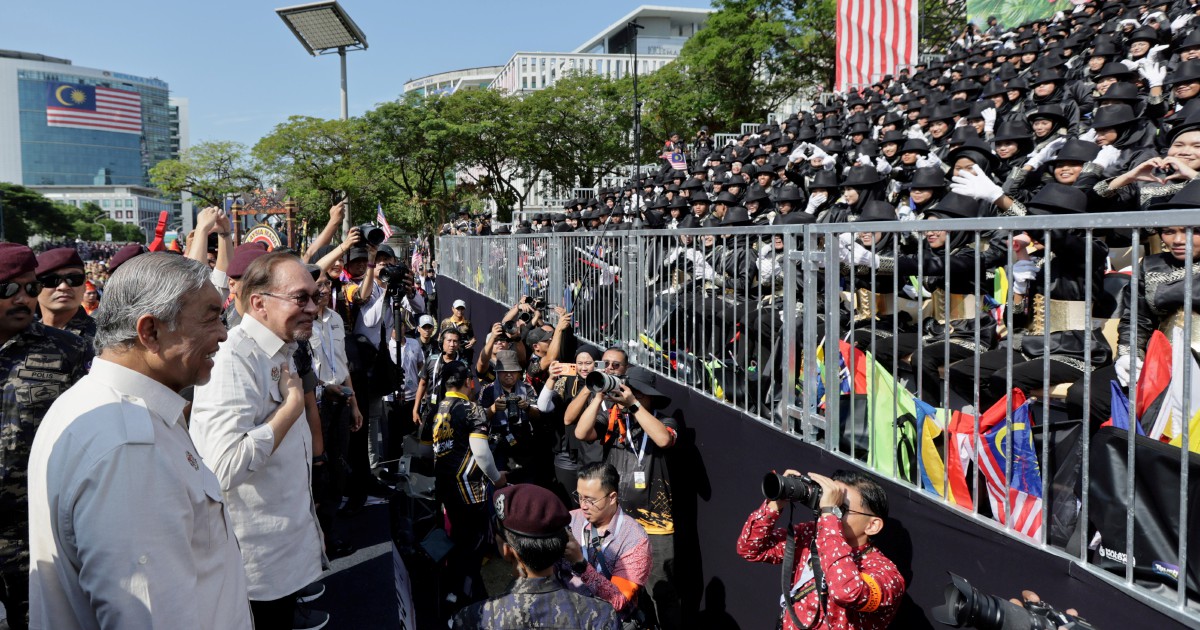
Prime Minister Datuk Seri Anwar Ibrahim demonstrated a hands-on approach to public engagement on National Day, using the occasion at Dataran Putrajaya not merely as a ceremonial event but as an opportunity for direct interaction with ordinary Malaysians. Following the formal parade proceedings, the Prime Minister embarked on an impromptu walkabout that revealed his inclination towards personal connection with citizens across different segments of society.
The unscheduled engagement saw Anwar pause his route multiple times to greet members of the public who had gathered to witness the National Day celebrations. These moments of interaction highlighted an increasingly visible aspect of his leadership style—one that prioritizes accessibility and visible presence among the population rather than maintaining formal distance. The exchanges appeared genuine, with the Prime Minister taking time to speak individually with various attendees rather than rushing through the ceremonial obligations.
Children were particular beneficiaries of Anwar's attention during the walkabout, with the Prime Minister stopping to embrace several young Malaysians throughout his journey. These gestures carry symbolic weight beyond mere optics, signaling to younger generations an approachable figure of national leadership. In Malaysian political culture, such direct engagement with children has traditionally been understood as an effort to humanize political figures and create lasting impressions of accessibility.
The National Day parade at Dataran Putrajaya, Malaysia's administrative capital, typically draws significant public attendance, creating a concentrated opportunity for leaders to interact with diverse demographics. The venue's formal setting and the occasion's national significance meant that Anwar's decision to extend his time with the public through personal engagement differed markedly from purely ceremonial participation. This approach suggests a deliberate strategy to strengthen public perception of his administration as one that values direct democratic engagement.
Following the formal parade proceedings, such walkabouts provide prime ministers with informal moments to assess public sentiment and reinforce their connection to the electorate. For Anwar, who has faced considerable political turbulence throughout his career, these moments of visible public warmth can serve to reinforce narratives of legitimacy and popular support. The informal nature of such interactions often registers more powerfully with observers than formal speeches or scripted appearances.
The decision to engage personally with the public reflects broader trends in Malaysian political leadership, where visible accessibility has become increasingly important in maintaining public confidence. In an era of social media scrutiny and rapidly shifting public opinion, leaders who demonstrate comfort with direct public interaction often cultivate stronger approval ratings than those who maintain traditional hierarchical distance. Anwar's approach aligns with this contemporary political reality.
Malaysian National Day celebrations carry significant cultural and political weight, representing not only the nation's independence but also providing opportunities for leaders to demonstrate patriotic commitment and national unity messaging. By using the parade's aftermath to engage with citizens rather than withdrawing to official functions, Anwar positioned himself within the broader celebratory atmosphere rather than apart from it. This participatory approach strengthens the symbolic connection between national leadership and civic participation.
The warmth of these interactions, captured and likely shared across social media platforms, serves multiple communication functions for Anwar's administration. It reinforces an image of approachable leadership while simultaneously demonstrating confidence in public reception. In Malaysian politics, where personal popularity can significantly influence party fortunes and electoral outcomes, such visible public affection becomes a measurable political asset.
For citizens attending the National Day celebrations, such moments of personal engagement with the Prime Minister represent rare opportunities for direct contact with the nation's highest executive office. These interactions, whether brief or extended, create memorable experiences that shape public perception of political leaders far more effectively than distant formal addresses. The emotional resonance of a personal embrace or individual greeting often outlasts the impact of prepared remarks.
The contrast between formal state occasions and informal public walkabouts highlights an important dynamic in contemporary Malaysian politics—the tension between ceremonial duty and democratic accessibility. Anwar's evident comfort with bridge-building between these two modes suggests a leadership philosophy that recognizes the importance of both formal protocol and human connection. This balance appears to be a deliberate component of his broader political strategy.
Beyond immediate optics, such public engagement serves practical political functions within Malaysian democracy. Direct interaction with citizens provides leaders with unfiltered feedback on public concerns and priorities, information that cannot always be gleaned through official advisories or formal policy consultations. These casual conversations often reveal grassroots perspectives that inform subsequent administrative decisions and policy directions.
The National Day parade tradition at Dataran Putrajaya continues to provide Malaysian leaders with opportunities to demonstrate their commitment to national values and public service. Anwar's evident commitment to extending his presence beyond ceremonial requirements suggests that his administration views such occasions not merely as obligations but as strategic opportunities for leadership visibility and public reconnection. As Malaysia navigates ongoing economic and political challenges, such visible expressions of national unity and leadership accessibility carry particular significance for public morale and confidence in governance.

