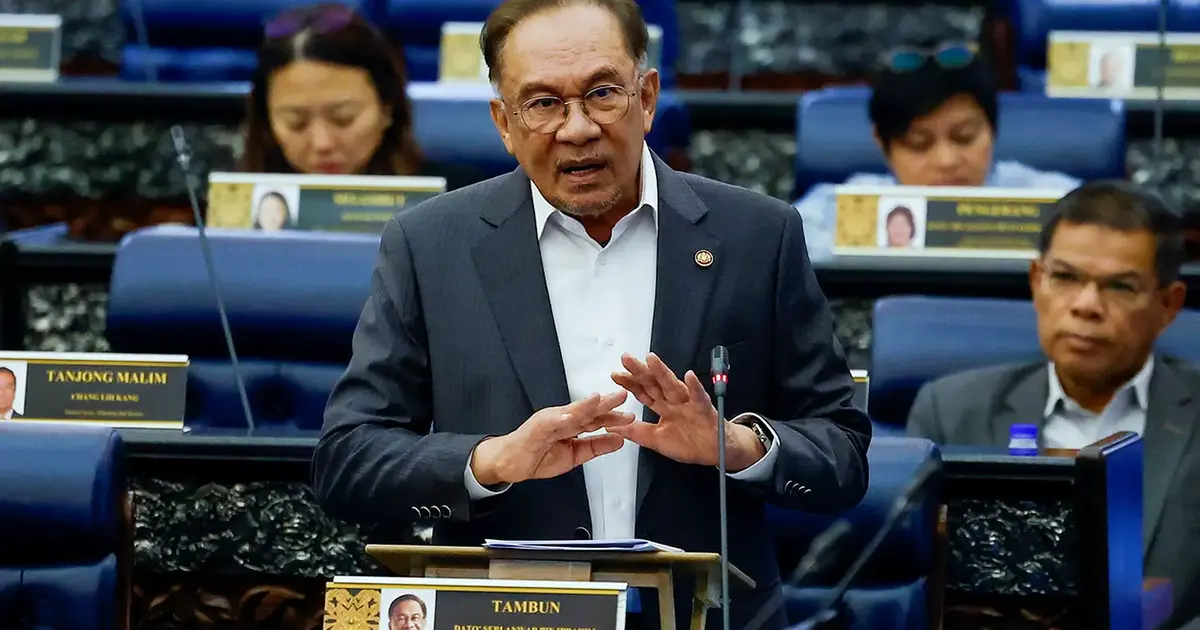
Prime Minister Anwar Ibrahim has clarified that the previous Warisan state administration in Sabah had formally agreed to the special grant rate structure now being implemented by the federal government, a statement that carries significant political weight amid ongoing fiscal negotiations between Kuala Lumpur and the East Malaysian state.
According to Anwar's assertions, the grant allocations were not arbitrary decisions imposed by the current federal administration but rather represent commitments that were previously endorsed at the state level. The amounts in question have escalated substantially over a four-year period, beginning at RM53.4 million for the 2020 and 2021 fiscal years before expanding to RM106.8 million by 2024. This near-doubling of the special grant sum underscores the growing financial support directed towards Sabah during a critical period of political and economic transition.
The clarification becomes particularly relevant given Sabah's distinctive constitutional position within Malaysia. As one of the two East Malaysian states that joined the federation under the Malaysia Agreement 1963, Sabah has historically maintained certain fiscal autonomies and negotiating leverage regarding federal allocations. Special grants to Sabah thus represent more than routine budgetary items; they reflect the ongoing calibration of centre-state financial relationships and serve as barometers of political cooperation between Putrajaya and Kota Kinabalu.
Warisan's tenure as the state government ended following the 2020 Sabah state election, when political realignments brought different leadership arrangements to the state. The fact that Anwar is now invoking Warisan's prior approval suggests the federal government is attempting to establish bipartisan consensus around these grant allocations, anchoring their legitimacy in decisions made across different political administrations. This approach potentially shields the current federal administration from accusations of arbitrary fiscal management or political favouritism.
The timing of Anwar's statement warrants consideration within broader Malaysian political dynamics. Special grants to states, particularly those in East Malaysia, frequently become subjects of political contestation, with opposition parties or competing administrations questioning their adequacy or appropriateness. By demonstrating that these rates had cross-party acceptance, the Prime Minister aims to depoliticise what might otherwise become a contentious issue during budget negotiations or electoral cycles.
Sabah's financial position within the federation has long been a matter of sophisticated political negotiation. The state government requires substantial federal support for infrastructure development, public services, and economic initiatives, while the federal centre seeks to maintain fiscal discipline and ensure equitable distribution across all states. Special grants represent a mechanism through which both entities reconcile these competing objectives, making their levels and conditionality subjects of regular renegotiation.
The incremental expansion from RM53.4 million to RM106.8 million over four years reflects either genuine economic growth in Sabah requiring increased federal investment or represents a response to political pressures for enhanced allocations. Understanding which factor predominates requires examining broader economic trends within the state, including population growth, infrastructure gaps, and development priorities that would justify the funding increase.
For Malaysian readers and policymakers beyond Sabah, these arrangements carry implications for federal-state fiscal architecture more broadly. If the precedent of special grants, once agreed by one state government, becomes binding on successor administrations, this establishes important constraints on future state governments' fiscal flexibility. Conversely, if new administrations can unilaterally challenge previous commitments, predictability in federal-state financial relationships becomes compromised, potentially discouraging long-term planning and investment.
Anwar's invocation of Warisan's prior approval also reflects the contemporary Malaysian political landscape, where coalition shifts occur with relative frequency. The federal government's ability to point to agreements from previous state administrations—regardless of their current political alignment—becomes a tool for maintaining continuity in fiscal arrangements despite electoral volatility. This practice, while pragmatic, raises questions about institutional memory and the extent to which state governments are bound by decisions made by their predecessors.
The sustainability of these grant levels merits scrutiny as well. If allocations continue expanding at rates proportional to the 2020-2024 increase, the federal government's fiscal obligations could eventually constrain flexibility in other areas. Budget analysts will monitor whether these growth trajectories continue or stabilise, and whether other states press for comparable enhancements based on similar population or geographic considerations.
Moving forward, the clarification regarding Warisan's agreement establishes a baseline for fiscal discourse around Sabah's allocations. Future disputes would centre not on whether these rates were appropriately approved historically but on whether they remain adequate given changing circumstances, and whether new rounds of enhancement require renegotiation. This framework potentially reduces political friction by grounding current arrangements in bipartisan consensus rather than unilateral federal determination.
For Southeast Asian observers, Sabah's fiscal arrangements within Malaysia offer insights into how federal systems navigate centre-periphery financial relationships, particularly when dealing with geographically dispersed territories and historically distinct political units. The mechanisms through which Malaysia accommodates these complexities—through special grants, negotiated rates, and reliance on predecessor commitments—demonstrate the sophisticated institutional solutions federal systems develop to manage diversity and maintain cohesion.

