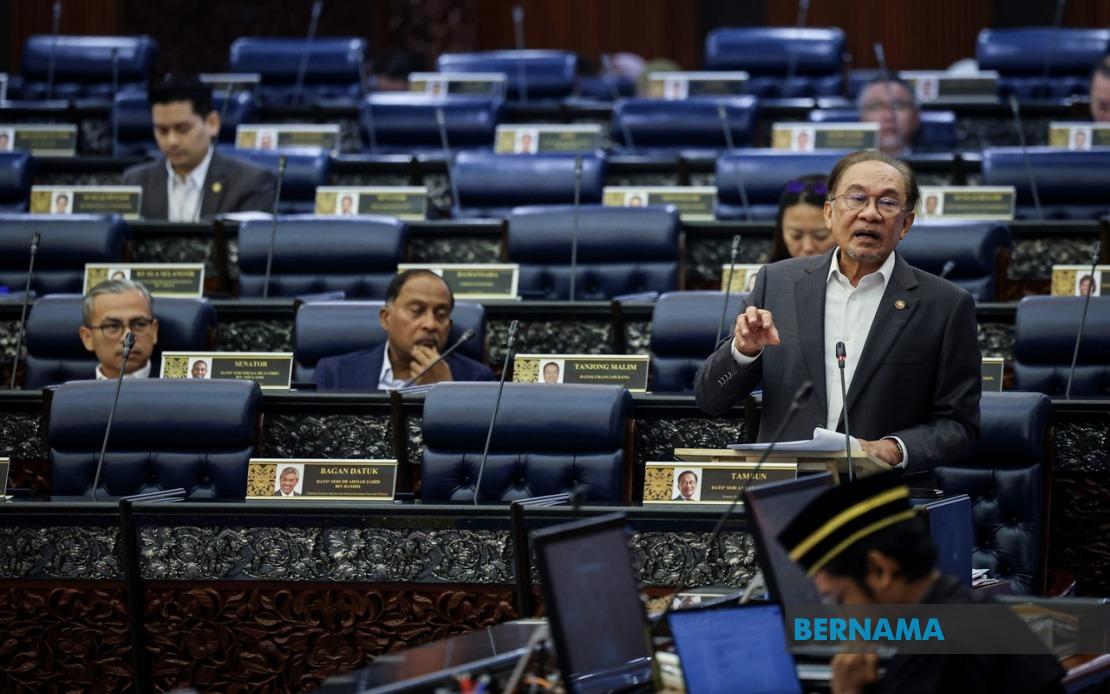
Prime Minister Datuk Seri Anwar Ibrahim moved to defuse political controversy on Wednesday by reframing his earlier comments about the Johor state election timing as nothing more than a personal observation, firmly rejecting any suggestion that he had attempted to meddle in the Election Commission's independent authority. Speaking during question time in parliament, Anwar clarified that his previous remarks favouring Sunday polling over Saturday were anchored in practical considerations affecting Malaysian voters, not in any desire to circumvent the EC's constitutional mandate.
The clarification came in response to opposition questioning about media coverage of Anwar's campaign statements during the Johor election period, when he had publicly suggested that moving the polling date to Sunday would better accommodate the large population of Malaysians employed across the border in Singapore. Anwar emphasised that the EC remained the sole arbiter of electoral procedures and that he fully respected whatever decision the body ultimately made, even if his personal preference leaned differently. His careful repositioning of these remarks reflects the sensitivities surrounding prime ministerial commentary on election logistics, an area where the appearance of neutrality carries constitutional weight in Malaysia's democratic architecture.
The practical context underpinning Anwar's original observation centred on the work schedules of cross-border commuters. Many Malaysians working in Singapore operate on half-day Saturday schedules, which would make Sunday voting more accessible for those needing to return home to cast ballots. By articulating this reasoning in parliament, Anwar sought to demonstrate that his earlier comments stemmed from demographic and logistical analysis rather than partisan calculation or improper influence over the EC's decision-making processes. This distinction matters considerably in Malaysian political discourse, where the boundary between legitimate advocacy and institutional overreach remains fiercely debated.
The row also touched on a broader question of cross-border coordination that has increasingly occupied regional policymakers. Anwar pointedly denied any intention to contact his Singapore counterpart, Prime Minister Lawrence Wong, to negotiate special voting arrangements or electoral facilitation for Malaysian citizens. He stressed that Malaysia scrupulously adheres to principles of non-interference in foreign electoral processes and expected reciprocal respect from its neighbours, despite the close bilateral relationship between Kuala Lumpur and Singapore. This position underscores how sensitive election matters remain in the region, where even well-intentioned coordination risks being perceived as external pressure on sovereign democratic processes.
Yet Anwar indicated that private sector engagement with Malaysian employees in Singapore represented a different category altogether. Companies operating across the Strait of Malacca had been informed on an informal basis to facilitate their Malaysian workforce's participation in domestic elections whenever polling occurred, he explained. This distinction between government-level diplomatic engagement and private commercial facilitation reveals how Anwar sought to distinguish between legitimate employer accommodation of civic participation and improper governmental negotiation over electoral mechanics. The approach acknowledges the practical reality that thousands of Malaysians residing in Singapore for work require coordination to exercise their franchise without suggesting that such coordination requires formal governmental mediation.
The questioning from Ahmad Fadhli Shaari of Perikatan Nasional and Mohd Sany Hamzan of Pakatan Harapan reflected a broader parliamentary interest in scrutinising how the government manages the intersection of labour mobility, electoral access, and institutional independence. Cross-border employment between Malaysia and Singapore represents one of the region's defining demographic features, yet it introduces complications for electoral administration that few democracies face at comparable scale. The Johor case illustrated how a senior leader's public remarks on election timing, however well-intentioned, can trigger parliamentary scrutiny and require careful clarification to preserve the EC's institutional autonomy.
Anwar's response strategy balanced multiple imperatives simultaneously. He needed to vindicate his earlier comments as reasonable observations rooted in demographic realities rather than recant them entirely, to defend the EC's independence as inviolable, and to position Malaysia as a nation that respects electoral processes both domestically and internationally. By characterising his remarks as personal opinion rather than policy direction, Anwar sought to occupy a middle ground that acknowledged legitimate advocacy for voter convenience while respecting constitutional boundaries around executive influence over the electoral commission. This rhetorical positioning has become increasingly important as Malaysia's political landscape grows more fractious and opponents scrutinise statements for evidence of institutional overreach.
The incident also highlights evolving sensitivities around prime ministerial authority in Singapore-Malaysia relations. Despite the close personal relationship between Anwar and Wong and the generally warm state of bilateral ties, electoral matters remain jealously guarded domains where even allied governments exercise extreme caution. Anwar's explicit denial that he would approach Wong on the subject reflected an understanding that such contact, even at the most senior levels, could generate domestic political turbulence in both nations by suggesting cross-border collusion on electoral matters. In an era of heightened suspicion toward foreign interference in elections globally, Malaysia and Singapore have particular reason to maintain visible distance between their respective democratic processes.
The practical implications for Malaysian workers in Singapore seeking to participate in the Johor election remain somewhat unclear following Anwar's parliamentary statement. While he suggested that informal employer accommodation would continue, no concrete institutional changes to voting procedures emerged. The clarification essentially closed off any pathway toward formal coordination with Singapore authorities whilst reaffirming that private sector actors could voluntarily facilitate Malaysian employee participation. This left the situation substantially unchanged from a logistical perspective but recalibrated the political narrative around the government's approach to election administration.
Looking forward, the episode suggests that Malaysia may need to develop more systematic approaches to managing cross-border electoral participation as the scale of labour mobility continues. Rather than relying on ad hoc private sector accommodation and informal understandings, explicit procedures governing voter registration, absentee arrangements, and workplace leave policies could provide clarity without requiring governmental coordination with Singapore. Such administrative reforms would acknowledge the demographic reality of cross-border employment whilst respecting both the EC's independence and Malaysia's commitment to non-interference with foreign governments on electoral matters. The Johor election thus served as a useful reminder of tensions inherent in administering elections across borders in one of Asia's most integrated labour markets.

