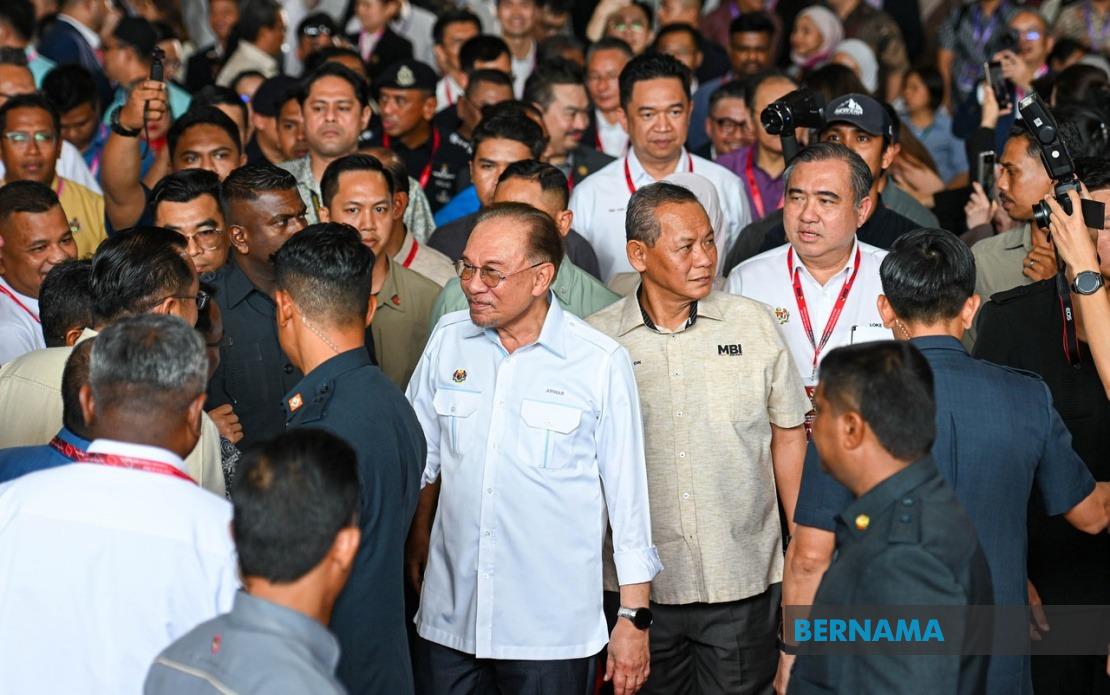
Prime Minister Datuk Seri Anwar Ibrahim has made a direct appeal to Melaka DAP to shelve its plans to exit the state government immediately, arguing that coalition stability and developmental progress should take precedence over internal disagreements. Speaking in Port Dickson on July 14 after inaugurating the AI-powered Midport Smart Container Terminal project, Anwar expressed his hope that the party would reconsider its withdrawal decision and allow negotiations to continue between stakeholders seeking a mutually acceptable resolution.
Anwar's intervention came in the wake of Melaka DAP's announcement that it would withdraw from the state administration following the passage of constitutional amendments by the Melaka State Legislative Assembly. These amendments would enable the appointment of nominated assemblymen to the legislature, a move that the party has steadfastly opposed as fundamentally at odds with democratic and electoral principles. Melaka DAP chairman Khoo Poay Tiong had framed the withdrawal as a principled stand reflecting the party's commitment to democratic integrity.
As both Prime Minister and Pakatan Harapan chairman, Anwar has positioned himself as a mediator in the dispute, indicating that he has already engaged directly with DAP secretary-general Anthony Loke and Melaka Chief Minister Datuk Seri Ab Rauf Yusoh. His comments suggest that intensive discussions remain ongoing behind closed doors, with the government keen to prevent a public rupture that could undermine the credibility of the coalition administration at the state level.
Anwar's framing of the dispute emphasizes a pragmatic balancing act within ruling coalitions. He characterizes disagreements among partner parties as inevitable in any multi-party governing arrangement, but argues that such differences should not overshadow the collective mission of delivering economic growth and enhancing citizen welfare. This language reflects a broader challenge facing Pakatan Harapan as it attempts to maintain unity while accommodating diverse political viewpoints and party interests across its component organizations.
The constitutional amendment controversy strikes at fundamental questions about the nature of representation and legitimacy in Malaysia's political system. The introduction of nominated seats effectively allows the ruling coalition to add representatives without electoral validation, a practice that DAP views as weakening the democratic mandate principle. For Melaka DAP, which has long positioned itself as a defender of electoral integrity and meritocratic selection, withdrawal from a government implementing such measures represents a matter of political conscience rather than mere tactical maneuvering.
Yet Anwar's appeal highlights the tension between principled opposition and pragmatic governance. Withdrawing from the state government would destabilize Pakatan Harapan's administration in Melaka and potentially jeopardize the coalition's ability to pursue its developmental agenda and policy commitments to voters. The timing is particularly sensitive with state elections anticipated in the near future, making government continuity and effectiveness important factors in determining electoral performance.
The broader implications for Malaysian coalition politics are significant. The Melaka situation reflects the difficulties of maintaining coherent multi-party coalitions when partners hold fundamentally different positions on constitutional matters and democratic processes. Similar tensions have surfaced in other states where component parties disagree on governance practices, suggesting that Anwar's mediation efforts here may establish patterns relevant elsewhere within the Pakatan Harapan structure.
For Southeast Asian observers, this dispute illustrates the ongoing challenges facing democratic coalitions in the region as they balance unity with principled differentiation. Malaysia's experience with consecutive coalition government arrangements has generated institutional knowledge about conflict management, though each new crisis tests the robustness of established compromise mechanisms. The willingness of senior leaders like Anwar to intervene personally in such disputes suggests recognition that allowing them to escalate unchecked risks broader coalition fracture.
The constitutional amendment issue itself warrants scrutiny within Malaysian governance discussions. Nominated seats represent a significant departure from strict electoral democracy, and DAP's objection reflects concerns shared across various segments of Malaysian civil society. However, other coalition partners or the Chief Minister's own party may view such mechanisms as pragmatic tools for ensuring stable representation and administrative capacity in state government.
Anwar's public plea for postponement rather than confrontation suggests confidence that continued dialogue can produce acceptable compromises. Whether Melaka DAP will accept this call depends on the extent to which party leadership perceives the constitutional amendments as non-negotiable red lines or as issues where some accommodation might be possible. The outcome of these negotiations will provide insights into the durability of Pakatan Harapan's internal consensus mechanisms and the relative weight accorded to principled positions versus coalition maintenance.
Looking ahead, this crisis exemplifies the recurring challenge for Malaysian coalition governments: reconciling the need for operational unity with respect for partner parties' distinct political identities and values. Should Melaka DAP proceed with withdrawal despite Anwar's appeals, it would signal that certain constitutional and democratic issues have become non-negotiable within the coalition framework. Conversely, if DAP agrees to postpone withdrawal pending continued negotiations, it may open pathways for addressing similar disputes in other state governments where Pakatan Harapan operates.

