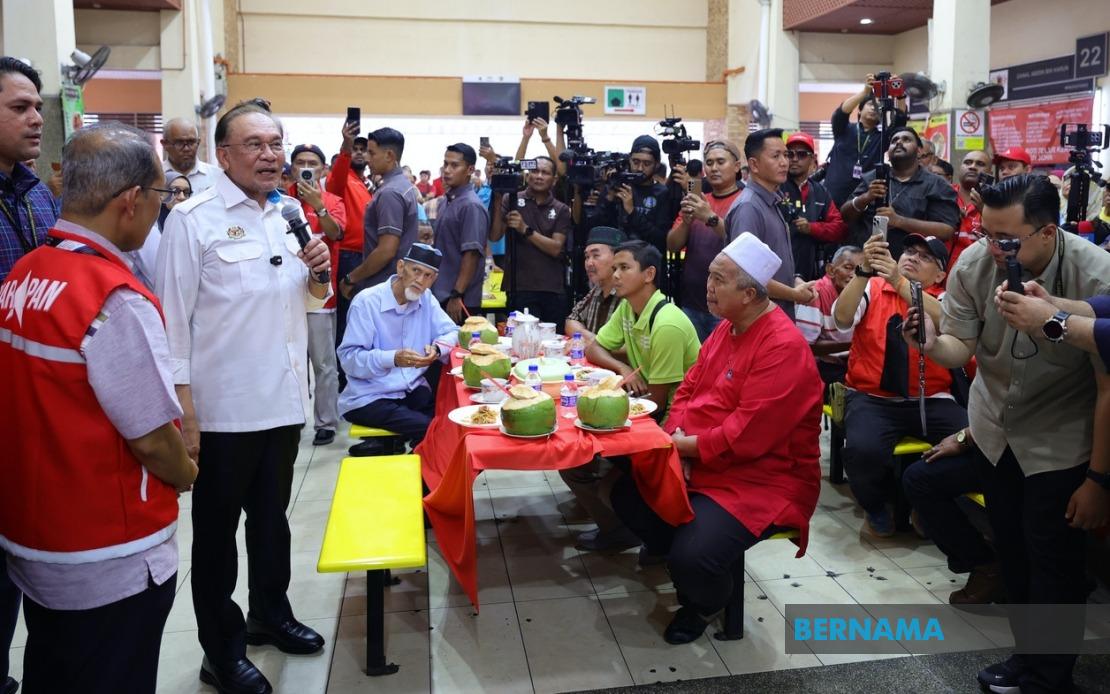
Prime Minister Datuk Seri Anwar Ibrahim made a direct appeal to voters in Negeri Sembilan on July 22, urging them to renew their support for Pakatan Harapan ahead of the state election, framing the poll as a critical moment for maintaining the political equilibrium that has defined the state's recent trajectory. Speaking in Seremban during a campaign swing, Anwar positioned the election not merely as a routine electoral exercise but as a referendum on the coalition's developmental agenda and its commitment to sustaining institutional coherence across Malaysia's multi-layered governance structure.
The Prime Minister's intervention underscores the strategic importance the federal coalition places on the Negeri Sembilan contest, where PH currently governs. By travelling to the state and throwing his political weight behind the campaign, Anwar signalled that outcomes in state elections carry material consequences for federal policy implementation and the distribution of resources. His presence was intended to mobilize party machinery and remind constituents of the broader narrative of stability and progress that PH has constructed since returning to federal office.
Central to Anwar's messaging was the contention that a reinforced mandate would enable seamless coordination between Negeri Sembilan's state administration and the Federal Government. He argued that synchronized governance—where both tiers operate under the same political umbrella—facilitates more efficient execution of development schemes and social welfare initiatives. This argument reflects a practical recognition that Malaysia's federal system can create friction when state and federal governments are controlled by different coalitions, potentially leading to resource disputes, policy misalignments, and reduced implementation capacity. By seeking a fresh endorsement, PH aims to avoid such fragmentation within its own territory.
Anwar specifically credited Menteri Besar Datuk Seri Aminuddin Harun with maintaining administrative stability throughout his tenure, attributing this achievement to inter-party cooperation and collective commitment to the state's interests. The framing served a dual purpose: it demonstrated respect for the incumbent state leadership while also suggesting that continuity under PH's stewardship remains the prudent choice. The reference to "Tok Min"—a familiar form of address—was designed to convey personal rapport and underscore Aminuddin's standing within the coalition hierarchy.
Yet Anwar's campaign message also contained a degree of candour often absent from political rhetoric. He acknowledged that PH's tenure in Negeri Sembilan, while generally successful, has not been flawless and remains susceptible to improvement. This concession likely reflects awareness that voter enthusiasm can wane if parties project an aura of infallibility, and admitting room for refinement may paradoxically strengthen credibility. By inviting continued feedback from citizens and promising responsive adjustments, Anwar attempted to position PH as a learning organization rather than a static establishment.
The PH coalition enters the Negeri Sembilan contest with a comprehensive slate, fielding candidates across all 36 state seats. The distribution—16 from PKR, 11 from DAP, and nine from Amanah—reflects the established power-sharing formula within the coalition, with PKR maintaining the largest representation. This internal balance has proven stable in recent years, though tensions periodically surface over seat allocations and resource distribution. The breadth of PH's candidacy signals confidence in defending its current stronghold, though the outcome remains genuinely uncertain given Malaysia's volatile electoral environment.
For Malaysian and Southeast Asian observers, the Negeri Sembilan election carries implications beyond state-level politics. Negeri Sembilan serves as a test case for whether PH can consolidate support in traditional strongholds while managing internal coalition dynamics. The state's economy, anchored in manufacturing, palm oil processing, and light industries, reflects broader sectoral patterns across Malaysia. Voter sentiment regarding economic management, cost of living pressures, and employment prospects in Negeri Sembilan will likely mirror concerns prevalent across the nation, making the state's results a potential bellwether for federal-level political trajectories.
The Election Commission has scheduled polling for August 1, with early voting commencing on July 28. This timing places the Negeri Sembilan election in the midst of Malaysia's seasonal electoral calendar and may affect voter turnout patterns. Early voting provisions, increasingly common in Malaysian elections, tend to favour incumbent parties with superior organizational capacity, a structural advantage that PH possesses. Nonetheless, the compressed campaign period and the state's demographic heterogeneity—ranging from urban Seremban constituencies to rural areas with distinct economic concerns—ensure that messaging must remain calibrated to local preoccupations.
Anwar's campaign appearance also reflected the centrality of state elections to PH's broader political strategy. After the 2022 federal election produced a fractured parliament and necessitated coalition-building, the coalition has emphasized state-level victories as evidence of sustained public confidence. Losing control of Negeri Sembilan would represent a symbolic setback, potentially emboldening rival coalitions and complicating narratives of PH's governmental competence. Conversely, a convincing victory could provide momentum heading into future electoral cycles and strengthen Anwar's negotiating position within the coalition itself.
The appeal for political stability, repeated throughout Anwar's remarks, resonates with a Malaysian electorate that has experienced significant institutional turbulence over the past several years. From the collapse of the Muhyiddin administration to the complex parliamentary arithmetic of the current federal government, stability has become a premium political commodity. By framing PH's continuation in Negeri Sembilan as essential to maintaining the conditions necessary for effective governance, Anwar tapped into voter preferences for predictability and continuity, even when imperfect.
Ultimately, Anwar's campaign message represents a conventional but strategically sound approach to incumbent electioneering: emphasizing achievement and stability while acknowledging scope for improvement, promising enhanced coordination between state and federal authorities, and explicitly inviting voters to renew their mandate. Whether this messaging proves sufficient to mobilize PH supporters and attract swing voters in Negeri Sembilan will become evident once August 1 arrives, but Anwar's personal engagement signals that the coalition regards the outcome as consequential for its broader political fortunes.

