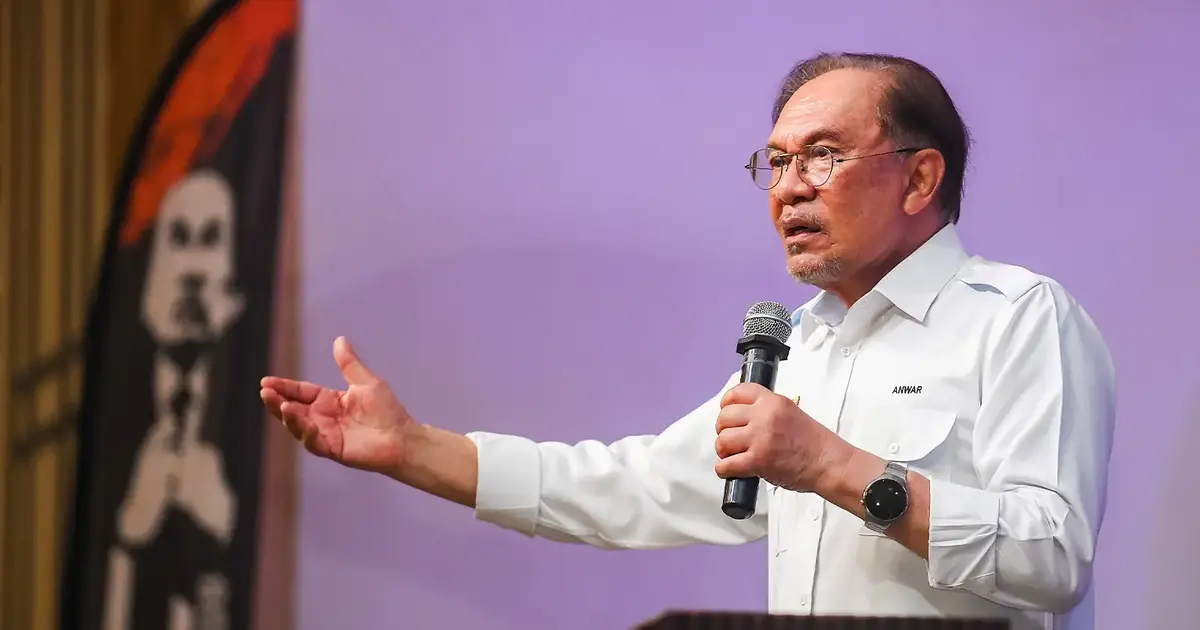
Prime Minister and Pakatan Harapan chairman Anwar Ibrahim has attributed the unexpected decision to hold an early Johor state election to activist movements campaigning for the release of former Prime Minister Najib Razak, suggesting the coalition was pushed into an undesirable electoral battle it did not initiate. In comments that reflect mounting frustration within the ruling coalition about the timing and necessity of the poll, Anwar expressed his view that no substantive reason existed to dissolve the state assembly prematurely and seek a fresh mandate from voters.
The emergence of the "Free Najib" campaign has become a significant political undercurrent in Malaysia, drawing support from segments of the population sympathetic to the imprisoned former leader who continues to serve sentences related to financial improprieties during his tenure. These organized efforts have kept pressure on the government through public demonstrations and social media mobilization, creating a political environment that Anwar suggests made it strategically difficult for his administration to maintain the status quo in Johor. The movement's visibility and momentum appear to have influenced the calculus of political players in the state, though Anwar's framing suggests the coalition viewed intervention as externally imposed rather than internally driven.
The Johor state election represents a critical test for Pakatan Harapan's political standing in one of Malaysia's most significant states economically and strategically. Johor's political complexion carries national implications, given its size, population density, and historical role as a political bellwether. An early election call, from Anwar's perspective, squandered an opportunity for the coalition to govern unopposed until the constitutionally designated timeframe, instead forcing the machinery into campaign mode ahead of schedule and depleting resources that could have been deployed more strategically elsewhere.
Anwar's comments underscore a broader tension within Malaysian politics between government stability and the demands of organized civic movements. The "Free Najib" campaign has successfully maintained Najib's narrative as a political issue rather than a closed chapter, keeping sympathizers energized and creating pressure on successive administrations. For a government already managing complex coalition dynamics and competing priorities, such external pressure campaigns present genuine tactical challenges that cannot be easily dismissed or ignored without political consequences.
The timing of the early election also reflects the volatile nature of state-level politics in Malaysia, where coalition partners often hold disproportionate leverage and shifting alliances can trigger unexpected electoral calls. Anwar's suggestion that the coalition was "dragged" into the contest implies that Johor's political actors, whether from within Pakatan Harapan itself or from rival coalitions, made calculations that necessitated an early appeal to voters. This reveals the precarious nature of governing majorities in Malaysian states, where consensus can fracture rapidly when political actors perceive strategic advantage in disrupting the status quo.
The "Free Najib" movement also carries international dimensions worth considering. Najib's convictions touched on matters of global financial crime and capital flight, with international bodies and foreign governments initially scrutinizing Malaysia's handling of the cases. Any sustained domestic campaign to reverse his legal status risks inviting renewed international attention to Malaysia's judicial independence and rule of law framework. For Anwar, whose government campaigned partly on anti-corruption credentials and renewed democratic values, the emergence of a powerful grassroots movement seeking to undo convictions of a predecessor presented a genuine governance dilemma.
From a broader Southeast Asian perspective, Malaysia's political cycles demonstrate how individual personalities and legacies can dominate electoral calendars across multiple election cycles. The Najib question has not faded despite his imprisonment, instead morphing into a continuing source of political mobilization. This reflects deeper factional divisions within Malaysian society that transcend conventional ideological boundaries, suggesting that resolving the underlying grievances motivating the "Free Najib" campaign remains essential for long-term political stability.
Anwar's willingness to publicly attribute the early election call to external pressure represents a notable rhetorical choice, effectively distributing blame away from his own coalition while simultaneously legitimizing the "Free Najib" movement's political potency. By acknowledging the movement's influence, he simultaneously validates its capacity to shape electoral outcomes and suggests that ignoring such grassroots sentiment carries electoral risks. Whether this framing resonates with voters or appears merely defensive will likely depend on Pakatan Harapan's electoral performance in Johor and the narrative the coalition constructs around the campaign itself.
The Johor election ultimately tests whether Pakatan Harapan can maintain momentum in a critical state despite being forced into premature campaigning. The coalition's ability to retain or expand its position will shape perceptions of whether movements like "Free Najib" genuinely reflect broader public sentiment or represent vocal minorities that electoral outcomes can safely ignore. For Malaysian observers watching national politics, the results will provide crucial indicators about the government's durability and the viability of coalitions dependent on maintaining complex multi-party arrangements in an environment of persistent factional competition and organized campaigns.

