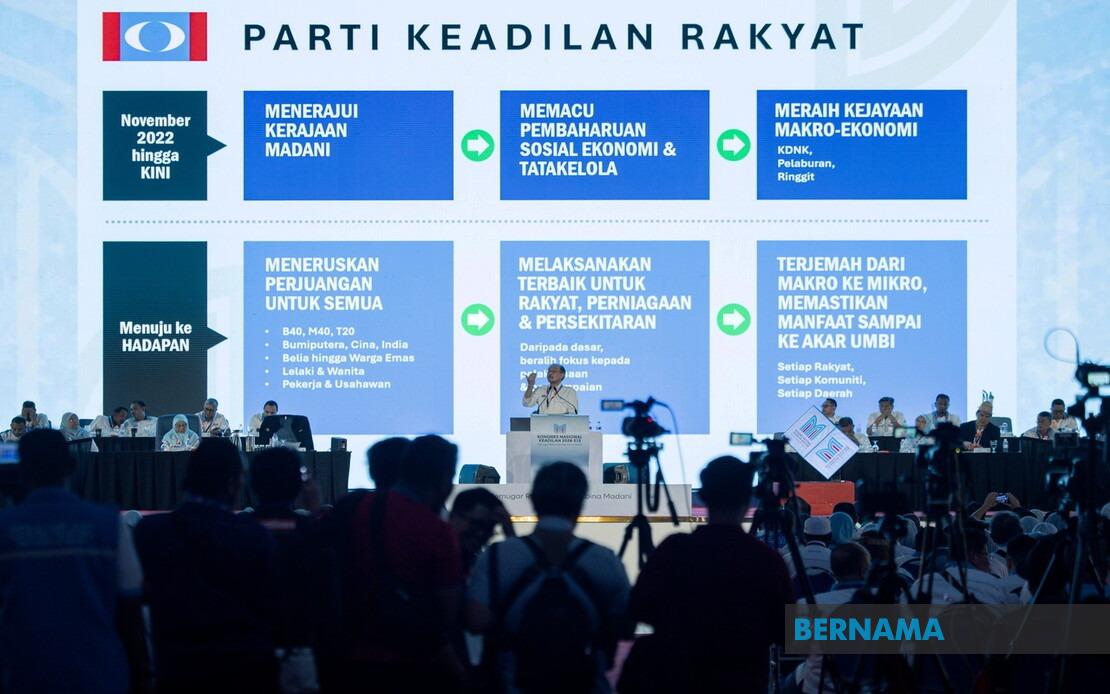
Prime Minister Datuk Seri Anwar Ibrahim has entrusted Home Minister Datuk Seri Saifuddin Nasution Ismail with comprehensive authority to execute the duties of PKR's deputy president on an interim basis, a significant restructuring announced during the party's national congress in Melaka on August 16.
The transition comes as Nurul Izzah Anwar, the current deputy president and the Prime Minister's daughter, steps back temporarily from her role. Rather than leaving the position vacant or distributing its functions piecemeal, Anwar chose to consolidate responsibilities under Saifuddin Nasution, underscoring the depth of trust he places in the experienced minister. Anwar characterised his decision in personal terms, referencing his longstanding relationship with Saifuddin Nasution and describing him as among his most loyal and understanding colleagues, qualities he deemed essential for seamlessly maintaining party operations during the transition.
The appointment represents a calculated response to the party's organisational demands, layering additional responsibilities onto a cabinet minister already burdened with Home Ministry functions. Yet Anwar framed this not as an imposition but as a necessary evolution, appealing to the broader PKR membership to rally behind Saifuddin Nasution with unqualified support and loyalty. The rhetoric reflected Anwar's attempt to legitimise the arrangement through consensus-building rather than top-down directive.
Anwar simultaneously announced complementary leadership changes designed to strengthen the party's institutional machinery ahead of potential electoral challenges. Datuk Seri Amirudin Shari, another vice-president, received appointment as the party's election director—a role carrying strategic weight given Malaysia's unpredictable political calendar and the possibility of federal or state elections materialising at short notice. Separately, Tengku Datuk Seri Zafrul Tengku Abdul Aziz moved into a newly fashioned coordinator position within the Prime Minister's Office, positioning him at the nexus of party-government integration.
These cascading appointments reflect a deliberate rebalancing of PKR's power structure, consolidating influence among trusted figures whilst repositioning others to address perceived operational gaps. The elevation of Amirudin to election director, in particular, signals Anwar's intention to professionalise campaign management, a priority given recent electoral setbacks that have challenged the party's dominance in several states.
Simultaneously, Anwar sought to manage internal dissent within PKR's Negeri Sembilan chapter following the party's defeat in the state election on August 1. Six divisional chiefs had publicly called for a review of Datuk Seri Aminuddin Harun's role as chairman of the Negeri Sembilan PKR State Leadership Council, a challenge that threatened to unravel cohesion in a state where PKR had previously held significant influence. Rather than removing Aminuddin, Anwar recalibrated his responsibilities, asking him to concentrate exclusively on his vice-presidential portfolio and a newly emphasised training remit aimed at nurturing emerging party cadres.
Anwar's approach to the Negeri Sembilan crisis exemplified his preference for repositioning over removal, a strategy that preserves institutional relationships whilst addressing performance concerns. By redirecting Aminuddin's energies toward cadre development—ostensibly leveraging his tenure as former Menteri Besar—Anwar avoided the public humiliation of demotion whilst implicitly signalling that his state-level leadership required improvement. The Prime Minister further deflected blame for Negeri Sembilan's failure, attributing it to collective shortcomings rather than individual culpability, a framing that allowed grievance to dissipate into shared responsibility.
The timing of these announcements during the PKR National Congress provided an opportune stage for legitimising leadership adjustments before the party membership. Congress speeches carry ceremonial weight in Malaysian party politics, and Anwar's winding-up address functioned as both governance communication and mass persuasion, embedding operational changes within broader appeals for unity and collective renewal.
The restructuring holds implications for PKR's internal dynamics extending beyond immediate personnel questions. Saifuddin Nasution's expanded brief may strain his capacity as Home Minister, potentially limiting his availability for party business or forcing uncomfortable prioritisation between government and party responsibilities. This tension could become more acute should security challenges or national crises demand intensive ministerial engagement. Conversely, concentrating deputy presidential authority in a respected elder statesman may provide operational clarity during an organisationally turbulent period.
For Southeast Asian observers, the shuffle illustrates how Malaysian ruling parties navigate successions and interim arrangements without formal constitutional provisions governing such transitions. Unlike institutionalised systems with explicit protocols for deputy leader absences, Malaysian political structures rely on informal mandates and trust-based delegation, arrangements that remain functional but potentially vulnerable to misunderstanding or challenge.
Anwar's decisions also reflect PKR's broader struggle to maintain electoral momentum following recent setbacks in state elections. The party's core remains the dominant component of the federal ruling coalition, yet its performance in state contests has proven inconsistent, suggesting that organisational or strategic gaps may be widening. Centralising authority under trusted lieutenants like Saifuddin Nasution may theoretically improve coordination, though it also concentrates risk, making the party's trajectory heavily dependent on a narrow circle of ageing leaders whose eventual retirement could precipitate succession crises.
The appointments thus represent both pragmatic governance and a tacit acknowledgment that PKR confronts competitive pressures requiring tighter coordination and sharper strategic focus. Whether this recalibration addresses underlying weaknesses or merely shuffles personnel without addressing structural deficiencies will become apparent through the party's electoral performance in coming years.

