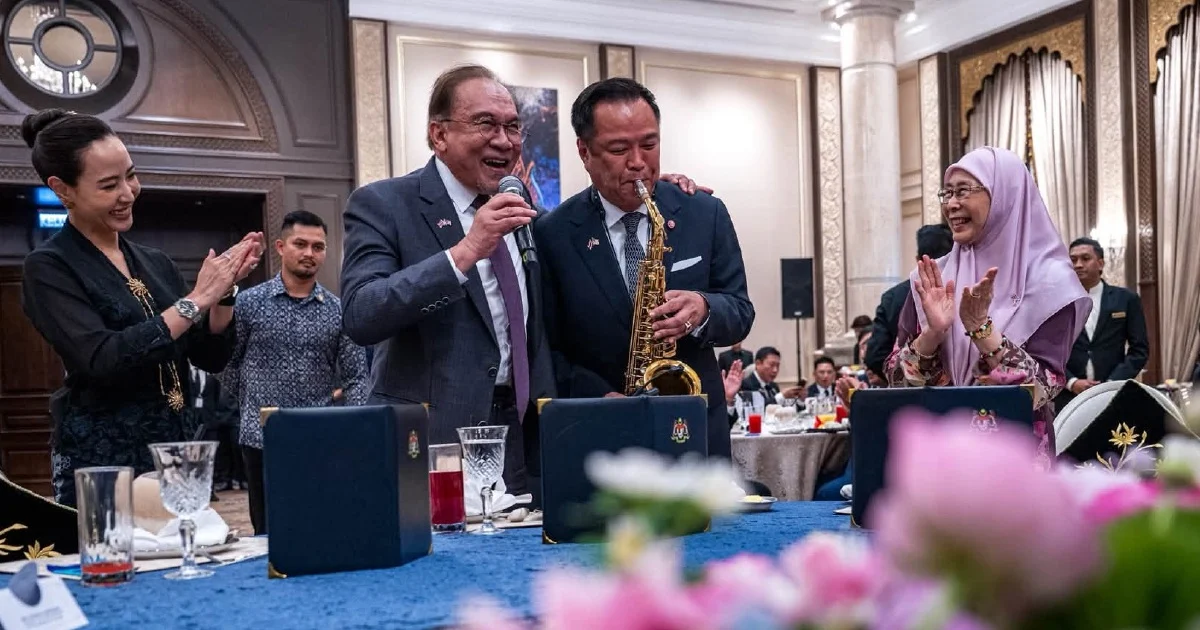
Prime Minister Datuk Seri Anwar Ibrahim and Thai counterpart Anutin Charnvirakul shared an entertaining moment at an official luncheon in Putrajaya following formal bilateral discussions, breaking the formality of diplomatic proceedings with an unrehearsed performance of Frank Sinatra's classic 'My Way', with Anutin accompanying on saxophone.
The impromptu musical interlude came after the two leaders completed substantive talks addressing the full range of Malaysia-Thailand relations. Rather than departing immediately after formal negotiations concluded, both premiers opted to extend the visit with a social meal, transforming what could have been a routine state function into a memorable occasion that reflected the warmth characterising current bilateral ties.
Anutin's decision to bring his saxophone to the luncheon demonstrated a willingness to engage beyond the usual constraints of high-level diplomacy. The instrument choice is noteworthy given that Southeast Asian leaders rarely incorporate such personal artistic touches into official state visits, suggesting a deliberate effort to project an approachable, personable image of Thai governance to Malaysia and the broader region.
The selection of 'My Way', with its themes of individual determination and charting one's own course, carries symbolic resonance for both nations. Malaysia and Thailand have historically navigated distinct regional development paths whilst maintaining a complex and multi-layered relationship spanning trade, security cooperation, and cultural exchange. The song's emphasis on autonomy and self-determination aligns with both countries' independent foreign policy positioning within ASEAN.
For Malaysian observers, such moments carry particular significance. Anwar's comfort in participating in spontaneous cultural exchanges underscores his efforts to project Malaysia as a nation confident in its diplomatic standing and unafraid to engage authentically with regional peers. The Prime Minister's willingness to step outside formal protocols reflects a broader approach to leadership that emphasises human connection alongside institutional relationships.
The incident also illustrates the shifting nature of modern bilateral diplomacy, where leadership personalities and personal interactions increasingly shape international perceptions alongside traditional diplomatic channels. In an era where official statements and prepared remarks are scrutinised intensely, unscripted moments of genuine interaction often register more powerfully with domestic and international audiences.
Thailand, under Anutin's coalition government, has been seeking to strengthen economic and strategic partnerships across Southeast Asia as it navigates regional geopolitical complexities. Enhanced Malaysia-Thailand cooperation carries mutual benefits, particularly in areas such as cross-border trade facilitation, security coordination along their shared border, and collaborative initiatives within ASEAN frameworks.
The performance's viral nature, drawing substantial online attention and social media commentary, demonstrates how contemporary diplomatic events transcend traditional news cycles. What might have occupied a single paragraph in previous decades now generates significant digital engagement, shaping public perception of bilateral relationships among younger demographics with limited memory of historical tensions.
For Malaysia specifically, projecting an image of harmonious relations with Thailand proves strategically valuable. The two countries share a porous border with long-standing sensitivities requiring careful management. Public displays of warmth and camaraderie between leaders, especially when genuinely spontaneous rather than orchestrated, help reinforce positive narratives and reduce space for divisive rhetoric that periodically surfaces.
Beyond the theatrical element, such visits address substantive regional concerns. Malaysia-Thailand cooperation on maritime security, counterterrorism, and transnational crime remains essential for both nations' security architectures. When leaders establish personal rapport and demonstrate mutual respect through cultural gesture, the groundwork for deeper institutional cooperation becomes more fertile.
The luncheon performance also carries generational implications. Anutin, representing Thailand's newer political coalition, uses such moments to signal openness to modernised regional relationships unburdened by historical grievances that occasionally constrain government-to-government engagement. Similarly, Anwar's participation affirms Malaysia's commitment to moving bilateral relations beyond transactional frameworks toward genuine partnership.
Regionally, Malaysia and Thailand occupy significant positions within ASEAN's institutional architecture and Southeast Asian strategic calculations. Their enhanced cooperation influences broader regional stability calculations, particularly given their respective relationships with major powers and their role in maintaining ASEAN centrality within evolving geopolitical competitions.
The moment ultimately reinforces that contemporary statesmanship encompasses not merely traditional negotiation and treaty-making, but also the cultivation of personal relationships and public-facing symbolism that communicate openness and goodwill to regional and global audiences. In an environment where trust between nations remains contested and regional tensions periodically escalate, such performances serve diplomatic purposes extending well beyond entertainment.

