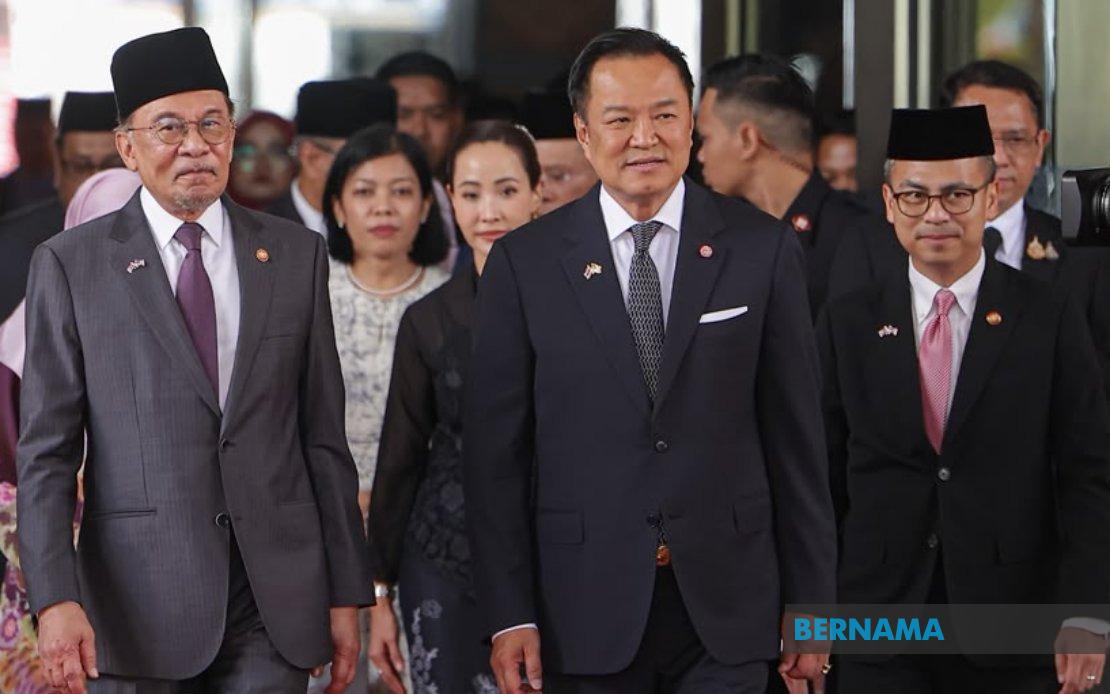
Prime Minister Datuk Seri Anwar Ibrahim and his Thai counterpart Anutin Charnvirakul convened for substantive bilateral discussions at the Perdana Putra Complex in Putrajaya on July 9, marking a significant diplomatic engagement aimed at evaluating the trajectory of Malaysia-Thailand relations and exploring fresh avenues for expanded cooperation across a diverse spectrum of sectors. The high-level meeting reflects the importance both nations place on their bilateral relationship at a time when Southeast Asia faces complex regional challenges and shifting geopolitical currents that demand coordinated responses from neighbour states.
Anutin arrived in Malaysia on a two-day official visit at Anwar's invitation, touching down at Kuala Lumpur International Airport at 11.11 am where the Malaysian Prime Minister extended a formal reception at the Bunga Raya Complex. The ceremonial reception underscored the diplomatic significance attached to the visit, with both leaders subsequently travelling together to the nation's administrative headquarters for the main bilateral discussions. Such protocols, while often routine in diplomatic circles, carry symbolic weight in demonstrating mutual respect and the priority assigned to strengthening bilateral bonds in an era when regional relationships require constant nurturing.
The agenda encompassed a comprehensive range of policy areas reflecting the breadth of Malaysia-Thailand engagement. Trade and investment dynamics figured prominently, as both economies seek to capitalize on the ASEAN Economic Community framework and explore complementarities in their respective manufacturing and services sectors. Border connectivity emerged as another critical discussion point, given that Malaysia and Thailand share land boundaries and maritime zones where coordination on infrastructure, customs procedures, and cross-border commerce remains essential for facilitating seamless people and goods movement. Agricultural cooperation warranted particular attention, with both nations preparing to formalize a Memorandum of Understanding in this sector, acknowledging the importance of food security within the region and the potential for collaborative research and market integration.
Security considerations featured prominently in the bilateral agenda, encompassing transnational challenges including human trafficking, drug smuggling, and maritime piracy that transcend national borders and require synchronized law enforcement efforts. Tourism and educational exchanges were positioned as vehicles for deepening people-to-people connections, recognizing that grassroots engagement and cultural understanding form the bedrock of sustainable international relationships. The inclusion of these traditionally soft-power dimensions alongside hard security and trade issues demonstrates a holistic approach to bilateral statecraft that acknowledges both the economic imperatives and the human dimension of international relations.
The composition of delegations from both sides reflected the comprehensive nature of the discussions. Malaysia fielded eight Cabinet ministers spanning defence, transport, agriculture, labour, investment, and economic portfolios, while Thailand deployed an equally senior delegation including three deputy prime ministers holding responsibility for foreign affairs, transport, and finance respectively. The presence of the Defence Minister from Thailand and the Home Minister from Malaysia highlighted security cooperation as a centrepiece of the bilateral agenda. This ministerial-level participation ensured that departmental leaders could engage directly on implementation mechanisms and budgetary allocations rather than relegating discussions to diplomatic staff, thereby accelerating decision-making on substantive issues.
Beyond immediate bilateral matters, both leaders were scheduled to exchange perspectives on broader regional and international developments within the context of ASEAN frameworks and other multilateral mechanisms. This dimension acquires particular significance given ASEAN's ongoing efforts to navigate great power competition, manage the South China Sea disputes, and coordinate responses to transnational challenges from pandemic preparedness to climate change. Malaysia and Thailand, as founding ASEAN members with substantial regional influence, occupy positions where their coordinated stances can shape collective regional positions on critical issues. Their discussions on these matters inevitably influence how ASEAN as a bloc engages with larger powers and international institutions.
The agricultural cooperation agreement represented the tangible institutional outcome of the bilateral meeting, with both prime ministers scheduled to witness the signing and exchange of a Memorandum of Understanding. Agriculture remains economically vital for both nations, with Thailand serving as a global rice export powerhouse while Malaysia maintains significant palm oil and livestock industries. Formal cooperation frameworks in this sector can facilitate technology transfer, establish joint research initiatives, and create preferential trading arrangements that benefit farmers and agribusinesses in both countries. For Malaysian policymakers and agricultural stakeholders, such agreements provide pathways to diversify markets and access Thai expertise in rice cultivation and export logistics.
The official luncheon hosted by Anwar following the formal discussions represented more than ceremonial courtesy, serving as an informal setting for continued dialogue and relationship-building away from the structured formality of the conference room. Such occasions frequently produce agreements in principle on matters that subordinate officials will subsequently elaborate into formal documents, and they provide opportunities for leaders to assess personal chemistry and establish rapport that eases future diplomatic interactions. The informality of shared meals in diplomatic contexts often proves conducive to candid discussion of sensitive issues and creative problem-solving approaches that formal settings discourage.
For Malaysia, deepening ties with Thailand carries strategic implications beyond bilateral commerce and security. Thailand serves as a crucial land bridge connecting Malaysia to Laos, Cambodia, and Vietnam, making bilateral infrastructure and connectivity improvements valuable for Malaysian businesses seeking market access throughout mainland Southeast Asia. Conversely, Thailand benefits from Malaysia's role as a maritime gateway and its established financial services infrastructure. The relationship also provides both nations with a mechanism for coordinating positions within ASEAN and managing regional dynamics where their interests frequently converge.
The timing of Anutin's visit arrived during a period of relative political stability in both nations, creating an opportune window for advancing long-term cooperation frameworks that transcend shorter-term political cycles. Malaysia's government under Anwar has prioritized regional engagement as part of its broader foreign policy reorientation, while Thailand under Anutin has similarly emphasized strengthening bilateral partnerships across Southeast Asia. These parallel diplomatic trajectories create propitious conditions for translating aspirations into concrete institutional mechanisms and measurable cooperative outcomes.
Looking forward, the substantive agenda discussed during the Putrajaya meeting will likely result in technical working groups tasked with developing implementation roadmaps for various cooperative initiatives. The agricultural agreement serves as an immediate deliverable, but the discussions undoubtedly encompassed longer-term strategic projects spanning infrastructure development, educational exchanges, and security cooperation that will require multi-year implementation timelines. Malaysian observers and stakeholders in affected sectors should anticipate follow-up negotiations at the ministerial and technical levels that will translate the bilateral political commitment into practical arrangements affecting trade flows, investment patterns, and security protocols.

