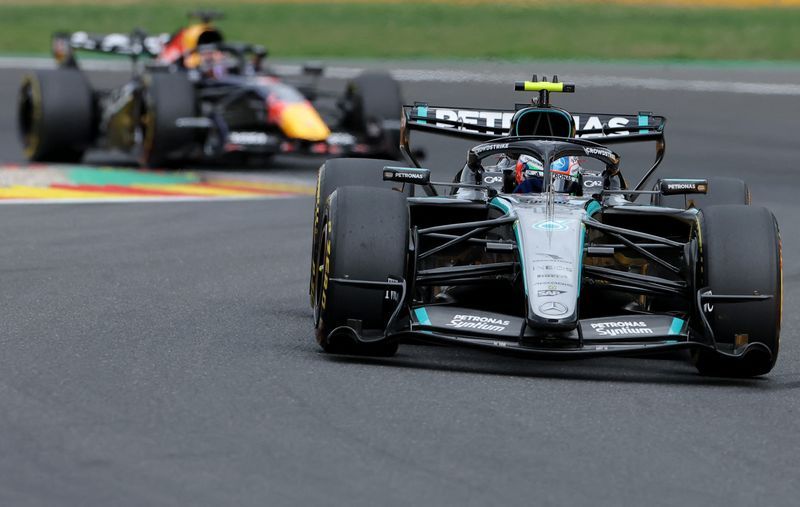
Mercedes' Kimi Antonelli cemented his position as the dominant force in Formula One's 2024 championship race with a victory at Spa-Francorchamps on Sunday, capitalizing on a dramatic collision involving his teammates to substantially increase his points buffer. The 19-year-old Italian crossed the line ahead of Ferrari's Charles Leclerc in what proved to be a consequential race for the season's narrative, reshaping the title battle just as teams head towards the campaign's second half.
The collision between Mercedes drivers overshadowed much of the race dynamics, with George Russell, who entered Belgium as Antonelli's closest rival, losing crucial ground through a first-lap incident. Russell spun off the circuit into the gravel trap after contact with Lewis Hamilton while attempting to recover positions he had surrendered at the start. This mechanical failure to manage his strategy compounded a difficult qualifying session and left Russell facing a significant deficit in the championship standings as the season progresses.
Antonelli's dominance extends beyond this single victory. His sixth triumph in just ten races this season underscores Mercedes' technical superiority in the current regulatory environment and the exceptional maturity of the Italian driver's racecraft. He claimed pole position at Spa-Francorchamps, continuing an extraordinary run of qualifying supremacy for the Stuttgart team that has yielded them every front-row start this season. This combination of qualifying excellence and race execution represents a formidable advantage that rival teams have struggled to counter.
The championship arithmetic has shifted dramatically in Antonelli's favour following Sunday's race. Prior to Belgium, Russell trailed by just a handful of points as Antonelli's closest challenger. However, the crash and subsequent points distribution have widened the gap substantially, with Antonelli now holding a commanding 50-point advantage over his teammate. For context in a competitive championship season, such a margin at the halfway point represents an almost insurmountable buffer in most F1 campaigns.
Charles Leclerc's second-place finish provided Ferrari with a consolation result, though the Scuderia's inability to challenge Antonelli's pace remains a pressing concern for the Maranello team. Leclerc benefited from strategic timing during a virtual safety car period, which allowed Ferrari to execute an advantageous pit stop that temporarily placed him ahead before Antonelli's raw pace reasserted itself. The 1.952-second margin at the flag illustrates the performance gap that has plagued Ferrari throughout the season.
Max Verstappen's third-place result afforded Red Bull a milestone moment, marking their 300th podium finish in Formula One history. Yet the achievement carries bittersweet undertones, as Verstappen's inability to contend for victory reflects the performance struggles Red Bull has encountered against Mercedes' relentless development curve. The podium, while notable statistically, does little to address the team's competitive deficit heading into the season's critical phase.
Hamilton's fourth-place finish came despite serving a five-second penalty for the Russell collision, but the Mercedes driver faced further uncertainty regarding an unsafe release from his pit stop that could result in additional sanctions and a potential fifth-place demotion. This lingering investigation symbolizes the marginal nature of contemporary Formula One, where administrative decisions can prove as consequential as on-track performance. The penalty structure and investigation protocols have drawn scrutiny from observers who note how these interventions sometimes overshadow the racing spectacle.
Oscar Piastri's fifth-place result represented a solid performance for McLaren, though the team continues to chase Mercedes' standard of consistency. Norris, meanwhile, recovered to seventh place despite a severe 10-place grid penalty resulting from a previous race infringement. His starting position of 13th made the recovery noteworthy from a tactical perspective, yet the grid drop mechanism itself raises questions about proportionality in contemporary penalty structures that remain contentious among analysts and team principals.
The lower points-scoring positions were distributed among an increasingly competitive midfield, with Gabriel Bortoleto securing points for Audi in eighth, Arvid Lindblad for Racing Bulls in ninth, and Franco Colapinto for Alpine rounding out the scoring in tenth. This distribution reflects the depth of competition in Formula One's midfield, where numerous teams possess sufficient technical capability to accumulate points. For Malaysian and Southeast Asian fans, Colapinto's presence represents growing diversity in the sport's driver lineup, mirroring broader trends towards international representation.
Antonelli's post-race comments emphasized the role of fortune in championship outcomes, a diplomatic acknowledgment of the circumstances that benefited him through Russell's mishap. However, his ability to capitalize on opportunities and maintain qualifying dominance suggests that his lead represents genuine competitive advantage rather than mere fortunate occurrence. The young Italian's development trajectory has impressed observers, though questions persist regarding the durability of Mercedes' technical advantage as other teams allocate resources towards closing the gap.
Looking forward, Russell's need to recover psychological momentum from this setback looms large. Championship campaigns require resilience, and whether the British driver can rebound from this collision-induced deficit will significantly influence the season's outcome. Similarly, Ferrari and Red Bull face mounting pressure to identify the technical innovations necessary to challenge Mercedes' supremacy, as incremental improvements have manifestly failed to narrow the performance gap.
The Belgian Grand Prix served as a pivotal moment in the 2024 championship narrative, transforming a competitive title battle into something resembling a coronation march for Antonelli. Whether this advantage proves insurmountable will become clearer as the season unfolds, but Mercedes enters the campaign's second half in an extraordinarily commanding position that few thought imaginable at the season's outset.

