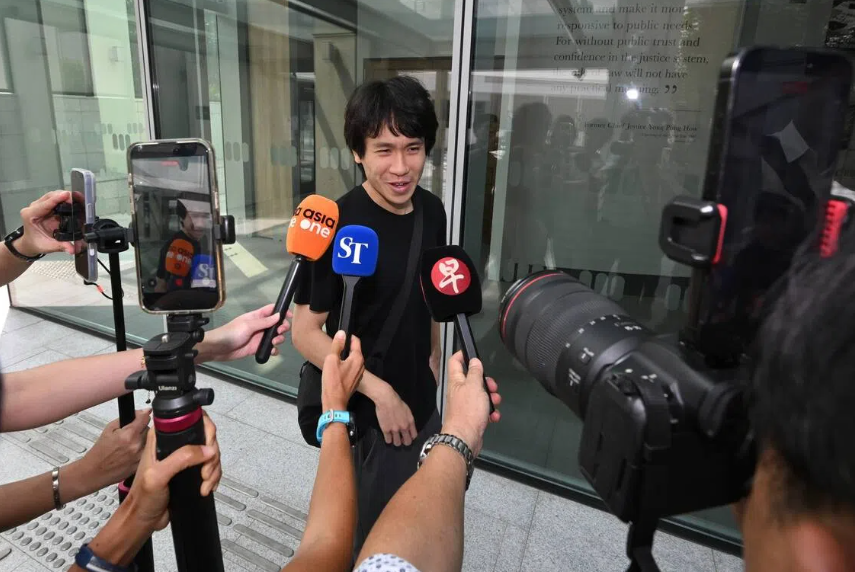
Former child actor Amos Yee appeared in Singapore's District Court on August 26 to face four additional criminal charges, bringing his total alleged violations to seven. The 27-year-old's legal troubles span multiple areas of Singapore's criminal code, from alleged incitement of communal tensions to disturbing content related to child protection, alongside separate violations of national service enlistment requirements.
Among the new charges, Yee is accused of attempting to foment racial disharmony through blog postings made on April 7 and April 11. According to the allegations, he published content claiming that Malays and Indians faced systematic discrimination perpetrated by the Chinese majority in Singapore. The prosecution contends that his posts went beyond mere commentary to actively encourage these communities to mobilise against the Government, thereby crossing the legal threshold from expression into incitement.
A second charge relates to video content uploaded on May 27, wherein Yee purportedly made statements characterising the Malay and Muslim community as experiencing severe discrimination by the Chinese population. The distinction between this charge and the earlier blog-based allegation appears to centre on the medium and timing of the statements, with authorities treating each distinct platform and date as a separate violation.
Two additional charges have been levelled under Singapore's Protection from Harassment Act, stemming from video material produced in 2021. The allegations centre on Yee's apparent advocacy for expanded legal protections and freedoms for individuals with paedophilic interests. Most disturbingly, the charges allege that Yee made statements suggesting that children and infants possess the capacity to consent to sexual activity. Beyond these video statements, he allegedly called for the decriminalisation and legalisation of child sexual abuse material, representing views that place him at odds with international child protection standards and Singapore's domestic legislation.
The prosecution further alleges that Yee reiterated these positions in a blog post published on June 30, potentially indicating a pattern of deliberate repetition rather than isolated comments. If convicted on the racial disharmony charge, Yee faces imprisonment of up to three years, a financial penalty, or a combination of both. Each Protection from Harassment Act conviction carries a maximum fine of S$5,000.
The court released Yee on S$15,000 bail on August 26, but imposed stringent conditions reflecting the sensitive nature of the allegations. He is explicitly prohibited from posting any content online relating to his views on paedophilia or statements that could inflame tensions between racial and religious communities. These restrictions effectively silence him on the very topics that have drawn law enforcement scrutiny, a constraint that raises questions about pre-trial publicity and the presumption of innocence in high-profile cases.
Beyond the newly charged offences, Yee remains entangled with three separate charges under Singapore's Enlistment Act. These relate to alleged failures to report for mandatory pre-enlistment medical screening and his alleged departure from Singapore without valid exit permits across multiple periods. The prosecution alleges he left the country unlawfully from December 13, 2015, to April 19, 2016, and subsequently from December 15, 2016, to March 19, 2026. Additionally, he allegedly failed to attend compulsory national service medical examinations spanning from April 26, 2016, through to March 19, 2026. These enlistment violations carry penalties of up to S$10,000 in fines, three years imprisonment, or both.
The Singapore Police Force issued a statement on August 25 indicating that it had received multiple reports between April and July 2026 concerning Yee's online activities. Authorities subsequently issued a disabling direction under the Online Criminal Harms Act on August 18, prompting the social media platform X to remove his video content. Additionally, Yee received stop communication directions requiring him to delete the offending posts from his blog.
For Malaysian and regional observers, the Yee case illuminates Singapore's assertive approach to online speech regulation and communal harmony legislation. Unlike many democracies that tolerate provocative speech as part of the political marketplace, Singapore treats incitement to racial or religious disharmony as a serious criminal matter, with enforcement mechanisms extending to social media platforms themselves. The charges also underscore growing international concern about online content promoting child sexual abuse, an area where Southeast Asian governments have increasingly coordinated with technology companies to identify and remove such material.
The case raises broader questions about the boundaries between protected political expression and criminal incitement in the region. While Yee's alleged statements about racial discrimination might constitute protected speech in other liberal democracies, Singapore's constitutional framework and the Maintenance of Religious Harmony Act provide authorities with legal tools to prosecute such speech. His next scheduled court appearance is a pre-trial conference on September 18, where procedural matters and potential plea arrangements may be discussed.
Yee's situation also reflects tensions within Singapore's multicultural society regarding who gets to define acceptable discourse on sensitive communal issues. The State argues that its legislation protects religious and racial minorities from harmful incitement. Critics contend that such laws can suppress legitimate criticism of government policies and majority community conduct. For the Malaysian context, where issues of bumiputera rights, Islamic law, and inter-ethnic relations remain politically fraught, the Yee precedent offers instructive—though not necessarily directly applicable—insights into how a neighbouring state manages these perpetually contentious topics through criminal sanction.

