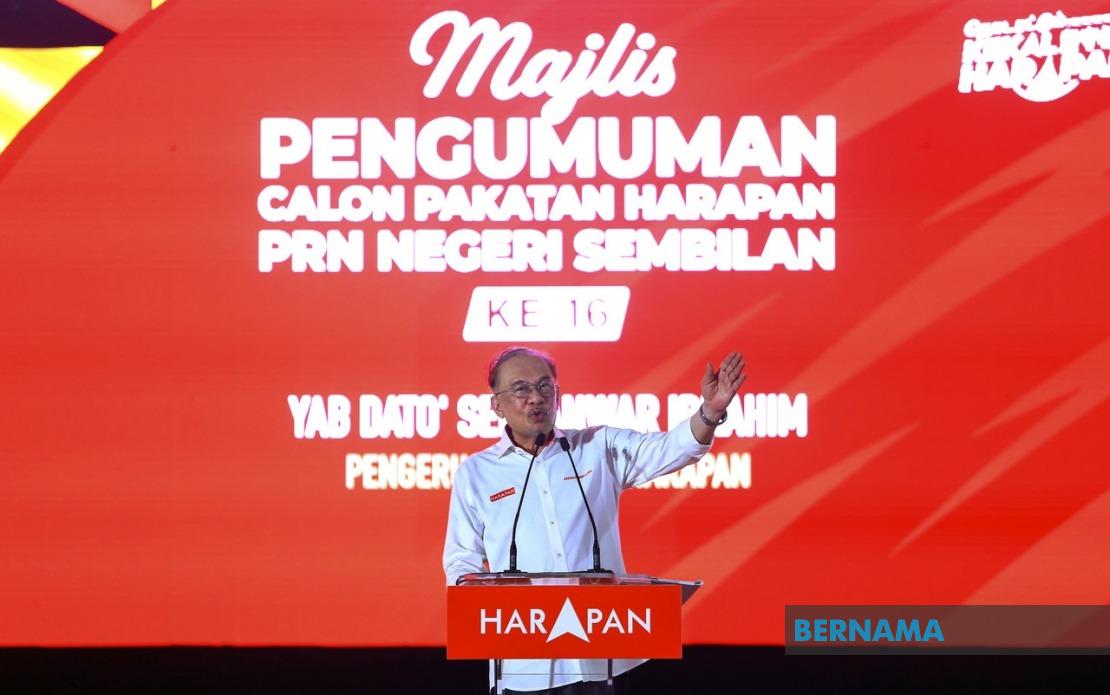
Prime Minister Datuk Seri Anwar Ibrahim has formally announced the Pakatan Harapan coalition's candidates for the Negeri Sembilan state election, signalling a recalibration of political strategy in a state that remains pivotal to the government's coalition stability. Negeri Sembilan Menteri Besar Datuk Seri Aminuddin Harun will represent the coalition in the Linggi constituency, whilst DAP secretary-general Anthony Loke will defend his long-held Chennah seat as the party braces for the electoral contest.
Aminuddin's move to Linggi marks a strategic shift for the coalition's leadership in the state. Having represented the Sikamat state constituency consecutively since the 2008 election—spanning four full terms—the Menteri Besar brings substantial political capital to the Linggi contest. As chairman of Pakatan Harapan in Negeri Sembilan, Aminuddin has consolidated significant influence within the state apparatus and coalition machinery, positioning him as a central figure in determining whether the government can maintain its hold on this relatively small but strategically important state.
The decision to field Aminuddin in Linggi rather than retaining him in Sikamat suggests internal coalition calculations about seat competitiveness and the need to strengthen representation in contested areas. Negeri Sembilan, with only 36 state seats, remains a barometer of political sentiment in the western corridor of Peninsular Malaysia. The state's outcome will carry symbolic weight beyond its numerical contribution to overall coalition strength, particularly given the recent political turbulence that has tested the Pakatan Harapan alliance.
Anthony Loke's candidacy represents continuity within the DAP's representation structure. The party's senior leadership has entrusted Loke to defend Chennah, which he has represented since 2013, spanning two consecutive election cycles. Loke's retention as the coalition's nominee reflects confidence in his electoral viability and his standing within both DAP and the broader Pakatan Harapan framework. His position as DAP secretary-general underscores the party's commitment to fielding senior figures in constituencies where electoral battles are expected to be closely contested.
The formal announcement ceremony, held in Kuala Pilah and presided over by Anwar Ibrahim himself, carried ceremonial weight befitting a state election that will test the coalition's grassroots organisation and messaging discipline. The presence of Amanah president Datuk Seri Mohamad Sabu, PH communications director Datuk Seri Fahmi Fadzil, and coalition election director Datuk Seri Amirudin Shari illustrated the seriousness with which the coalition leadership approaches the Negeri Sembilan contest. The gathering of thousands of supporters demonstrated efforts to generate momentum and project an image of unified coalition strength.
For Malaysian observers tracking coalition dynamics, this announcement carries several implications. The decision to position Aminuddin prominently in the campaign reflects confidence in his political durability despite the challenging environment facing the government since the 2023 federal election. Yet the shift from Sikamat to Linggi warrants scrutiny regarding whether this represents a calculated move to bolster a vulnerable seat or a reshuffling driven by other internal coalition considerations that remain unspoken in public statements.
The Negeri Sembilan election arrives at a moment when Pakatan Harapan faces sustained pressure from opposition coalitions, particularly in Malay-Muslim majority areas where Perikatan Nasional has aggressively campaigned. State elections in Malaysia's current political climate often serve as referenda on federal government performance, meaning voter sentiment toward Anwar Ibrahim's administration will likely influence outcomes in Linggi, Chennah, and other constituencies.
Loke's defence of Chennah is particularly significant given DAP's ongoing effort to maintain electoral relevance in state-level contests whilst navigating a federal coalition partnership that has occasionally generated internal tensions. The party's ability to retain seats previously won signals both voter confidence and organisational capacity, metrics that feed into broader assessments of coalition health and public support.
The timing of candidate announcements and the careful choreography of public unveilings serve tactical purposes beyond mere information sharing. By having Anwar himself announce these candidacies, the coalition signals that the Negeri Sembilan election matters sufficiently to warrant direct prime ministerial involvement in candidate selection. This approach contrasts with elections where the federal leadership maintains distance, and it suggests coalition strategists view this contest as one where the stakes warrant centralised political attention.
Moving forward, the campaigns in Linggi and Chennah will occupy significant media attention, particularly given the seniority of the candidates fielded. Aminuddin's ability to transition successfully from Sikamat to Linggi will test both his personal political brand and coalition machinery effectiveness. Similarly, Loke's retention will signal whether DAP's presence in state assemblies remains resilient despite the party's federal government integration. Both contests will provide meaningful data about voter behaviour and coalition support as Malaysia navigates the longer trajectory toward the next federal election.

