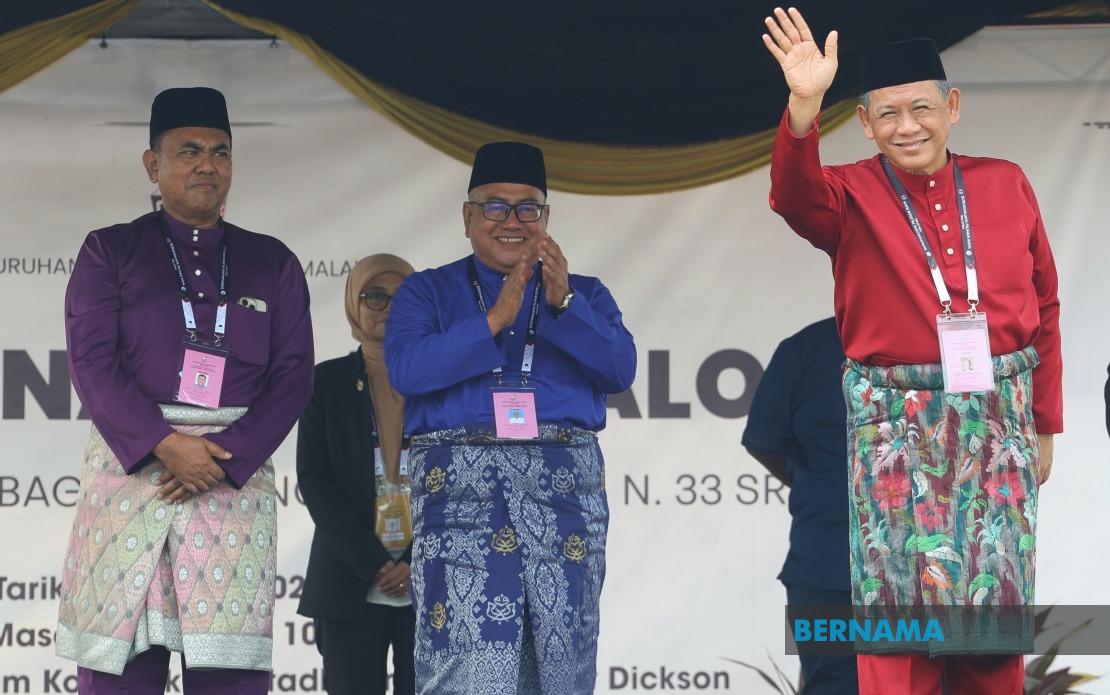
Negeri Sembilan's political landscape has solidified for the 16th state election, with nominations now closed and candidate lineups confirmed across contested seats. The standout battle centres on Linggi, where Pakatan Harapan's Menteri Besar Datuk Seri Aminuddin Harun will defend his position against incumbent Barisan Nasional representative Datuk Mohd Faizal Ramli and Bersatu's Datuk Zamri Md Said. The returning officer, Nurhazelin Makli, announced the final slate of candidates at Port Dickson District Administration Complex Auditorium after nominations closed at 10 am on July 18, setting the stage for what promises to be a closely watched contest in one of Malaysia's smallest states.
The Linggi matchup reflects the fractured opposition landscape that has emerged across Malaysia's electoral terrain. Rather than a straightforward contest between the ruling coalition and opposition forces, Negeri Sembilan now features a splintered middle ground, with Bersatu—once part of the Perikatan Nasional alliance but increasingly independent in its positioning—fielding candidates across multiple constituencies. This three-cornered dynamic in Linggi mirrors similar configurations elsewhere in the state, suggesting voters will grapple with more complex electoral mathematics than traditional binary choices. The presence of Bersatu as a third force complicates efforts by any single bloc to secure decisive mandates, potentially fragmenting support and creating opportunities for parties that can consolidate their core voters.
Beyond Linggi, the state presents a mosaic of competitive contests across its five parliamentary divisions. In Sri Tanjung, the incumbent from Pakatan Harapan, Dr G. Rajassekaran, must navigate his own three-way race against Barisan Nasional's A. Achutan and Bersatu newcomer Leevineshwaraan Murugan. The Lukut seat features another multi-sided battle, with Pakatan Harapan's sitting member Choo Ken Hwa facing pressure from Perikatan Nasional's Sathes Kumar Nilameham and independent candidate Teo Seng Lee. These configurations underscore how Malaysia's political fragmentation has created unpredictable electoral environments where traditional vote-counting methodologies no longer reliably predict outcomes.
Not all contests feature three-cornered dynamics. Chuah offers the state's sole straight fight, with Pakatan Harapan incumbent Yew Boon Lye squaring off directly against Barisan Nasional's Pau Jeou Ching. This bilateral arrangement may represent a more traditional battle where voters face clearer ideological and policy choices. Conversely, Bagan Pinang showcases another tripolar contest, pitting PAS incumbent Abd Fatah Zakaria against Pakatan Harapan's Nasir Raman and Bersatu's Sheikh Junaidy Jamaludin. The presence of PAS in this seat reflects the Islamic party's continued organisational presence in Negeri Sembilan, though its electoral performance has varied considerably across the state's different constituencies.
The electoral commission has designated August 1 as polling day, with early voting scheduled for July 28, providing military personnel, police officers, and their spouses an opportunity to cast ballots before the general vote. This bifurcated voting schedule has become standard practice in Malaysian elections, accommodating the logistical requirements of security personnel who may be deployed away from their home constituencies. The commission estimates that 889,490 voters are eligible to participate, comprising 867,151 ordinary voters supplemented by 16,884 military personnel and their families and 5,455 police officers and their families. This relatively modest electorate—compared to peninsular states like Selangor or Pahang—means individual campaign decisions and turnout patterns could disproportionately influence final outcomes.
For Pakatan Harapan, holding Negeri Sembilan represents a modest but symbolically important achievement. The state's small population and limited economic resources mean limited political leverage within federal calculations, yet incumbent governments defend home turf with particular intensity. Aminuddin Harun's tenure as Menteri Besar has been characterised by efforts to improve state finances and social services, though these achievements remain overshadowed by broader national political dynamics. The three-cornered contest in his own constituency specifically complicates his position, as splits in the opposition vote could theoretically benefit Barisan Nasional despite overall Pakatan Harapan strength in the state.
Barisan Nasional's strategy in Negeri Sembilan reflects its broader repositioning following successive electoral setbacks in 2018 and 2022. By fielding candidates across multiple constituencies and emphasising local governance competence rather than national political messaging, the coalition seeks to rebuild credibility with voters fatigued by centralist policies and governance scandals. Faizal Ramli's defence of Linggi represents an opportunity to demonstrate that Barisan Nasional incumbents can effectively compete even in environments where Pakatan Harapan has established political dominance. The coalition's ability to retain seats will significantly influence post-election coalition-building calculations, particularly if results prove inconclusive.
Bersatu's positioning as a third force adds unpredictability to state-level outcomes. The party, which fractured from Pakatan Harapan following the 2022 general election, retains organisational structures and electoral machinery in several states. Its candidates in Negeri Sembilan, though not necessarily expected to win, could spoil outcomes for either of the major coalitions by splitting votes in closely contested seats. This dynamic renders traditional electoral projections unreliable and elevates the importance of granular constituency-level analysis. Political analysts will scrutinise Bersatu's vote share carefully as an indicator of whether the party has established genuine electoral traction or merely serves as a transitional vehicle for politicians repositioning themselves within Malaysian politics.
The state election unfolds against Malaysia's broader political realignment. The 15th general election in 2022 produced hung parliaments and fractious coalition governments that have struggled to command clear majorities for controversial legislation. State elections increasingly serve as referendums on incumbent performance and testing grounds for new political combinations at the federal level. Negeri Sembilan's result will signal voter sentiment regarding Pakatan Harapan's performance in a state where it holds the chief executive position, providing early indicators of broader electoral trends ahead of potential federal elections. A decisive Pakatan Harapan victory would suggest public satisfaction with governance and electoral consolidation; conversely, erosion of the coalition's majority could portend broader challenges in upcoming federal contests.
Campaign messaging from all major contenders has emphasised local economic development, infrastructure projects, and social welfare provisions rather than the confrontational identity politics that characterise campaigns in other states. Negeri Sembilan's relative ethnic and religious harmony, combined with its limited economic dynamism compared to neighbouring Selangor, has traditionally insulated the state from the divisive campaigns mounted in larger, more heterogeneous jurisdictions. This year's election appears to maintain that trajectory, though national political tensions could yet penetrate local discourse as campaigns intensify. Voter turnout, historically modest in Negeri Sembilan compared to larger peninsular states, will prove critical in determining whether incumbent parties retain control or whether fragmented opposition voting produces surprising results.

