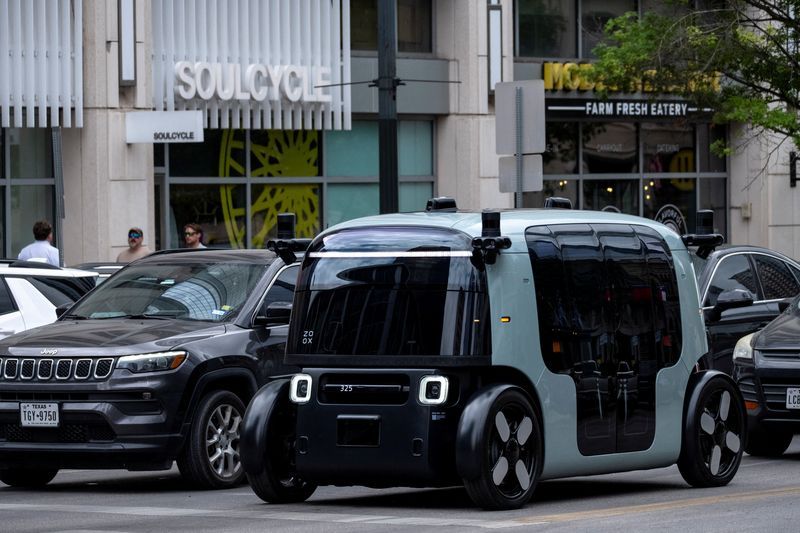
Amazon's autonomous vehicle unit Zoox is moving into commercial operations this week, launching paid robotaxi services in Las Vegas following regulatory clearance from US authorities. The company announced on Wednesday that paying passengers can begin hailing rides from Monday, marking a significant inflection point for the autonomous vehicle industry and validating years of development investment by the Seattle-based tech giant. The Las Vegas rollout signals that the technology has matured sufficiently for companies to operate commercially in real-world conditions, though questions about safety and reliability remain contentious as the sector scales rapidly.
Zoox's distinctive electric vehicle, designed with two rows of seats facing inward in a carriage-style configuration, differs fundamentally from competitors who have adapted conventional automobiles for autonomous operation. The company has been operating free trial services across Las Vegas, San Francisco, Austin, and Miami to gather real-world data and refine its systems. This extensive testing phase positioned Zoox to become the first autonomous ride-hailing operator to receive an exemption from the National Highway Traffic Safety Administration, permitting deployment of fully driverless vehicles without human safety operators—a distinction that underscores the company's technological advancement relative to its rivals.
The regulatory approval, while significant, comes with meaningful constraints. NHTSA granted Zoox permission to operate up to 2,500 vehicles in each of the next two years, a ceiling that reflects continued government caution about scaling autonomous vehicles too rapidly. The agency's decision acknowledges that Zoox's vehicle meets safety standards equivalent to conventional vehicles meeting federal requirements, but the regulator imposed additional reporting obligations for incidents such as accidents or inappropriate roadway stops. This conditional approval represents a middle ground between full authorization and continued restriction, allowing commercial deployment while maintaining oversight mechanisms.
Zoox's Las Vegas pricing strategy positions its service as a premium offering rather than an economy alternative. The company will charge fares using a model combining base fare, time, and distance calculations based on optimal routing, with destination-specific surcharges disclosed before trips begin. This pricing structure mirrors the "comfort" tier of established ride-hailing services, typically commanding premiums of twenty to forty percent above standard rates in exchange for newer, more spacious vehicles. By adopting this positioning, Zoox avoids competing directly on price against cheaper ride-hailing options, instead emphasizing the novelty and experience of autonomous transportation.
The Las Vegas launch intensifies competition in a rapidly consolidating robotaxi sector. Alphabet's Waymo already operates paid driverless services across multiple American cities, having built its autonomous capabilities through years of testing in urban environments. Tesla, under Elon Musk's direction, has begun rolling out its autonomous taxi service, leveraging its existing vehicle fleet and Supercharger network. Each competitor is pursuing distinct technological and business approaches, but all share the objective of scaling autonomous ride-hailing before establishing regulatory and market dominance. For Southeast Asian observers, this competition demonstrates how quickly autonomous vehicle deployment is accelerating in developed markets, potentially offering insights into timelines for regional adoption.
Zoox has not announced timelines for expanding paid services to San Francisco, Austin, or Miami, suggesting the company will concentrate resources on perfecting operations in Las Vegas before broader rollout. This measured approach contrasts with the more aggressive expansion strategies of some competitors, reflecting either organizational caution or capacity constraints. The Las Vegas market offers advantages including a high concentration of tourists and convention attendees who may embrace novel transportation technologies, lower overall vehicle density than major metropolitan areas, and established relationships with hospitality and gaming operators who might promote the service to guests.
Safety remains the central concern for regulatory authorities and the public alike. Robotaxi operators face persistent scrutiny regarding their handling of emergency situations and interactions with vulnerable road users including pedestrians and cyclists. Zoox has issued multiple software updates over the past two years to address identified deficiencies, including a notable July recall after one of its vehicles failed to detect heavy smoke at an emergency scene—a critical safety gap that underscores the challenges of programming vehicles to respond appropriately to unusual circumstances. These incidents demonstrate that autonomous systems, despite their promise, remain imperfect and require continuous refinement through real-world deployment and feedback loops.
The July smoke detection failure particularly illustrates why regulators remain cautious about autonomous vehicle expansion. Emergency scenes present complex visual and operational challenges that test the boundaries of current sensor fusion and artificial intelligence capabilities. A vehicle that fails to recognize smoke, fire, or other hazardous conditions cannot respond appropriately by stopping, reversing, or alerting passengers, creating liability and safety risks. These technical limitations will likely persist as constraints on autonomous vehicle deployment until companies achieve substantially higher reliability thresholds, particularly for edge cases and unusual environmental conditions.
For Malaysia and Southeast Asia, Zoox's Las Vegas achievement carries both immediate and long-term significance. The regulatory approval pathway that NHTSA has established may influence how Asian authorities approach autonomous vehicle regulation, potentially accelerating or constraining regional deployment timelines. Countries considering their own autonomous vehicle policies can observe how American regulators balance innovation incentives against safety imperatives. Additionally, successful commercial operation in Las Vegas will likely attract international investor attention and talent toward the autonomous vehicle sector, potentially increasing venture capital and technical resources flowing toward Asian startups pursuing similar technologies.
Zoox's transition from free testing to paid commercial service also validates the business model that ride-hailing companies have pursued since Uber's founding—utilizing a mobile app to aggregate passenger demand and connect users with transportation providers. The autonomous twist eliminates the human driver from the economic equation, theoretically improving margins once fleet sizes reach scale. However, profitability remains unproven, and companies must overcome substantial operational costs including vehicle maintenance, insurance, and customer acquisition before generating sustainable returns. The financial sustainability of autonomous ride-hailing will ultimately determine whether this represents a technological revolution or an expensive novelty for affluent early adopters.
The company's decision to launch in Las Vegas rather than San Francisco or Austin may reflect strategic preferences regarding regulatory environment, traffic complexity, or market demographics. San Francisco is Amazon's home market with sophisticated consumers and strong venture capital interest, but also features dense traffic, aggressive cyclists, and weather variability that complicate autonomous operation. Las Vegas offers a more controlled environment with consistent weather, wide roads designed for vehicle throughput, and tourists predisposed toward novel experiences. This choice demonstrates how successful autonomous vehicle operators must carefully select deployment locations that maximize success probability while minimizing operational risk.
Looking forward, Zoox's paid launch represents an important waypoint in autonomous vehicle commercialization rather than a destination. The company must demonstrate sustained operational reliability across thousands of trips, maintain safety incident rates below those of human drivers, achieve profitability at acceptable scale, and expand to additional markets while managing regulatory approval processes. Competitors will simultaneously advance their own capabilities and expand their geographic footprints. The competitive dynamics of the coming years will determine which companies emerge as dominant providers and whether autonomous ride-hailing becomes a transformative transportation technology or remains a niche service serving specific demographics and geographic markets.

