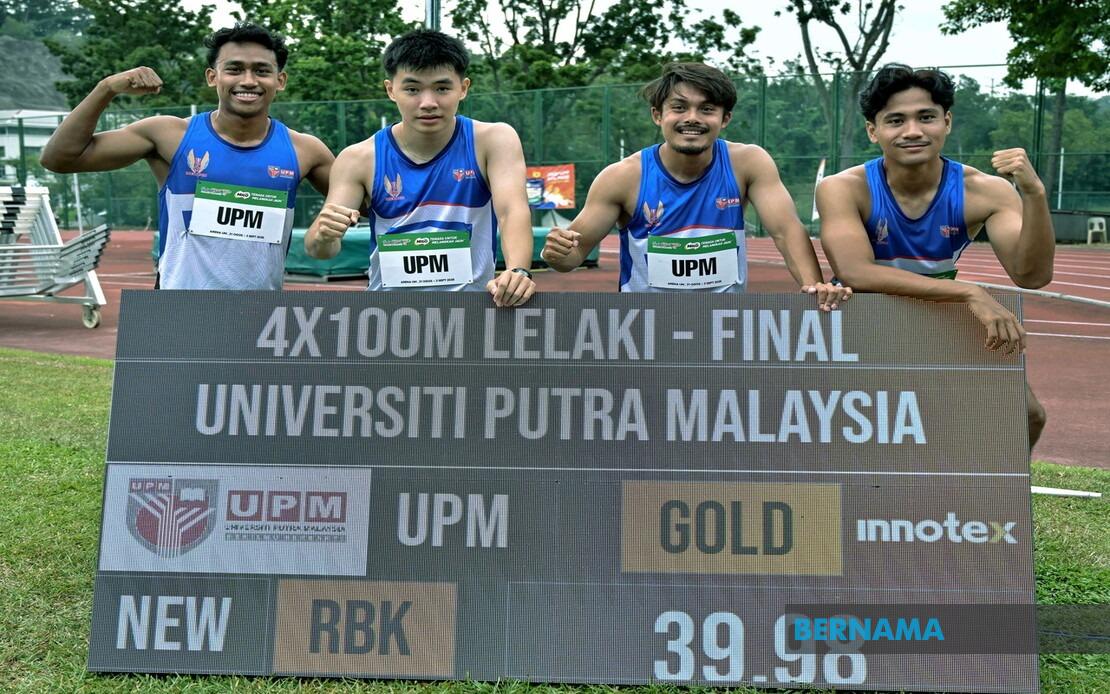
Universiti Putra Malaysia's men's 4x100-meter relay team claimed gold at the 2026 Higher Education Institutions Sports Games (SUKIPT) with a groundbreaking performance, clocking 39.98 seconds at UM Arena in Kuala Lumpur. The time not only secured the gold medal but also rewrote the games record, erasing the previous benchmark of 40.98 seconds that had stood since earlier iterations of the championship.
The achievement carries deeper significance for the institution's athletics programme. The quartet's success demonstrates that UPM's transition strategy—moving from established stars to developing emerging talent—is yielding tangible results on the track. This generational shift has been carefully orchestrated, with senior runners guiding younger athletes through the demanding competitive landscape while preparing them for future leadership roles within the university's athletics structure.
Aliff Iman Mohd Fahimi, competing in his final SUKIPT appearance, anchored the predominantly junior lineup with considerable responsibility. The veteran sprinter recognised that his role extended beyond personal performance; he was essentially custodian of UPM's sprinting legacy, ensuring that the institutional knowledge accumulated by previous champions like Jonathan Nyepa and Zulfiqar Ismail would transfer smoothly to his younger teammates. His contribution transcended the 40-second barrier—it represented a conscious mentorship of the next competitive generation.
For Aliff Iman, the victory carried personal redemptive value. He had endured a six-month enforced absence from competition due to injury, a significant setback for any elite athlete. His return to action, marked symbolically by wristbands bearing 'Papa' and 'Mama', represented both a physical comeback and a reaffirmation of his commitment to UPM athletics. Making his final championship appearance count with a record-breaking performance offered a poignant conclusion to his university career.
The composition of the relay team itself merits examination. All three junior runners were experiencing SUKIPT competition for the first time, a remarkable circumstance that underscores both the depth of UPM's sprinting talent pool and the calculated risk the coaching staff took in fielding such an inexperienced quartet. Typically, such inexperience might invite caution and conservative target-setting. Instead, the team embraced ambition, establishing ambitious performance targets grounded in each member's individual achievements.
Aliff Iman's confidence in his teammates stemmed from concrete data. Each junior runner had demonstrated individual sprint times hovering around 10.4 to 10.5 seconds—respectable figures that, when aggregated across four legs, theoretically made sub-40-second performances achievable. This mathematical approach to relay strategy reflects modern athletics coaching methodology, where individual performance metrics inform collective targets rather than relying solely on tradition or precedent.
Reeve Kua's contribution to the record-breaking performance gained additional resonance given the circumstances of his participation. Competing while recovering from a severe fever represented a considerable physical challenge, yet he managed to execute his leg effectively. Kua's willingness to push through illness, coupled with practical measures like paracetamol and adequate rest, demonstrated the psychological resilience required at this competitive level. His performance suggested that even sub-optimal physical conditions need not derail elite execution when mental fortitude remains intact.
The relay's anchor leg, executed by Ahmad Amir Aiman Mohd Kamaruddin, benefited from seamless handovers and accumulating momentum built by his predecessors. The anchor position in sprint relays demands not only raw speed but also psychological composure—the ability to execute flawlessly when previous teammates have already invested their maximum effort. The smooth baton exchanges evident in the final time suggest excellent technical preparation across all transition zones.
Competition for the medals remained robust. Universiti Pendidikan Sultan Idris (UPSI) secured the silver medal with 40.16 seconds, powered by national-level runner Danish Iftikhar Muhammad Roslee. The narrow 0.18-second margin separating gold and silver indicates that Malaysian university-level sprinting maintains highly competitive standards, with multiple institutions capable of sub-40 second performances. This depth of talent benefits Malaysian athletics more broadly, creating a robust pathway for developing elite sprinters who can eventually compete at national and international level.
The Malaysian Polytechnics team rounded out the podium with a bronze-medal time of 41.75 seconds, still representing solid performance within the higher education athletics circuit. The three-medal distribution across different institution types—university, teacher-training university, and polytechnic—reflects the breadth of athletic development across Malaysia's tertiary education system.
For Southeast Asian university athletics more broadly, UPM's record carries implications. The region's higher education sports landscape has increasingly emphasised identifying young talent early and nurturing development through structured competitive pathways. UPM's success in breaking the games record with a predominantly first-time championship team suggests that well-designed talent development systems can accelerate athlete maturation rates, potentially shortening the timeline between identification and elite performance.
The psychological dimension of this achievement warrants consideration. New athletes often experience SUKIPT's championship environment with considerable apprehension, potentially hindering performance. By assembling an entirely junior quartet yet achieving record-breaking results, UPM may have inadvertently established a competitive template that reduces psychological barriers for young competitors, demonstrating that experience accrues rapidly when athletes compete alongside confident senior leaders.
Looking forward, the record represents both culmination and beginning. It marks the successful completion of Aliff Iman's university athletics career while simultaneously launching three junior sprinters onto competitive trajectories that could span multiple years at SUKIPT. Should these athletes continue developing at comparable rates, Malaysian university athletics may see sustained excellence in relay competition for years ahead, contributing meaningfully to the nation's broader athletic competitiveness in Southeast Asia.

