Alexandra Eala's stunning victory over Iga Swiatek at Wimbledon this past Saturday marks a watershed moment not just for the 21-year-old Filipina's burgeoning career, but for the broader landscape of professional tennis in Southeast Asia. The 29th seed's progression to the last 16 of the prestigious Grand Slam tournament represents a breakthrough moment that carries significance far beyond the manicured grass courts of SW19. Speaking in her post-match press conference, Eala articulated a vision that extends well beyond her own sporting achievements, expressing a determination to use her newfound platform as a catalyst for inspiring young Filipinos to pursue their own ambitious paths, whether in tennis or elsewhere.
Eala's emergence on the international women's tennis circuit has already begun reshaping perceptions about Philippine representation in elite sports. For decades, the Philippines has looked to boxing as its primary conduit for global sporting recognition, with Manny Pacquiao's legendary career establishing a template for what Filipino athletic success could resemble on the world stage. Yet Eala represents something distinctly different—a figure who has ascended through the highly technical and fiercely competitive realm of professional tennis, a sport that has historically seen limited Philippine participation at the elite level. The crowds that have begun following Eala at major tournaments underscore the hunger among Filipino sports enthusiasts for new champions capable of commanding attention on tennis's grandest stages.
What distinguishes Eala's approach to her newfound celebrity is her explicit resistance to becoming a mere template for imitation. During her post-match remarks, she articulated a philosophy centred on authenticity and individualism rather than replication. She emphasised that her ultimate aspiration is not to become the standard against which future Filipino athletes measure themselves, but rather to demonstrate through her own example that forging one's distinct path remains possible. This message carries particular resonance across Southeast Asia, where young athletes often face intense pressure to conform to established models of success. Eala's insistence on authenticity as a cornerstone value suggests a more nuanced understanding of athletic mentorship—one predicated on inspiration rather than imitation.
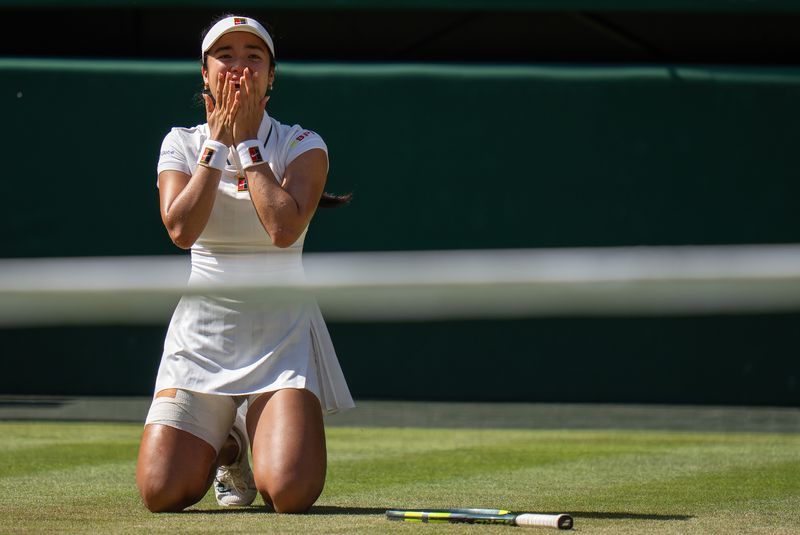
The emotional landscape surrounding Eala's Wimbledon breakthrough has itself become part of her compelling narrative. Photographs of her dropping to the ground in tears immediately following her victory over Swiatek captured a raw, unguarded moment that resonated powerfully with audiences watching her journey unfold. Yet Eala demonstrated remarkable mental discipline in managing those emotions, acknowledging their significance while simultaneously beginning to reorient her focus toward the upcoming challenge posed by Jasmine Paolini, the 2024 Wimbledon runner-up. This capacity to celebrate achievements authentically whilst simultaneously compartmentalising that celebration and refocusing on the next objective suggests an unusual maturity in how Eala processes competitive success.
Eala's characterisation of her emotional response—as something neither practiced nor trained, but rather emerging organically from her character—reflects a broader philosophy about athletic development that merits closer examination. She explicitly cautioned against interpreting her tears as indicative of satisfaction, a distinction that reveals sophisticated thinking about the relationship between emotional expression and competitive hunger. The framework she described involves allowing herself genuine moments of joy and reflection following victories, yet possessing what she termed a "skill of locking back in" that enables rapid psychological transitions from celebration to preparation. This psychological flexibility, she suggested, represents itself a trainable skill worthy of deliberate cultivation alongside the technical and physical dimensions of tennis performance.
The broader implications of Eala's breakthrough extend beyond her individual trajectory. Her advancement at Wimbledon occurs against a backdrop of growing investment in tennis development programmes across Southeast Asia, yet the region has historically struggled to produce players capable of consistently competing at the highest levels of the professional game. Eala's achievement on one of tennis's most prestigious stages demonstrates that such breakthrough performances remain attainable, potentially encouraging greater participation and investment in tennis infrastructure across the Philippines and neighbouring countries. The visibility she commands through her performances and media engagements creates a demonstration effect that extends far beyond her direct influence.
Eala's self-awareness regarding her role as a public figure who influences perceptions and aspirations among young Filipinos demonstrates maturity beyond her 21 years. She explicitly acknowledges that the platform her success has created carries corresponding responsibilities, noting how this exposure has facilitated her own self-reflection and personal development. The notion that increased visibility has become a catalyst for becoming her best self reveals how Eala has internalised the reciprocal nature of inspiration—that those who inspire others often discover dimensions of their own potential through that responsibility. This psychological framing transforms what might otherwise be experienced as burdensome pressure into something more generative and self-directed.
The structural position Eala now occupies within professional tennis remains precarious, despite her recent achievements. Her contest against Paolini in the next round pits her against an opponent with substantially more Grand Slam experience and recent success at the highest levels. The tournament itself has already provided Eala with unprecedented exposure and credibility, yet converting this breakthrough into sustained achievement will require continued development of her technical capabilities and tactical acumen. The question that now frames her Wimbledon campaign is whether this run can catalyse genuine progress in her overall ranking and competitive positioning, or whether it represents a notable but isolated achievement on an otherwise more pedestrian trajectory.
For Malaysian and broader Southeast Asian sporting audiences, Eala's trajectory warrants careful observation for several interconnected reasons. Her success challenges longstanding assumptions about the geography of professional tennis excellence, suggesting that elite performance need not emanate exclusively from traditional powerhouse nations or established tennis infrastructure. The Philippines, like Malaysia, sits on the periphery of global tennis's traditional centres of gravity, yet Eala's achievements demonstrate that geographical remoteness from established tennis institutions need not preclude competitive excellence at the highest levels. Her approach to inspiration and mentorship—emphasising individualism over conformity—also offers valuable lessons for how Southeast Asian sports cultures might cultivate the next generation of international competitors.

