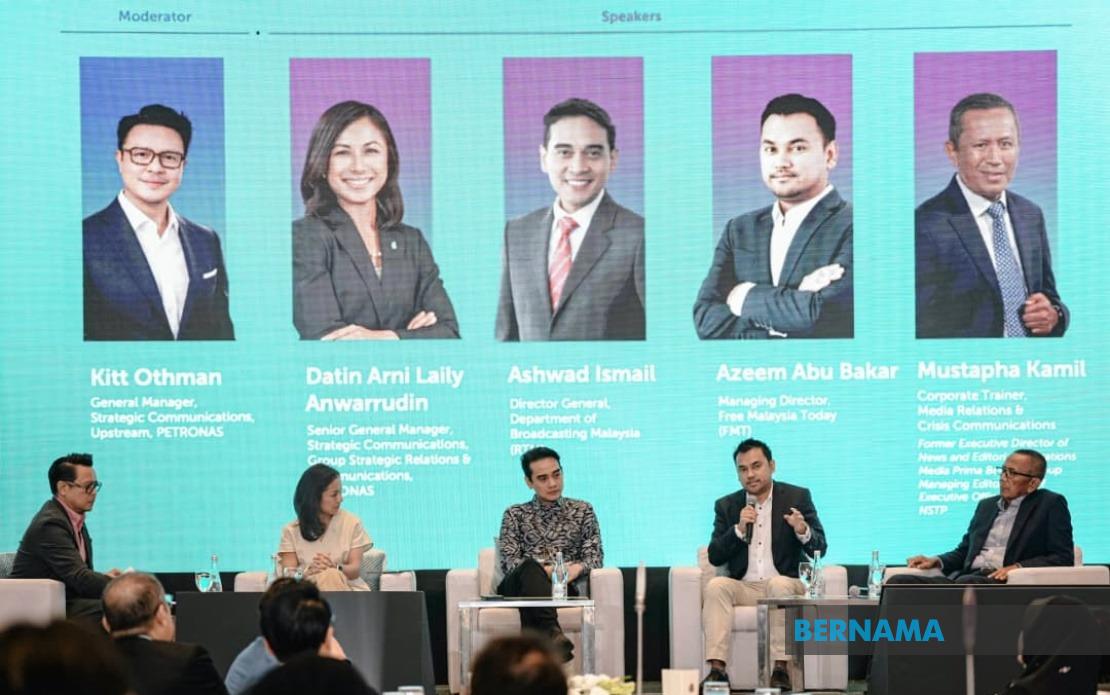
The accelerating pace of artificial intelligence deployment and the instantaneous spread of digital information are compelling Malaysian corporations and newsrooms to fundamentally restructure how they communicate during crises and maintain public trust, senior executives warned at a forum organised by PETRONAS and the Malaysian Press Institute in Kuala Lumpur this week. The traditional playbook for managing reputational threats has become largely irrelevant in an environment where falsehoods and unverified claims can circle the globe before verification is even possible, creating unprecedented challenges for organisations seeking to control their brand narratives.
Datin Arni Laily Anwarrudin, Senior General Manager of Strategic Communications at PETRONAS, highlighted how the velocity of AI-driven information dissemination now poses an existential threat to corporate reputation management. Rather than passively defending against misinformation after it surfaces, she argued that organisations must adopt a proactive stance by authoring and owning their own narratives from the outset. The principle underlying this shift is straightforward: if a company fails to actively communicate its position, version of events, or perspective on emerging issues, external parties—whether malicious actors, competitors, or simply vocal critics—will readily fill that vacuum with their own interpretations, regardless of accuracy.
"The age of AI kind of forces us as an organisation to be a lot more transparent, because otherwise someone else will fill that space. And the question then comes in, do we want someone else to tell that story?" Anwarrudin posed during the PETRONAS Lunch Escape 2026 programme, which brought together media editors, news directors, and communications strategists to examine how credibility functions in an AI-saturated landscape. Her framing rejects the notion that transparency is merely an ethical imperative; rather, it becomes a strategic necessity in a world where silence and opacity are interpreted as admission of guilt or incompetence.
The obsolescence of conventional crisis response timelines emerged as a recurrent theme throughout the discussion. Mustapha Kamil Mohd Janor, former executive director of news and editorial operations at Media Prima Berhad and NSTP Group managing editor, emphasised that the historical 16-hour window—the approximate time between when a corporate crisis erupts and when newspapers go to print—no longer exists as a practical buffer. In today's environment, news breaks, spreads, and metastasises across social media platforms in minutes, creating intense pressure on organisations to respond almost instantaneously. Yet hasty reactions without proper fact-checking frequently compound initial damage rather than mitigating it.
Anwarrudin underscored the tension that now defines crisis communications: how can organisations move quickly enough to address emerging threats while simultaneously taking the time to verify information and confirm their actual operational status? The answer, she suggested, lies not in abandoning deliberation but in restructuring internal processes to allow parallel workflows where communication teams can prepare holding statements and verified information simultaneously, rather than forcing a false choice between speed and accuracy. Organisations without dedicated, pre-trained crisis communication structures will find themselves catastrophically disadvantaged, Mustapha Kamil warned, suggesting that this represents an opportune moment for Malaysian companies to establish or upgrade such functions.
Among the panellists were Ashwad Ismail, director-general of Radio Televisyen Malaysia; Azeem Abu Bakar, Managing Director of Free Malaysia Today; and representatives from BERNAMA including Chief Executive Officer Datin Paduka Nur-ul Afida Kamaludin and Editor-In-Chief Arul Rajoo Durar Raj. The composition of the panel reflected recognition that addressing credibility challenges in the AI era requires alignment between corporate communications professionals, government broadcasters, independent news outlets, and the national news agency. The convergence of these typically distinct sectors around a common problem suggests the scale and urgency executives perceive.
Despite the seismic technological shifts reshaping information ecosystems, Mustapha Kamil insisted that journalism's fundamental role remains unchanged. News organisations function as searchlights illuminating particular areas of social reality and guiding collective understanding toward informed decision-making. The metaphor proves particularly apt in an AI context: as algorithmic content curation increasingly fragments public attention into isolated information bubbles, professional journalists who maintain editorial standards and broader contextual awareness become more valuable rather than less. The threat is not journalism itself but rather the wholesale replacement of curated, edited, verified information streams with algorithmic aggregation of viral content.
Azeem Abu Bakar articulated a vision of how human journalists and AI might productively coexist rather than compete. He proposed that while machines could increasingly handle routine operational tasks—data processing, basic transcription, preliminary research organisation—news organisations must invest in cultivating what he termed "SUPER journalists." This acronym encompasses sources (the ability to cultivate and maintain confidential relationships with insider sources), understanding (deep contextual knowledge of beats and complex issues), pattern recognition (connecting apparently disparate pieces of information into coherent narratives), efficiency (producing quality work at necessary speed), and reputation (maintaining credibility and audience trust). None of these dimensions can be outsourced to algorithms; they are quintessentially human skills that technology can augment but not replace.
For Malaysian organisations grappling with these challenges, the implications are profound. The country's media landscape already exhibits concerning fragmentation, with state-linked outlets, independent news organisations, and digital-native platforms offering starkly different editorial approaches and reliability standards. In this environment, corporate organisations have even greater incentive to establish direct communication channels and maintain transparent information-sharing practices. The convergence of AI-driven misinformation risks, instant digital amplification, and a heterogeneous media landscape means Malaysian companies face a higher credibility threshold than their counterparts in more consolidated media markets.
Moreover, the transition to AI-era crisis communications has implications extending beyond individual corporate interests. When organisations fail to communicate proactively, when verified information loses competitive advantage to sensational falsehoods, when public understanding becomes fragmented across incompatible information ecosystems, the entire foundation of informed democratic and economic decision-making erodes. The forum's emphasis on transparency, speed balanced with verification, and cultivated expertise reflects an implicit recognition that maintaining credibility in the AI age requires institutional commitment transcending narrow organisational self-interest. Whether Malaysian corporations and media organisations will rise to this challenge remains an open question.

