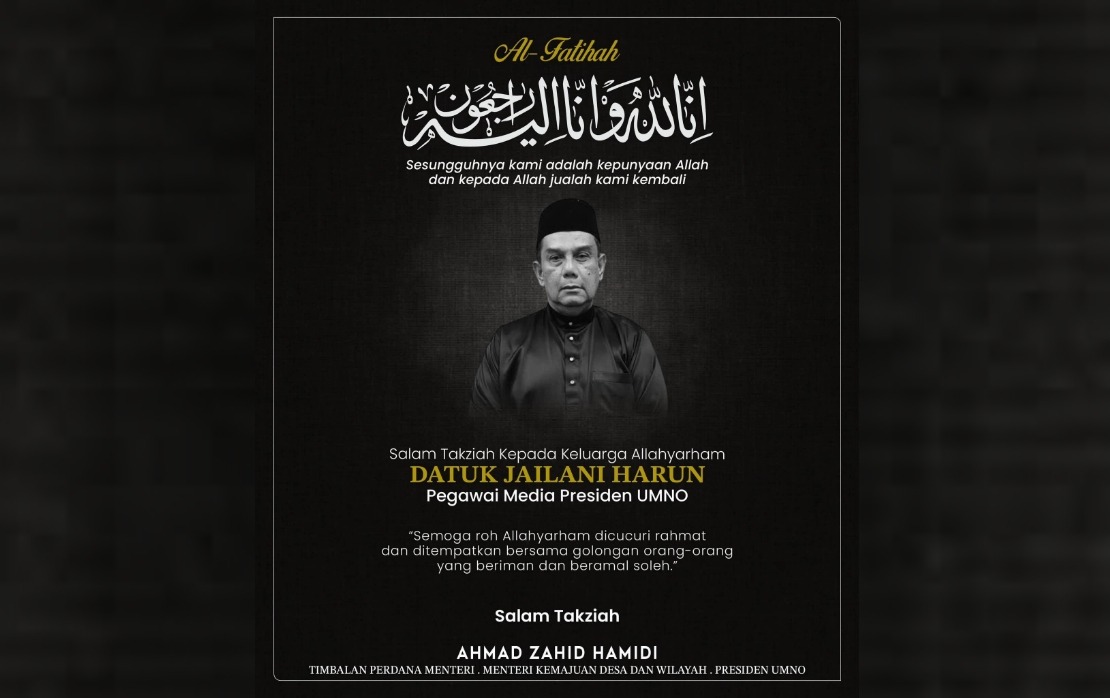
Deputy Prime Minister Datuk Seri Dr Ahmad Zahid Hamidi has conveyed his deepest condolences following the death of Datuk Jailani Harun, a prominent journalist and longtime media officer attached to the office of UMNO's president. The passing of the 66-year-old veteran communicator on July 7 marks the loss of a figure long recognised within Malaysia's political and media circles for his distinguished career spanning decades of service to the ruling party.
Ahmad Zahid, in his capacity as UMNO president, shared his personal grief through a Facebook statement, recounting that he had visited Jailani at Serdang Hospital earlier that morning. The Deputy Prime Minister's account painted a poignant picture of his final moments with the ailing media officer, describing an encounter that left him emotionally shaken despite hoping for recovery. His remarks underscored not merely an institutional loss but a personal one, reflecting the bonds formed through years of working together within UMNO's upper echelons.
The UMNO leader characterised Jailani as possessing qualities that had earned him widespread respect across political and journalistic circles—describing him as kind-hearted, unpretentious, and deeply valued by those who knew him. Such tributes from senior figures typically speak to the manner in which a person conducted themselves professionally and personally, suggesting Jailani had navigated the often-contentious intersection of politics and media with integrity. In Malaysia's political landscape, where media relations carry significant weight, individuals who maintain credibility across different constituencies are particularly noteworthy.
Ahmad Zahid's invocation of Islamic teachings in his condolence message reflected customary practice among Muslim leaders in Malaysia when acknowledging loss. He prayed that Allah would grant forgiveness to Jailani's soul, shower divine mercy upon him, and grant him a place among the righteous and faithful. Such sentiments, while routine in Malaysia's Muslim-majority society, carry particular weight when expressed by senior government figures and serve to provide spiritual comfort to bereaved families navigating their grief.
The passing occurred at 11:34 am at Serdang Hospital, a major medical facility in the Klang Valley serving both routine and critical cases. Details surrounding the circumstances of his illness were not disclosed in the official statement, though his hospitalisation clearly represented a serious health matter. For a figure of Jailani's prominence, such hospitalisation would have been a matter of concern within UMNO circles and among his extensive network of colleagues throughout Malaysia's media and political establishment.
Final rites were to be conducted according to Islamic protocol, with burial scheduled at Alam Damai Muslim cemetery in Cheras following afternoon prayers. This location, serving as a resting place for many prominent Malaysians, underscores Jailani's standing within the community. The timing of funeral arrangements—scheduled immediately after asar prayers—reflects traditional Muslim funeral practices in Malaysia, where deceased individuals are typically buried on the same day or within 24 hours of death.
Jailani's career as a journalist and media professional placed him at the intersection of two powerful institutions in Malaysian society. His role as media officer at the UMNO president's office meant he functioned as a crucial liaison between the party's senior leadership and the broader media landscape. Such positions require not only communication skills but also political acumen and the ability to maintain confidentiality while managing narratives during sensitive periods. His longevity in such roles suggests he navigated these complexities with competence.
The loss of experienced media professionals like Jailani carries implications for institutional memory and continuity within political organisations. Such individuals accumulate deep knowledge of historical contexts, personalities, and the mechanics of political communication that cannot easily be replicated. Their departure represents a genuine loss to the organisations they served, particularly during transitional or challenging periods when institutional knowledge becomes especially valuable.
For UMNO, Jailani's passing comes as the party continues navigating significant political changes and challenges in the Malaysian political landscape. The death of senior figures—particularly those with long service records—often prompts broader reflection within organisations about succession planning and the preservation of institutional wisdom. Jailani's career spanned multiple eras of UMNO leadership, meaning he possessed perspectives that connected the party's contemporary challenges to its historical experiences.
The public expression of grief by Ahmad Zahid, one of UMNO's most prominent contemporary figures, also reflects the continued importance of acknowledging the contributions of those who have served behind the scenes. Media officers and communications professionals rarely achieve the public prominence of elected officials, yet their work proves foundational to how political organisations communicate with citizens and shape public perception. Jailani's recognition through such high-level tributes acknowledges this often-underappreciated dimension of political work.
Within Malaysia's broader media community, Jailani's death would likely be noted as the passing of someone who had bridged journalism and political service—a path that requires careful management of professional ethics and loyalty to institutions. Those who have worked in similar capacities understand the balancing act required to maintain credibility across multiple constituencies while serving political masters.

