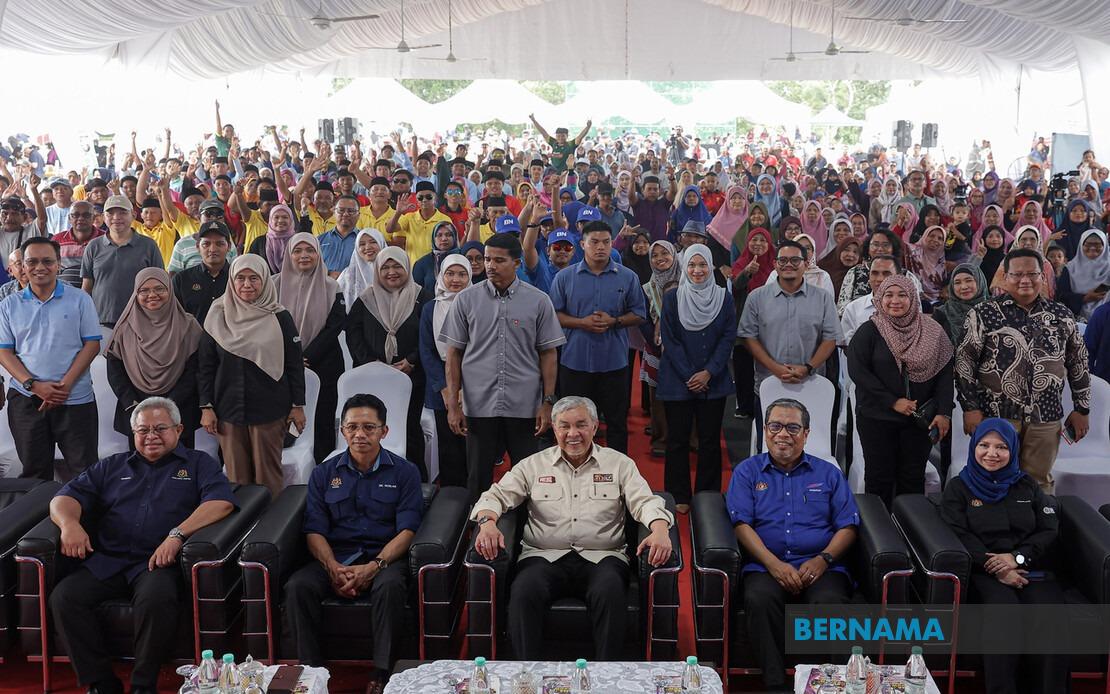
Malaysia's fractured political landscape is pushing the major coalitions to rethink their approach to state and national contests, according to Barisan Nasional chairman Datuk Seri Dr Ahmad Zahid Hamidi. Speaking at a programme in Jempol, Ahmad Zahid emphasized that the rapid evolution of Malaysian politics necessitates fresh tactical calculations and partnership frameworks if the nation is to maintain political equilibrium. The remarks signal growing recognition among establishment figures that rigid, historical bloc politics may no longer serve their interests as effectively as more flexible, pragmatic arrangements.
The catalyst for this strategic reassessment is a limited understanding between BN and Perikatan Nasional regarding the upcoming 16th Negeri Sembilan state election. Rather than positioning themselves as direct rivals across all contested seats, the two coalitions have agreed to avoid overlapping nominations in certain constituencies, reducing the prospect of vote fragmentation that would benefit their opponents. Ahmad Zahid described this arrangement as a test case—a proof-of-concept exercise—that could inform whether similar cooperative frameworks should be extended to the forthcoming Melaka state election and, more significantly, to the 16th General Election.
Crucially, Ahmad Zahid sought to downplay the significance of this understanding by clarifying that it does not constitute a formal merger or binding political alliance. Instead, he portrayed it as a practical, seat-sharing convention designed to prevent internal competition that dilutes support for their respective vote banks. This linguistic distinction matters considerably in Malaysian politics, where coalition politics carry specific constitutional and institutional meanings, and where partners jealously guard their autonomy and bargaining leverage. The BN chairman's framing suggests that both coalitions wish to reap the tactical benefits of coordination without assuming the political risks associated with formal partnership.
The Negeri Sembilan arrangement emerges from the intense competitive pressure facing both BN and PN in an era when no single coalition commands overwhelming electoral dominance. Since the 2018 General Election, Malaysian politics has been characterized by coalition fragmentation, shifting alliances, and volatile electoral behaviour. Both BN and PN have experienced phases of ascendancy and decline, while smaller parties have gained disproportionate kingmaker leverage. In such an environment, cooperating to prevent mutual vote-splitting becomes strategically rational, even for organizations that may harbor deeper ideological or organizational differences.
For Negeri Sembilan specifically, the state contest carries particular importance because the state has demonstrated unpredictable voting patterns in recent years. The electoral arrangement allows both BN and PN to contest from positions of relative strength without fragmenting their support bases through three-way or four-way contests that would inevitably disadvantage them. Early voting for the election is scheduled for July 28, with the main polling day set for August 1, providing a relatively short window for the two coalitions to operationalize their understanding and mobilize their respective supporters.
The implications of this approach extend well beyond Negeri Sembilan's boundaries. A successful outcome in the state election would provide Ahmad Zahid and PN leadership with tangible evidence that pragmatic, limited-scope cooperation can deliver electoral advantages without requiring deeper institutional integration. This would substantially increase the likelihood of similar arrangements being negotiated for the Melaka state election and, more critically, for the 16th General Election. Such expansion would represent a fundamental reshaping of Malaysian electoral competition, moving it away from clearly defined, nationally coherent coalition blocs toward a more fluid, state-by-state or even region-by-region approach to partnership.
For Malaysian voters and political observers, this shift carries both positive and complicating dimensions. On one hand, pragmatic seat-sharing arrangements can reduce unnecessary vote fragmentation and ensure that electoral outcomes more closely reflect genuine voter preferences rather than the accidents of nomination strategies. On the other hand, such fluid alignments may complicate voters' ability to understand coalitions' policy platforms and long-term governance intentions. Voters casting ballots in Negeri Sembilan, Melaka, or the general election will need to navigate more complex political mathematics than previous elections presented.
The broader context for Ahmad Zahid's comments reflects deeper anxieties within establishment circles about BN's electoral trajectory. Having governed Malaysia continuously from 1957 to 2018, and again from 2021 onwards, BN has confronted a new political reality in which it must compete aggressively rather than assume electoral inevitability. PN's emergence as a serious contender—particularly following its capture of several states in 2018 and its federal government role between 2020 and 2021—has created a genuinely competitive two-coalition environment. Neither force commands the resources or goodwill to ignore the other, lending credibility to Ahmad Zahid's suggestion that new alignments are essential.
The reference to GE16 underscores that Ahmad Zahid and BN strategists are already conducting long-term calculations about the next general election, which must occur by mid-2026. The Negeri Sembilan and Melaka contests function as laboratories for testing coalition mechanics and assessing voter responsiveness to different partnership configurations. Should these state elections demonstrate that BN-PN cooperation enhances electoral success, the framework would very likely be extended nationally, potentially reshaping the entire competitive landscape for the 2026 general election.
Regionally, Malaysia's evolving coalition dynamics may interest observers in neighbouring Southeast Asian democracies grappling with their own questions about how to build stable governing majorities in increasingly fragmented electoral landscapes. The BN-PN understanding represents an attempt to balance electoral competitiveness with political stability—a challenge that transcends Malaysia's borders. How successfully Ahmad Zahid and other leaders manage this balance will influence not only Malaysia's political trajectory but also broader regional trends in managing pluralism and coalition governance.

