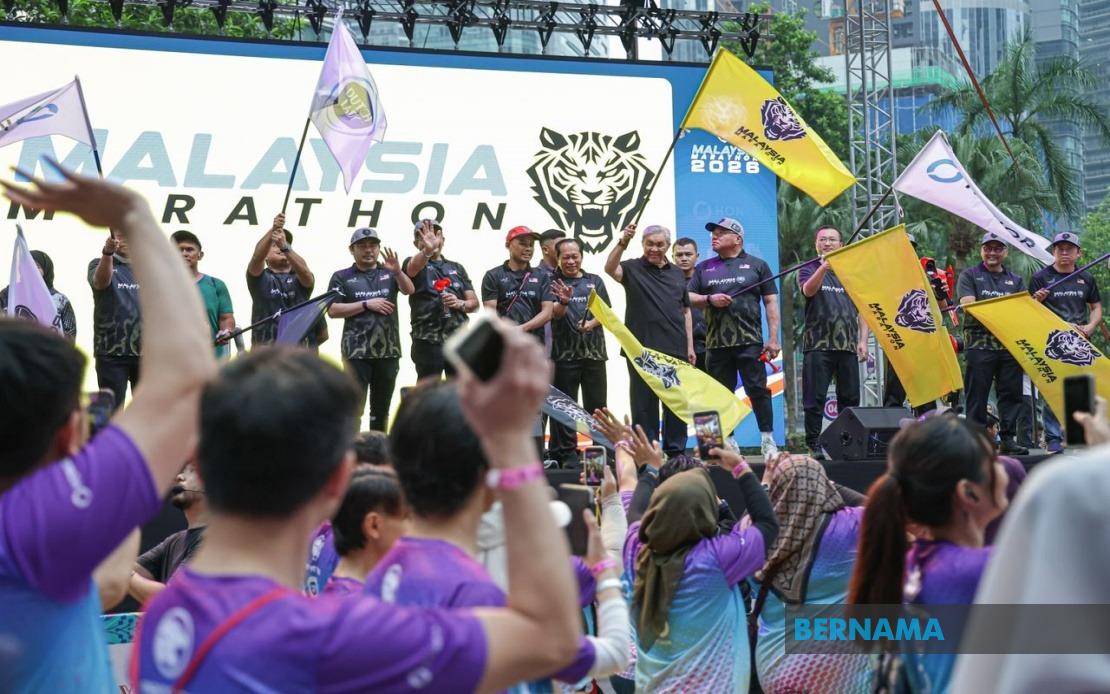
Deputy Prime Minister Datuk Seri Dr Ahmad Zahid Hamidi officiated the commencement of Malaysia Marathon 2026 on Friday, sending off 10,000 participants onto the 5-kilometre fun run course that wound through the grounds of Kuala Lumpur City Centre. The staging of this inaugural mass running event represents an ambitious attempt to position Malaysia as a serious destination for international athletics tourism whilst simultaneously leveraging the occasion to mark the nation's forthcoming 2026 National Day celebrations with a major public sporting spectacle.
The programme unfolded across the sprawling KLCC grounds, a venue chosen to accommodate the exceptionally large participant numbers and provide a dynamic urban backdrop befitting an event of national significance. The ceremonial opening incorporated traditional elements, beginning with the national anthem before members of the Malaysian Armed Forces band performed to energise the assembled crowds. This deliberate threading of patriotic symbolism throughout the proceedings underscored the government's intent to frame the marathon not merely as a fitness initiative but as a unifying national endeavour timed to coincide with independence commemorations.
Several senior government figures lent their official backing to the occasion. Tourism, Arts and Culture Minister Datuk Seri Tiong King Sing and Deputy Works Minister Datuk Seri Ahmad Maslan both attended, their presence reflecting the government's multi-agency coordination behind the initiative. Tiong had earlier in the morning overseen the flag-off for the full marathon category, releasing 2,000 runners onto the demanding 42-kilometre course from the departure point at Pavilion Kuala Lumpur. This staggered start arrangement, with different race distances commencing from separate locations before converging at the KLCC finish line, required substantial logistical coordination across the capital.
The 2026 edition attracted participation numbers far exceeding typical local marathon figures, with organisers recording a combined entry of 25,000 competitors spanning both domestic and international segments. The event structure offered four distinct racing categories to accommodate varying fitness levels: the flagship 42-kilometre full marathon, the half-marathon distance of 21 kilometres, a 10-kilometre option, and the 5-kilometre fun run. The distribution of participants across these categories—2,000 in the full marathon, 8,000 in the half-marathon, 5,000 in the 10-kilometre race, and the 10,000 in the fun run—reveals deliberate structuring to maximise participation breadth rather than concentrate effort on elite-level competition alone.
World Athletics, the international governing body for track and field sports, has conferred official recognition upon the Malaysia Marathon 2026. This endorsement carries practical significance, as it ensures the event meets internationally established standards for course measurement, timing systems, and athlete safety protocols. For Malaysian runners harbouring aspirations to compete internationally, the recognition provides assurance that personal bests recorded during the race will gain acceptance within the global athletics database, potentially opening doors to international competition opportunities. The recognition equally signals to overseas marathoners that Malaysia's event meets world-class professional standards.
A particularly memorable component of Friday's proceedings involved a one-kilometre parade featuring the Malaysian flag, mobilising 1,000 students drawn from Kolej Poly-tech MARA (KPTM) Bangi. This youth-centred element transformed a segment of the race route into a moving tableau celebrating national symbols, effectively converting athletic participation into a form of civic engagement. The deployment of polytechnic students rather than established athletes for this symbolic display reflects a deliberate emphasis on inclusivity and grassroots participation, messaging that the marathon belongs not to a sporting elite but to the broader Malaysian public.
The selection of KLCC as both the departure point for the 5-kilometre fun run and the universal finish line for all race categories marks a departure from historical practice. Traditionally, major running events in Kuala Lumpur have culminated at Dataran Merdeka, the city's symbolic civic heart. The shift to KLCC, one of the capital's most recognisable architectural and commercial landmarks, reflects both the venue's superior infrastructure capacity and a reorientation of the city's perception of itself as a modern, internationally-oriented metropolis. KLCC's presence as backdrop and host venue significantly elevates the event's visibility within Malaysia's commercial and international business communities.
For Malaysian readers, the marathon's timing carries particular resonance. The alignment with 2026 National Day celebrations positions physical activity and mass participation as expressions of national pride and cohesion. At a time when Malaysia continues navigating complex political and social dynamics, large-scale public events that transcend such divisions through the universal language of sport offer valuable moments of collective national identity. The enthusiastic turnout and official high-level endorsement suggest receptiveness within Malaysian society to organised mass-participation athletic events.
The international dimension of the 2026 entry represents another significant development. Tourism and cultural exchange benefits flow bidirectionally when overseas athletes travel to Malaysia to compete, exposing them to local hospitality, food, attractions, and culture. The event thus functions as a tourism promotion instrument at minimal direct cost to government, as visiting participants and their support networks require accommodation, meals, and local transportation during their Malaysian stay. For countries throughout Southeast Asia monitoring Malaysia's sports tourism initiatives, the marathon's success provides a competitive benchmark.
The logistical complexity of managing 25,000 runners across four simultaneous race categories whilst maintaining safety, crowd control, and spectator engagement in an urban setting like Kuala Lumpur demands substantial planning expertise and resources. The apparent seamless execution suggests that Malaysia's event management capabilities have matured considerably. Successfully replicating—or even exceeding—such numbers in future editions will require sustained investment in infrastructure, volunteer recruitment and training, and medical support systems positioned along the race routes.
Looking forward, the Malaysia Marathon 2026 is positioned as the inaugural edition of what government officials evidently envision as an ongoing fixture within Malaysia's annual events calendar. The World Athletics recognition and substantial international participation provide platforms for iteration and growth. Subsequent editions could potentially attract even larger overseas contingents should Malaysia's tourism marketing apparatus leverage this year's proven success. The event has effectively established a significant date within Southeast Asia's growing sports calendar, competing for participants and attention alongside established marathons in Singapore, Bangkok, and other regional hubs.
The Deputy Prime Minister's presence at the 5-kilometre fun run flag-off underscores the political weight attached to the event at the highest levels of government. Such high-profile officiation signals to both domestic and international audiences that Malaysia takes its sporting and tourism development seriously. As the nation approaches its 2026 National Day milestone, this marathon represents tangible evidence of forward-looking governance focused on building international engagement and celebrating national identity through inclusive, modern mechanisms.

