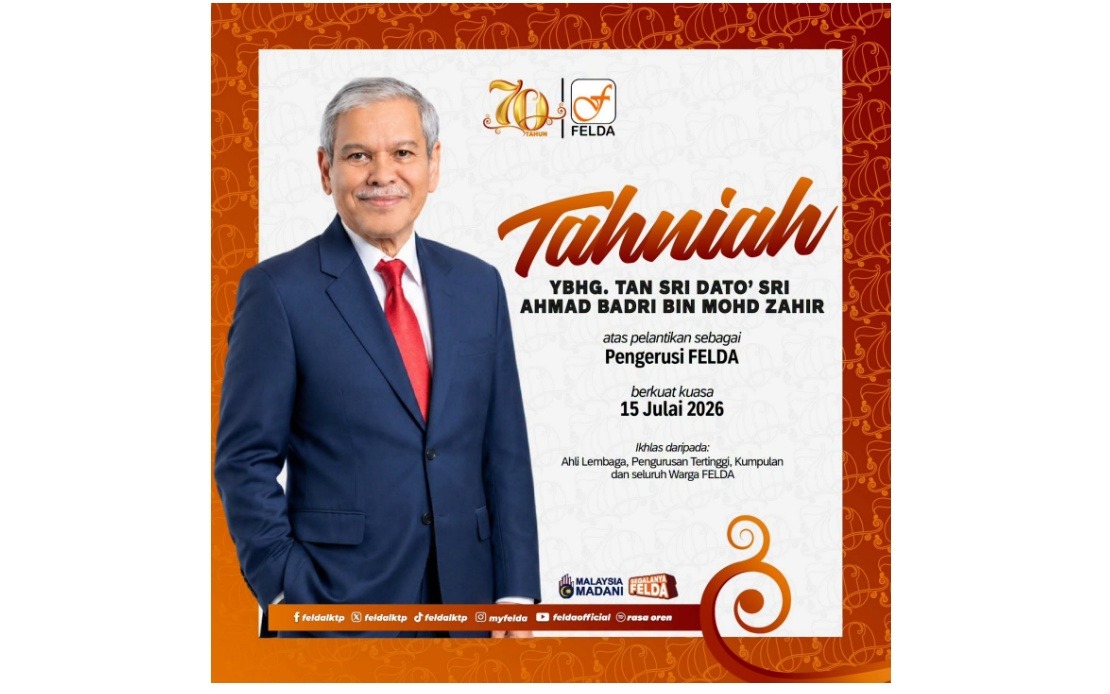
Tan Sri Ahmad Badri Mohd Zahir has been appointed as the new chairman of the Federal Land Development Authority (FELDA), marking a significant leadership transition at the organisation responsible for overseeing Malaysia's vast settler community. The appointment signals government confidence in his proven ability to navigate complex institutional challenges while maintaining focus on public interest objectives.
Ahmad Badri brings a career spanning more than three decades across Malaysia's public and private sectors, beginning with his 1989 appointment to the Ministry of Finance. His trajectory through the civil service demonstrates expertise in managing large-scale organisations and navigating the intersection of fiscal policy and strategic development. Most notably, he served as Treasury Secretary-General from 2018 to 2020, a position requiring navigation of the nation's financial operations during a volatile period of economic and political transition.
Beyond his government service, Ahmad Badri has accumulated extensive board experience across Malaysia's institutional landscape. He previously led the Employees Provident Fund, the country's largest retirement savings institution managing trillions in member contributions. His tenure there positioned him at the heart of discussions surrounding pension adequacy, investment strategy, and worker welfare—issues increasingly critical as Malaysia's population ages and retirement security becomes a pressing policy concern.
His network extends across Malaysia's financial and industrial infrastructure. Ahmad Badri has served on the boards of Bank Negara Malaysia, overseeing monetary policy implementation, Permodalan Nasional Berhad, managing state-linked strategic investments, and Tenaga Nasional Berhad, the national power utility. These positions collectively illustrate involvement in shaping Malaysia's economic architecture during a period of significant structural change and transition toward renewable energy.
Currently, Ahmad Badri chairs RHB Bank Bhd and the Malaysian Rubber Board while serving on Sime Darby's board. These roles place him at the intersection of financial services, agricultural commodity management, and diversified industrial operations—sectors vital to Malaysia's economic resilience and export competitiveness. His simultaneous management of multiple strategic portfolios demonstrates capacity for balancing competing institutional demands.
FELDA's appointment of Ahmad Badri addresses the organisation's need for leadership capable of managing transformation while preserving settler interests. The authority oversees development on approximately 1.2 million hectares of land affecting more than three million settlers and their families, constituting one of Malaysia's largest organised rural populations. The scale and complexity of managing this population's economic welfare, land rights, and development opportunities demands leaders with sophisticated understanding of both public administration and commercial operations.
Ahmad Badri's educational background reinforces his positioning for this role. His Master of Business Administration from the University of Hull provides international management perspective, while his estate management degree from Universiti Teknologi MARA grounds him in the land administration principles fundamental to FELDA's core operations. This combination of technical foundation and advanced business training suggests capacity to modernise FELDA's organisational practices while respecting the legal and social frameworks governing settler relationships.
FELDA faces substantial contemporary challenges requiring experienced leadership. The organisation must balance traditional settlement support functions with commercial imperatives, navigate commodity price volatility affecting settler incomes, and manage inherited infrastructure while adapting to evolving agricultural practices and environmental sustainability requirements. Ahmad Badri's experience managing large-scale organisations during periods of institutional transformation positions him to address these intersecting pressures.
The appointment also reflects broader shifts in Malaysia's approach to public institution leadership. Successive governments have increasingly sought leaders with demonstrated experience across both government and corporate environments, recognising that modern institutional challenges require facility with commercial discipline alongside public sector accountability frameworks. Ahmad Badri's career path exemplifies this pattern, having moved fluidly between treasury service and private sector board responsibilities.
For FELDA settlers, Ahmad Badri's appointment carries implications extending beyond ceremonial leadership change. His background suggests commitment to financial sustainability, operational efficiency, and professional governance standards. His track record at the EPF, managing worker interests within commercial constraints, suggests awareness that settler welfare and institutional viability need not exist in tension—that proper management can sustain both objectives simultaneously.
The timing of this appointment occurs as Malaysia reassesses the role of federal institutions in supporting rural communities amid structural economic transformation. FELDA represents one of the world's largest organised settlement schemes, and its performance carries implications for rural development approaches across Southeast Asia, where many nations attempt similar schemes balancing settler support with financial viability. Ahmad Badri's international exposure may inform fresh perspectives on FELDA's strategic positioning.
Ahmad Badri's leadership will likely emphasise governance strengthening and transparent management practices, consistent with stated appointment rationale. His background suggests inclination toward professional systems, accountable decision-making, and alignment with contemporary governance expectations. These emphases could enhance FELDA's institutional standing while building settler confidence in administration of their interests.
The coming months will clarify Ahmad Badri's specific priorities for FELDA's development trajectory. His challenge involves stewarding the authority through continued economic adjustment while safeguarding the welfare of millions of settlers whose livelihoods depend substantially on FELDA-administered land and resources. His appointment suggests the government believes his experience equips him for this multifaceted responsibility.

