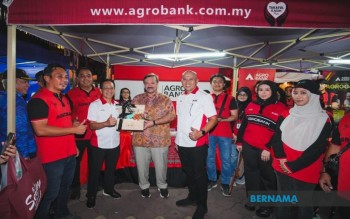
Agrobank has mobilized over RM8 million in financing applications by taking its services directly to small traders and hawkers through a series of community engagement sessions, reflecting growing demand for accessible capital among Malaysia's informal business sector. The development bank's on-the-ground initiative, which began in the Klang Valley, has now been extended to Sabah, marking a strategic pivot toward extending financial services beyond traditional urban banking channels to reach entrepreneurs operating in night markets and farmers' markets across the country.
The expansion into Sabah represents a significant geographic step for Agrobank's grassroots financing strategy. During sessions held at Api-Api Night Market on Jalan Gaya in Kota Kinabalu and Tamu Papar Farmers' Market, bank officers engaged directly with 153 and 95 traders respectively, discussing their specific financing requirements and business challenges. These locations were deliberately chosen because night markets and farmers' markets serve as vital economic nodes in their communities, generating employment and sustaining livelihoods for hundreds of individuals who might otherwise lack access to formal banking services.
The engagement sessions focused on identifying concrete financing needs tailored to the operational realities of street traders and small farmers. Working capital requirements emerged as a primary concern, with many traders seeking funds to replenish stock, upgrade equipment, or manage seasonal fluctuations in cash flow. Business expansion also featured prominently in discussions, indicating that despite operating in informal settings, many entrepreneurs harbor ambitions to scale their operations and formalize their practices.
Agrobank's approach reflects a departure from conventional banking, which often requires formal documentation and collateral that small traders cannot easily provide. By establishing a physical presence at trading venues during operating hours, the bank reduces barriers to access and creates opportunities for informal sector entrepreneurs to discuss their needs with knowledgeable officers who can explain available products and support mechanisms. This methodology acknowledges that financial inclusion requires more than simply offering products; it demands genuine engagement and understanding of how small businesses actually operate.
Finance Minister II, Datuk Seri Amir Hamzah Azizan's attendance at the Api-Api Night Market session underscores government commitment to addressing financial access disparities affecting Malaysia's informal economy. The presence of senior political figures at such events signals that supporting small traders remains a policy priority at the highest levels. This political backing provides legitimacy to Agrobank's initiative and may encourage other financial institutions to develop similar grassroots programs.
Agrobank Group president and chief executive officer, Datuk Tengku Ahmad Badli Shah Raja Hussin emphasized that each business community faces distinct challenges requiring localized understanding. The expansion to Sabah acknowledges that traders in Borneo operate within different economic, logistical, and supply chain environments compared to their counterparts in Peninsular Malaysia. What works as a financing solution in urban Klang Valley markets may need modification for agricultural communities or regional trading centers in Sabah. This nuanced approach contrasts with one-size-fits-all banking models that have historically underserved smaller entrepreneurs.
Beyond direct financing, Agrobank is positioning itself to provide complementary non-financial support services including business advisory assistance and training on sustainable business practices. This holistic approach recognizes that capital alone cannot transform struggling enterprises; entrepreneurs also require guidance on bookkeeping, marketing, regulatory compliance, and operational efficiency. By bundling financial and non-financial services, Agrobank aims to increase the likelihood that funded traders will successfully manage their loans and achieve genuine business growth.
The initiative aligns with Prime Minister Datuk Seri Anwar Ibrahim's directive requiring financial agencies to accelerate disbursement of RM5 billion designated for financing small traders. This broader government commitment demonstrates that financial inclusion has become central to Malaysia's economic strategy. However, reaching the RM5 billion target will require sustained effort from multiple institutions and a fundamental shift in how formal finance engages with the informal sector. Agrobank's experience suggests that direct community engagement, flexible product design, and supportive infrastructure can help achieve these ambitious goals.
The RM8 million in applications generated thus far, while substantial, represents just the beginning of what targeted outreach might achieve. Many traders still remain unaware of Agrobank's services or harbor skepticism about formal banking based on past negative experiences. Expanding these engagement sessions to additional night markets and farmers' markets across other states could unlock significant additional demand. Each successful loan disbursement creates a demonstration effect, encouraging neighboring traders to apply and participate in financial formalization.
For Malaysian small traders operating on thin margins in competitive environments, access to affordable, appropriately-structured financing can be transformative. Instead of relying on informal moneylenders charging exorbitant interest rates or family networks with limited capital, traders can access institutional finance to weather seasonal downturns, invest in productivity improvements, or diversify product offerings. This shift toward formal financial inclusion has implications extending beyond individual businesses to encompassing broader economic stability and poverty reduction.
The session outcomes also provide valuable data for policymakers and financial institutions regarding unmet financing demand in the informal sector. Understanding the types and volumes of applications generated in different communities can inform future policy design and resource allocation. If similar sessions in other markets produce comparable application levels, this suggests significant untapped demand for small business financing across Malaysia.
Agrobank's initiative demonstrates that financial institutions can effectively serve small traders by meeting them in their own spaces and understanding their operational contexts. Success will ultimately depend on translating applications into actual disbursements, ensuring that approved loans reach traders efficiently, and monitoring loan performance to refine products and services continuously. The RM8 million milestone represents progress, but sustained commitment to grassroots engagement and proven ability to convert interest into successful lending relationships will determine whether this model becomes transformative for Malaysia's informal business sector.

