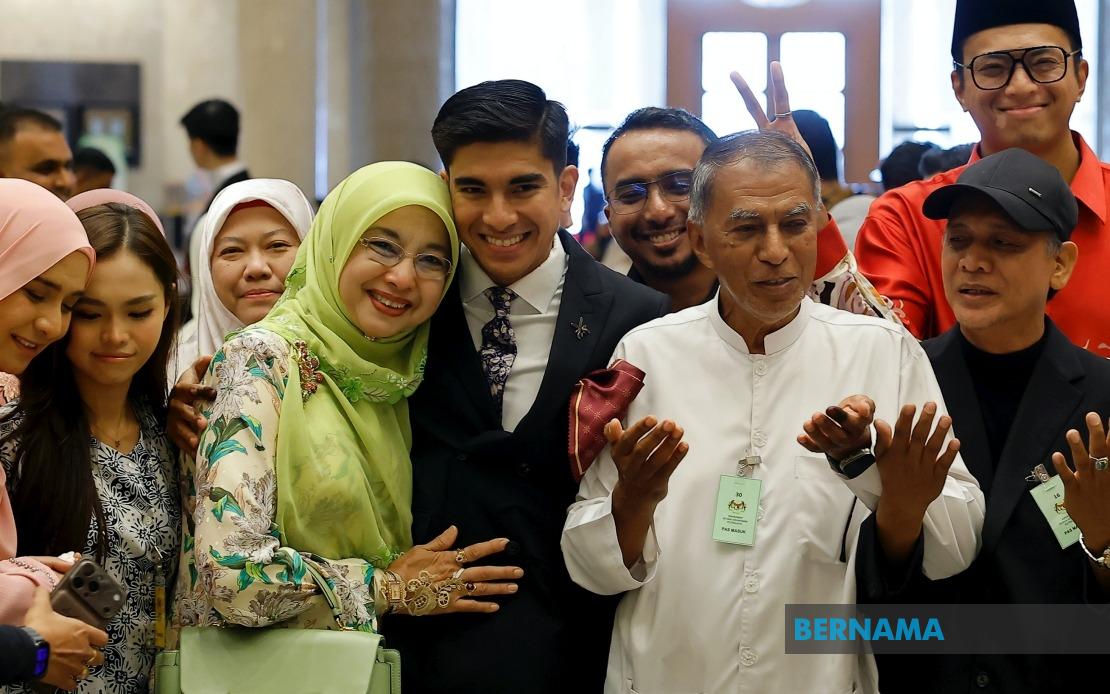
Malaysia's Federal Court has delivered a decisive victory for Muar Member of Parliament Syed Saddiq Syed Abdul Rahman, upholding his acquittal on all charges stemming from a case that has consumed the better part of a decade. The ruling brings to a close a protracted legal ordeal that saw the 33-year-old face four charges of abetting criminal breach of trust, misappropriation of property, and money laundering—all connected to funds belonging to Angkatan Bersatu Anak Muda (Armada), the youth wing of PKR.
The moment carried profound personal significance for Syed Saddiq and those closest to him. Upon hearing the court's judgment, the Muar MP performed a sujud syukur with his family at the Palace of Justice in Putrajaya, a gesture reflecting both gratitude and vindication. Speaking to reporters in the lobby, he emphasised that the protracted legal process, while emotionally and physically taxing, had ultimately reinforced his conviction that truth and justice would emerge triumphant within Malaysia's judicial system. For a political figure who has faced sustained scrutiny, the outcome represents both personal redemption and a broader statement about institutional integrity.
The six-year span of legal proceedings has left an indelible mark not only on Syed Saddiq himself but rippled through his immediate circle and the broader political ecosystem. His parents endured uncertainty alongside him, his supporters witnessed their member of parliament navigate dual demands of parliamentary duty and courtroom appearances, and the nation's political landscape absorbed the implications of a high-profile case involving alleged misappropriation of youth movement finances. The extended timeline—from the initial charges through multiple court hearings to this final Federal Court determination—meant that Syed Saddiq has carried this legal weight through significant periods of Malaysian political transition and reform discussions.
In his statement, Syed Saddiq articulated a philosophy forged through adversity. He stressed that courage derives not from external circumstances but from the conviction of being in the right, and that this fundamental principle guided him through six years of proceedings. More significantly, he used the occasion to advance a position regarding Malaysia's institutional architecture, explicitly linking the independence and integrity of the justice system to the nation's foundational strength. For Southeast Asian observers, such statements from acquitted politicians carry weight in assessing the region's democratic maturation and judicial independence.
The former youth and sports minister did not shy away from acknowledging the personal toll. He recognised that those who stood by him—family, friends, and political allies—had absorbed collateral damage from an extended legal process. Yet he framed this shared struggle as a clarifying experience. His message to others facing seemingly insurmountable odds was unambiguous: compromise of principles or integrity might offer short-term escape routes, but the path of principle, trust in God, and faith in institutional frameworks ultimately delivers vindication.
Looking forward, Syed Saddiq signalled a deliberate recalibration of his priorities. While emphasising his continued commitment to MUDA—the political party he helped establish—he indicated that questions about his immediate political trajectory would remain unresolved. The acquittal, he suggested, marks a threshold moment for personal restoration rather than immediate political acceleration. He plans to attend parliamentary sittings and organise gatherings for his Muar constituents, but has carved out space for family reconnection and the management of personal affairs that accumulated during six years of legal proceedings. Notably, he revealed that his parents have approved his wedding plans, suggesting that normalcy and life milestones delayed by legal uncertainty can finally resume.
The legal team representing Syed Saddiq expressed gratitude for the judicial panel's decision while acknowledging the substantial trust placed in them throughout the extended proceedings. Datuk Hisyam Teh Poh Teik, the defence counsel, highlighted the collaborative effort required to navigate such protracted litigation, underscoring that acquittals in high-profile political cases often involve meticulous legal strategy sustained over years of proceedings.
The prosecution's response conveyed formal acceptance of the court's authority while leaving the door slightly ajar regarding potential further action. Deputy Public Prosecutor Datuk Wan Shaharuddin Wan Ladin stated that while the prosecution respects the Federal Court's decision, the Attorney General has not yet determined whether to pursue a review. This measured posture suggests institutional deference to judicial finality while preserving theoretical procedural options, though the prosecution's hesitation to commit immediately to a particular course indicates recognition of the decision's authoritative weight.
For Malaysian observers and the Southeast Asian legal community, the case underscores the extended timelines characteristic of complex financial crime prosecutions. The arc from initial charges through multiple appellate levels to final Federal Court determination reflects both the seriousness with which Malaysian courts treat allegations involving public or semi-public funds and the procedural safeguards embedded within the system. That an acquitted defendant can be vindicated at the apex court, even after years of legal uncertainty, provides a counterpoint to persistent debates about judicial independence and the abuse of legal processes for political purposes.
The Armada funds case also illuminates broader questions about youth wing governance within Malaysian political parties, particularly regarding financial oversight and accountability mechanisms. That allegations involving youth movement finances reached the Federal Court level reflects the scale of sums involved and the institutional weight accorded to such matters, even as the ultimate judgment favoured the defence.
Syed Saddiq's emergence from this prolonged legal shadow carries implications for MUDA's trajectory and his own political future. At 33, with years of parliamentary experience and heightened public recognition through an ordeal that many would have found politically destructive, he enters a new phase with either fresh credibility or, conversely, with accumulated political capital that may be difficult to deploy if extended from public life. His stated desire to pause and recalibrate suggests awareness that the legal victory, while decisive, may not immediately translate into resumed political momentum.
The Federal Court's affirmation of acquittal constitutes a full stop to this chapter, yet its reverberations will extend through Malaysia's political calculations, PKR's internal dynamics, and broader national conversations about judicial fairness. For a nation earnestly engaged in discussions about institutional reform and democratic deepening, the case offers evidence that final appellate courts can deliver outcomes that vindicate individual rights even when political winds might push otherwise. Whether such demonstrations of judicial independence prove sufficiently robust to anchor public confidence in Malaysia's legal system amid ongoing scepticism about other institutional domains remains a question the nation continues to negotiate.

