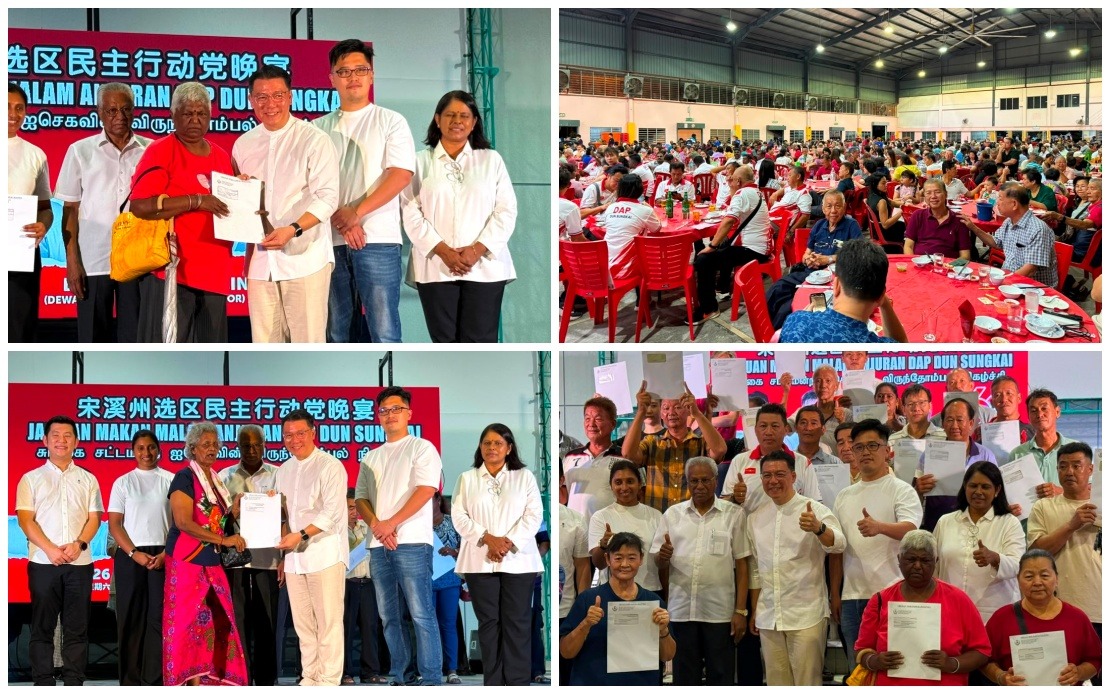
A protracted housing crisis affecting squatter communities in the Sungkai and Kuala Bikam areas has finally reached resolution, with 120 families receiving formal land grants this week. Housing and Local Government Minister Nga Kor Ming presented the documentation at an event marking the culmination of efforts spanning more than four decades to secure tenure rights for these vulnerable households. The distribution of land grants represents not merely a bureaucratic transaction but a watershed moment for families who have lived with legal uncertainty regarding their residential status for generations.
The minister framed the achievement within the broader narrative of the current administration's inclusivity agenda, asserting that the resolution demonstrated commitment to equitable development regardless of ethnicity or economic standing. Nga emphasised that the MADANI Government operates on the foundational principle that no segment of Malaysian society should experience marginalisation or exclusion from the nation's development trajectory. His remarks at the DAP Sungkai divisional dinner, attended by more than 1,200 community representatives, underscored the political significance of addressing longstanding grievances that had accumulated over decades of governmental inaction.
The successful land grant distribution involved sustained coordination between multiple government departments and state officials. Nga acknowledged the pivotal role of Sungkai assemblyman Datuk A. Sivanesan, who chairs the state Human Resources, Health, Indian Community Affairs and National Integration Committee, alongside unnamed civil servants whose administrative perseverance enabled the resolution. This interagency collaboration illustrates how persistent institutional effort can untangle complex property disputes that often become entrenched through bureaucratic layering and competing jurisdictional claims. The involvement of state-level officials proved instrumental in navigating the regulatory pathways necessary to convert informal settlements into formally recognised residential holdings.
Beyond this singular achievement, the minister positioned the land grant distribution within a constellation of initiatives targeting the Indian Malaysian community specifically. The government has earmarked RM20 million for improvements to Indian settlements nationwide, a figure suggesting recognition that housing insecurity disproportionately affects this demographic group. Complementing this allocation, RM50 million has been committed to Tamil vernacular schools, acknowledging educational disparities that often correlate with residential stability and socioeconomic circumstances. These investments reflect a deliberate policy pivot toward addressing structural inequities that have historically characterised development distribution patterns.
The Malaysian Indian Transformation Unit, commonly referred to as MITRA, has received substantial budgetary enhancement with allocations increasing to RM150 million. This institutional empowerment signals governmental intention to centralise efforts aimed at improving outcomes for Indian Malaysians across multiple policy domains beyond housing alone. The confluence of these funding mechanisms—land grants, educational investment, and institutional strengthening—suggests a coordinated approach rather than ad-hoc interventions. However, implementation fidelity will ultimately determine whether these allocations translate into tangible improvements for beneficiary communities.
Nga's remarks carried an implicit political dimension, urging citizens to evaluate governmental performance on empirical metrics rather than allowing perception or sentiment to distort assessment. His exhortation to distinguish between actual accomplishment and rhetorical framing speaks to an underlying concern that development narratives can be manipulated or obscured by competing political narratives. The minister's invocation of "destructive" versus "constructive" politics appears directed at opposition movements that the government perceives as employing divisive framing. This rhetorical manoeuvre—conflating performance-based governance with national unity—represents a common governmental strategy for neutralising criticism.
The Sungkai constituency itself carries particular significance within Perak's political landscape and broader Malaysian demographics. The presence of multiple elected representatives at the land grant ceremony, including Ipoh Timur MP Howard Lee Chuan How, Buntong assemblyman M. Thulsi, Malim Nawar assemblywoman V. Bavani, and Astaka assemblyman Jason Ng Thien Yong, underscores the multi-tiered political interest in consolidating support within this locale. The DAP's commemoration of its 60th anniversary through this event intertwines party history with contemporary governance achievements, strategically linking organisational continuity to tangible deliverables.
For the 120 families receiving land grants, the documentation provides legal certainty and establishes pathways toward property formalisation, mortgage eligibility, and intergenerational wealth accumulation. The four-decade delay in resolving these claims represents lost opportunity for economic advancement and compound disadvantage affecting educational and health outcomes. Securing land tenure removes a source of chronic stress and institutional precarity that had shadowed these households, though the grants themselves do not automatically resolve infrastructure deficits, service delivery inequities, or social marginalisation that frequently accompany informal settlements.
The resolution carries implications for similar unresolved squatter disputes elsewhere in Malaysia. Approximately 600,000 squatters nationwide inhabit informal settlements lacking formal tenure security, suggesting that this Sungkai case, while noteworthy, addresses only a small fraction of the broader challenge. The government's demonstrated capacity to resolve this 40-year dispute may prompt intensified petitioning from other affected communities seeking comparable intervention. Alternatively, if implementation proves inadequate or if promised supporting services fail to materialise, the symbolic value of the land grants could be undermined, potentially generating renewed frustration within beneficiary communities.
The event also reflects demographic and political shifts within Perak's Indian Malaysian population, which constitutes approximately 10 percent of the state's inhabitants but has experienced historical marginalisation in resource allocation and political representation. The substantial dinner attendance and ministerial engagement signal heightened governmental attention to this constituency, potentially responding to electoral dynamics or demographic shifts that have elevated community concerns on the political agenda. Whether this represents sustained institutional commitment or tactical political positioning will become evident through monitoring of ongoing implementation, budget execution, and follow-up service delivery.
Looking forward, the successful resolution of the Sungkai and Kuala Bikam settlement dispute establishes a documented precedent for addressing historically intractable housing questions through administrative persistence and coordinated governmental action. The case demonstrates that decades-long disputes need not remain perpetually unresolved if sufficient political will and institutional resources concentrate on problem-solving. However, the broader policy challenge remains ensuring that such interventions occur systematically and promptly rather than episodically following extended periods of inaction. The government's framing of this achievement as evidence of inclusive governance provides both an accomplishment to cite and a benchmark against which future performance will inevitably be measured.

