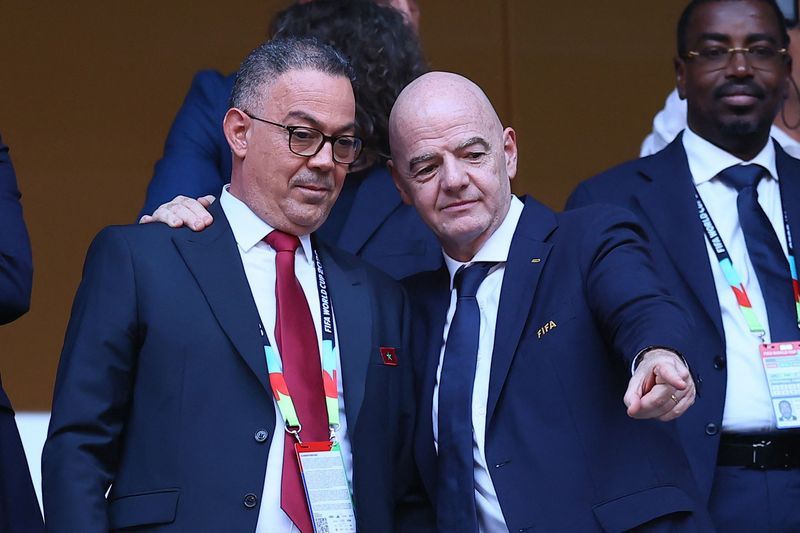
Gianni Infantino appears to be banking on African support to weather the international storm surrounding his leadership of FIFA, with several influential administrators from the continent throwing their weight behind the embattled president even as governing bodies elsewhere have signalled their loss of confidence. The FIFA chief's attempt to salvage his position ahead of next March's presidential election hinges significantly on the Confederation of African Football's 54 member nations, whose backing could offset criticism from other global football regions.
Five prominent African football officials have released statements endorsing Infantino in recent days, a show of solidarity that carries particular weight given that Asia, Europe, and CONCACAF—the federation overseeing North and Central American and Caribbean football—all publicly withdrew their confidence in his leadership over the weekend. These expressions of support arrived just as Infantino abandoned his FIFA Forward Enterprise initiative, a contentious proposal designed to generate $4.2 billion by selling stakes in future World Cup broadcasting and commercial rights.
The most significant backing has come from figures with substantial influence within African and global football governance. Moroccan official Fouzi Lekjaa, who serves as CAF Vice President, has joined FIFA Council members Hany Abo Rida of Egypt, Hamidou Djibrilla of Niger, and Ahmed Yhaya of Mauritania in publicly supporting the FIFA president. Additionally, Veron Mosengo-Omba, the newly elected president of the Democratic Republic of Congo's football federation and a former CAF general secretary, released a similarly supportive statement, with the two men sharing a university background in Switzerland that underscores their long-standing personal connection.
Understanding the depth of African support for Infantino requires examining the financial arrangements that have fundamentally altered the relationship between FIFA and its African member associations. Since winning the FIFA presidency in 2016 on the back of promises to dramatically increase development funding, Infantino has dramatically expanded the financial assistance flowing to member nations across the continent. The FIFA Forward programme, which represents an exponential increase over its predecessor scheme, now provides crucial revenue streams that many African football federations depend upon to remain competitive internationally and invest in domestic infrastructure.
The financial realities facing African football administrators help explain their reluctance to join the revolt against Infantino. Many nations with limited government resources and competing economic priorities struggle to fund their football programmes without external assistance. As Saïd Ali Athouman, president of the Comoros Football Federation, articulated, African nations face fundamental disadvantages when competing against wealthier regions that can invest in player development, training facilities, and equipment as a matter of course. The disparity is stark: wealthy European countries can finance comprehensive football ecosystems, while many African nations must make difficult choices between medical supplies for hospitals and investment in sporting infrastructure.
Fleetwood Haiya, president of Malawi's Football Association, illustrated this struggle with particular clarity when discussing his nation's funding challenges. Malawi requires not only operational money for its football federation but also basic stadium infrastructure—requirements that government budgets often cannot accommodate alongside pressing public health and welfare needs. In this context, FIFA Forward grants become essential rather than supplementary, making the prospect of supporting Infantino's ousting an economically rational but politically costly decision for African leaders.
Currently, FIFA provides baseline funding of $8 million to each of its 211 member associations across four-year cycles, with the Confederation of African Football adding annual grants on top of this allocation. This structure represents a remarkable evolution in international football governance. The practice of dispensing grants to member associations was originally introduced by Infantino's predecessor, Sepp Blatter, during his 1998 election campaign against Lennart Johansson when the Swede was UEFA president. Though CAF formally endorsed Johansson at that time, most African countries, having never previously received direct financial support from football's governing body, provided their votes to Blatter, who thus won the presidency.
Infantino has carried forward and substantially expanded Blatter's grant-dispensing model, rebranding the original Goal Project as FIFA Forward and increasing funding exponentially. This strategy has proven remarkably effective in cultivating loyalty among African football federations, many of which view Infantino's tenure as unprecedented in terms of financial support. The political calculus is straightforward: withdrawing support from a president who has demonstrated genuine commitment to African football development would be economically self-defeating.
The upcoming Confederation of African Football executive committee meeting scheduled for Thursday will formally consider the abandoned FIFA Forward Enterprise scheme, though no guarantee exists that the continental body will take an explicit public stance on Infantino's future leadership. CAF's measured approach to the controversy contrasts sharply with the swift denunciations from other regions, reflecting both the diplomatic complexities of coordinating 54 member nations and the genuine benefits that African football has derived from Infantino's financial policies.
Infantino's pivot in abandoning the World Cup revenue scheme before intense international pressure could have forced his hand demonstrates political acumen, but his path to survival depends fundamentally on African backing. CAF's initial response—issuing only a cautious statement last Wednesday indicating it would study the FIFA Forward Enterprise initiative before Infantino shelved the project—suggests the continental body remains undecided on mounting an active defence of his presidency. Nonetheless, the individual statements from senior African football officials provide him with substantive support.
The loyalty expressed by figures like CAF Vice President Lekjaa and other prominent administrators reflects not merely personal relationships, though Infantino's university friendship with Mosengo-Omba likely carries some weight, but rather a recognition of mutual interest. African football administrators have benefited tremendously from Infantino's expansion of FIFA's financial commitments to member development, making their continued support both politically logical and practically justified from a continental sports development perspective.
As Infantino contemplates his re-election campaign amid unprecedented international criticism, the African continent represents his most reliable base of support. Unlike Asian, European, and Caribbean football bodies, which have formally questioned his leadership, African football's leadership has largely maintained solidarity with the FIFA president. This distinction may prove decisive in determining whether Infantino can retain power, underscoring how financial interdependence shapes international sports governance and how African football's development priorities have become intertwined with the political survival of FIFA's current leadership.

