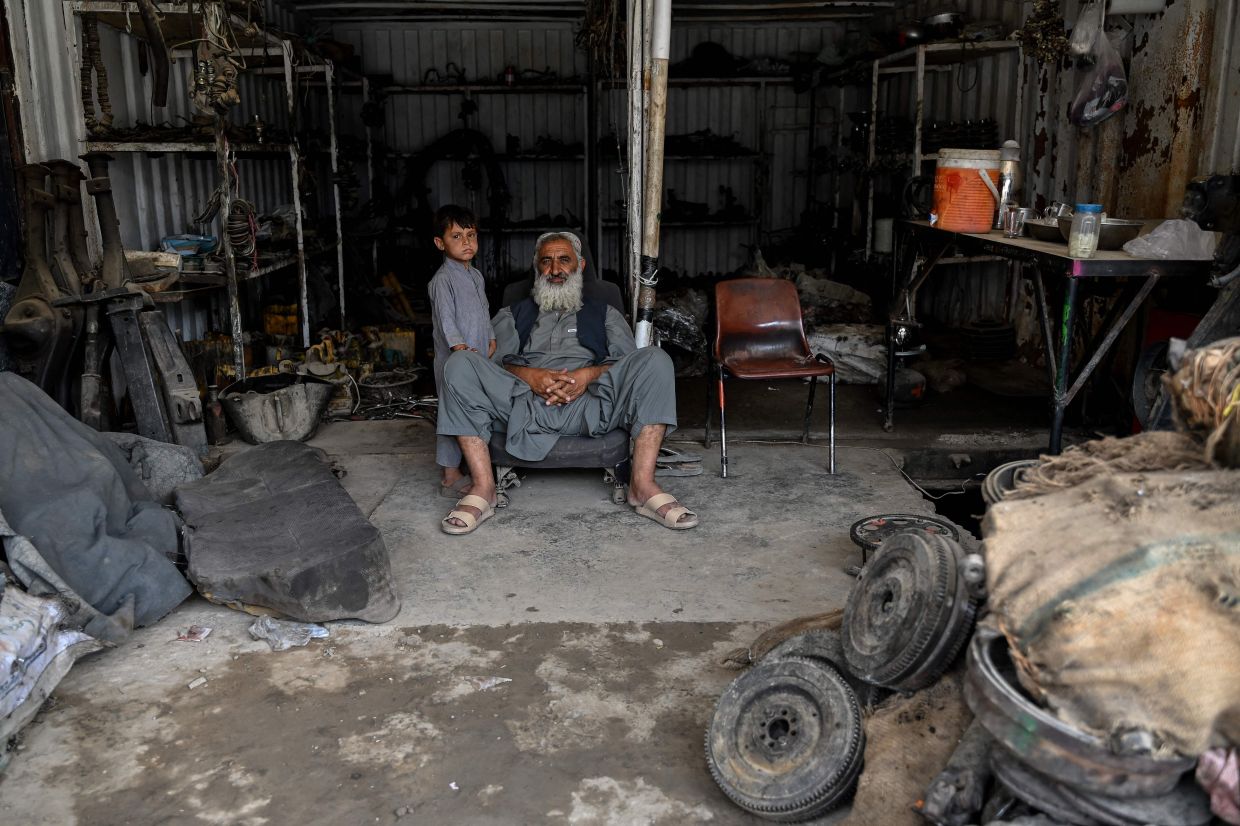
The bustling vehicle parts market of Spin Boldak in Afghanistan's Kandahar province has descended into an eerie quiet, with workshops that once hummed with activity now sitting empty. What was once a thriving regional hub for assembling and distributing imported automobiles has essentially ceased operations, as successive waves of geopolitical turmoil have systematically strangled the supply chains that kept the business alive. For thousands of workers and business owners dependent on this sector, the collapse represents an economic catastrophe with few signs of recovery on the horizon.
The first major blow arrived in October when escalating cross-border tensions with Pakistan forced authorities to impose a near-total closure of the frontier. The Spin Boldak crossing, which historically served as the primary route for vehicle parts sourced from Japan and other distant suppliers, became impassable. According to Abdul Baqi Bina, deputy head of the Kandahar Chamber of Commerce and Investment, traders initially adapted to this disruption by rerouting shipments through Iran's Bandar Abbas port, though this alternative proved significantly more cumbersome and expensive. The flexibility of the business community, however, was temporarily sufficient to maintain a reduced level of operations despite the complications.
The precarious equilibrium that traders had established began to unravel when geopolitical tensions in the Middle East erupted into open conflict in February. This regional instability created what Bina described as "very difficult problems for Afghanistan," extending far beyond the landlocked nation's immediate borders. The outbreak of hostilities sparked a wave of disruptions throughout global shipping, particularly affecting transit through the Strait of Hormuz—a critical chokepoint through which vast quantities of international commerce flow. Shipping companies warned that normalising operations through this vital waterway would require substantial time, leaving businesses with no clear timeline for resumed normal trade.
The mechanics of the Spin Boldak operation reveal how deeply integrated Afghanistan had become with international supply chains. Vehicle components arriving from Japan and the United Arab Emirates were either assembled into finished automobiles on site or distributed throughout the country for use in repairs. The complete halt of this flow has created a bottleneck effect: no new parts means no new vehicles can be assembled, which means no product to sell, which means no revenue for the businesses dependent on this ecosystem. The simplicity of this commercial chain makes the impact of supply disruption particularly devastating.
For individual importers like Asadullah, who sources stock from Dubai and Japan, the financial impact has been catastrophic. He vividly recalls the scale of his previous operations, recounting that his yard used to process two shipping containers daily. The cost structure of international logistics has shifted dramatically against his business interests. Before the Middle East conflict, each container cost approximately US$2,000 to transport; this figure has exploded to US$8,000 in the months since the outbreak of hostilities. The increase reflects a combination of longer routing distances, reduced shipping capacity, and insurance premiums reflecting heightened risks. Asadullah currently has more than thirty containers stranded in Japan and the UAE, many languishing at Dubai's Jebel Ali port, which serves as a critical hub for regional logistics operations.
Other traders have begun taking drastic measures to manage their losses. Masoud, who imports parts exclusively from Japan, faces a situation of almost total business cessation. His operation once processed dozens, sometimes hundreds of containers monthly, but current volumes have effectively dropped to zero. The economics have become so unfavourable that he has begun the painful process of shipping containers back to Japan rather than continuing to pay mounting storage fees in the UAE. This decision, while financially rational, represents an admission of defeat—containers already in transit are being reversed, essentially doubling transportation costs while destroying any profit margin. He speaks of this outcome with resignation, acknowledging that he sees no viable alternative and characterising the situation as "a total loss."
The impact radiates outward through the entire supply chain to affect workers throughout the market. Mohammad Naeem, a twenty-one-year-old crane operator, faces the prospect of abandoning his profession entirely if current conditions persist. His employment depended entirely on the constant flow of containers requiring unloading and movement, a function that has essentially vanished. The workshops themselves present a portrait of economic paralysis, where skilled labourers sit idle beside dormant equipment while waiting for raw materials that no longer arrive. Samiullah, a workshop owner, recalls that his operation previously produced five to seven complete vehicles weekly—a pace that has completely ceased due to the absence of incoming parts. Despite this collapse in revenue-generating activity, Samiullah must continue paying his employees, creating an unsustainable situation where fixed costs persist without corresponding income.
The retail end of this supply chain tells an equally grim story. At the Spin Boldak car showroom, owner Noor Ali sits surrounded by colourful vehicles that represent an increasingly obsolete inventory. Built using Japanese parts imported during more stable times, these vehicles now accumulate dust with no buyers. Noor Ali has experienced an entire month without a single sale, a reflection of how dramatically customer demand has evaporated alongside the supply crisis. Potential buyers, facing uncertainty about future vehicle availability and likely anticipating that prices will stabilise only after supply normalises, have withdrawn from the market.
The broader economic context amplifies these local disruptions into a national crisis. The World Bank, in May, characterised Afghanistan as "highly exposed to external shocks," noting a troubling divergence in the nation's trade balance. The gap between imports and exports has widened to encompass seventy percent of GDP during the 2025 fiscal year, indicating a fundamental imbalance in the economy's structure. Afghanistan's reliance on imported goods, of which vehicle parts constitute a significant component, makes the nation acutely vulnerable to any disruption in international logistics networks. This structural vulnerability means that external conflicts occurring thousands of kilometres away can rapidly cascade into domestic economic hardship.
The situation confronting Afghanistan's car trade exemplifies how deeply regional conflicts now ripple through global supply chains, affecting even remote markets with no direct connection to the source of the disruption. Kandahar's traders have become unwitting victims of geopolitical tensions in the Middle East and military friction with neighbouring Pakistan, neither of which they can influence. The accumulation of these simultaneous shocks—border closure, Middle East conflict, shipping disruption—has created a perfect storm that has essentially annihilated the economic logic that sustained the Spin Boldak market. Recovery depends not on local initiative but on the resolution of conflicts far beyond Afghanistan's control and the restoration of predictable shipping routes through the Strait of Hormuz, conditions that appear distant from realisation.

