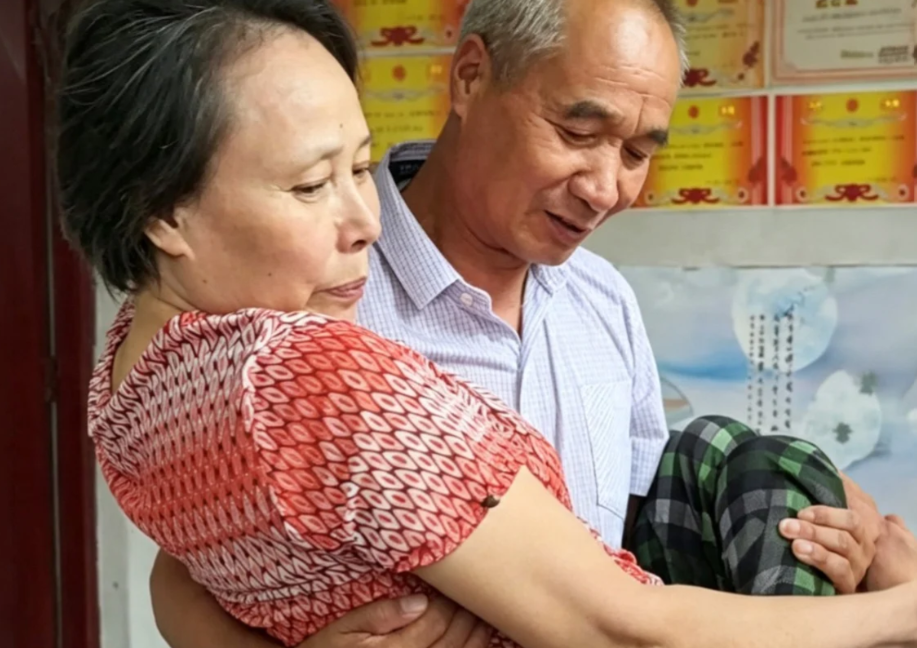
From the central Chinese city of Pingdingshan in Henan province emerges a narrative of spousal devotion that has resonated deeply with audiences across mainland China's social media platforms. For two and a half decades, Li Junliang has served as the primary caregiver for his wife Jia Fang, who sustained catastrophic injuries that left her paralysed from the chest downwards following a devastating fall in 2001. The couple's journey through disability, family responsibility, and unwavering personal commitment has struck an emotional chord with millions, reflecting broader conversations about duty, love, and sacrifice within contemporary Chinese society.
The incident that fundamentally altered both their lives occurred when 36-year-old Jia Fang fell from a cliff while riding a pedicab, an accident that resulted in severe spinal injury and permanent paralysis. At the time of this tragedy, Li Junliang and Jia were parents to two young children, aged 10 and 13, who would need to navigate their formative years within a household forever changed by medical crisis. Rather than abandoning his family to institutional care, Li made the deliberate choice to assume comprehensive responsibility for his wife's medical and physical needs, transforming their domestic space into a functional caregiving environment.
The practical realities of Li's caregiving role have been extraordinarily demanding and unrelenting. During the initial phases of Jia's paralysis, he rotated her body every two hours throughout day and night, a routine required to prevent the development of pressure ulcers—a serious complication common in severely immobilised patients. Over the years, he gradually adjusted this schedule to four-hour intervals, yet the consequence has meant that Li has essentially forfeited uninterrupted sleep for the past 20 years. This chronic sleep deprivation, sustained across decades, represents a form of physical sacrifice largely invisible to those observing from outside the household.
Beyond the essential turning and positioning, Li has maintained an active engagement with Jia's physical wellbeing through additional interventions designed to preserve her remaining function. He regularly performs limb massage to counteract muscular atrophy, a progressive condition that threatens to further restrict whatever mobility or sensation Jia retains. He also facilitates her transfer to a wheelchair, enabling her to access natural sunlight and outdoor air—what many might consider minor indulgences, but which represent significant efforts in the management of severe paralysis and represent Li's commitment to preserving her quality of life despite her severely restricted circumstances.
The economic dimensions of their situation remain somewhat obscured from public view. The source material provides no clarity regarding Li's employment or income-generating activities, leaving open questions about how he has managed to sustain the household financially whilst dedicating the majority of his time and energy to Jia's care. This ambiguity hints at potential economic hardship or creative arrangement of work schedules that has allowed him to prioritise caregiving responsibilities—a reality faced by many informal caregivers across Asia who lack access to formal support systems or financial assistance.
Despite the extraordinary demands placed upon the family, Li and Jia successfully guided their two children through childhood and adolescence toward independent adulthood. The walls of their Pingdingshan home display certificates acknowledging their children's academic achievements, silent testaments to Li's determination to ensure that his wife's disability did not diminish the educational opportunities or social development available to their offspring. Their children have since established their own families, breaking the potential cycle of caregiving burden and beginning lives of their own.
Jia's own reflections on her quarter-century of dependency reveal the emotional complexity embedded within their relationship. She observes that whilst Li's hair has greyed substantially from stress and exhaustion, her own remains predominantly black, an observation that simultaneously highlights his greater age and the physical toll that caregiving has extracted. Her gratitude, expressed publicly to media representatives, acknowledges the asymmetry inherent in their relationship—one partner entirely dependent upon the other's physical labour and emotional commitment. Yet her statement that she considers herself "the happiest person in the world" suggests that meaning and fulfilment can coexist with profound physical limitation and dependency.
Li's response to his wife's gratitude frames his caregiving not merely as obligation or burden, but as the fulfilment of a fundamental marital promise. His invocation of a wedding day commitment—that "home is complete only with your presence"—situates his current care within a broader narrative of lifelong partnership that transcends health, disability, or circumstance. His declaration that he would continue caring for Jia for "another 25, 35, or even 45 years" despite his own advancing age projects a vision of commitment that extends beyond rational calculation or prudent self-interest.
Community responses to their story, captured through both neighbour testimony and anonymous online commentary, emphasise the exceptional nature of Li's commitment by positioning it against presumed social norms. The unnamed neighbour's observation that "many men would find it difficult to endure" such caregiving responsibilities, combined with admiration for the tidiness and cleanliness of their home, suggests that Li's dedication represents a significant departure from typical patterns of spousal abandonment or institutionalisation that might otherwise occur in similar circumstances. Online observers invoke religious language—references to "God's heart" and familial blessing—to elevate his actions into a moral or spiritual register.
For Malaysian and Southeast Asian audiences, this story resonates within cultural contexts that similarly emphasise family obligation, filial piety, and the sanctity of marital commitment. Across the region, extended family caregiving remains common, yet the concentration of responsibility entirely upon a single spouse—particularly across 25 years of severe disability—remains remarkable. The narrative also highlights the absence of robust formal care systems or government support that might distribute caregiving responsibilities, forcing families to develop improvised solutions that depend upon individual moral commitment rather than institutional infrastructure.
The broader implications of such stories extend beyond individual sentiment to encompass questions about ageing societies, disability support, and the sustainability of family-centred care models. As China and other East Asian nations experience rapid population ageing, the availability of informal caregivers like Li becomes increasingly strained. The valorisation of his sacrifice, whilst emotionally moving, also obscures potential systemic failures in providing adequate support to families managing severe disability. His story, touching as it is, should prompt reflection on whether societies should depend upon such extraordinary individual commitment or whether institutionalised support systems might better serve families facing similar challenges.
Ultimately, the international circulation of Li and Jia's story through social media platforms reflects contemporary audiences' hunger for narratives of human connection and commitment that transcend material advantage or self-interest. In an era often characterised by transactional relationships and individual calculation, their quarter-century partnership—bound by love, obligation, and public vow—offers a counternarrative that resonates across cultural and geographical boundaries. Yet this same circulation risks transforming their personal struggle into inspirational content, potentially obscuring the daily exhaustion, financial precarity, and systemic inadequacy that underpin their survival.

