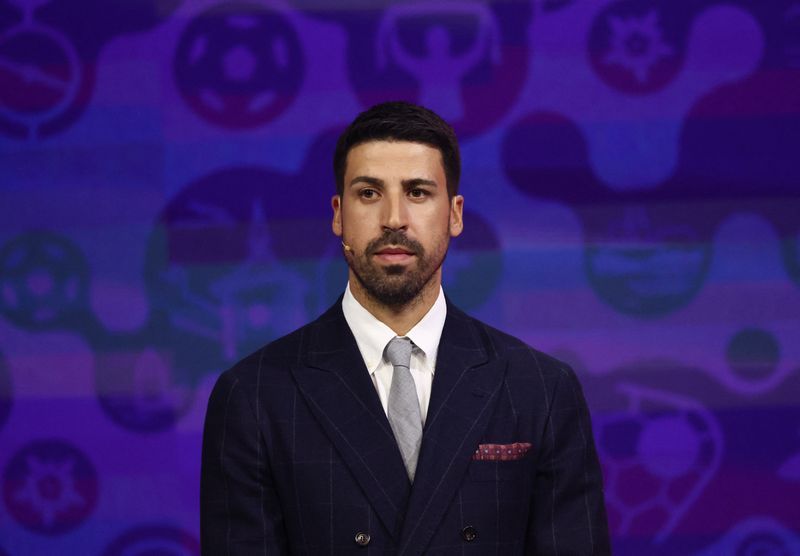
Sami Khedira carries two nations within him, and he sees nothing problematic about that. The German midfielder and 2014 World Cup winner has become an unlikely voice of wisdom on one of football's more emotionally charged contemporary issues: siblings representing rival countries at international tournaments. Speaking at the Home of Football museum in New York, Khedira articulated a refreshingly straightforward position that flies in the face of nationalist sentiment—namely, that brothers wearing different shirts is not a scandal but rather a natural expression of our globalised world.
His perspective carries particular weight because Khedira lives the experience himself. His brother Rani is competing at the World Cup for Tunisia, the country of their father's heritage, while Sami chose to represent Germany, where he and his brother were born and raised by a German mother. Rather than viewing this as a source of division or confusion, Khedira frames it as something altogether more positive. For him, the presence of dual-identity players throughout modern football reflects genuine human experience—the messy, beautiful reality that nationality cannot always be confined to a single passport or reduced to bloodlines alone.
The notion that someone might question his Germanness because of his name and appearance, or be viewed as German when in Tunisia, no longer troubles him. His answer is elegantly simple: both identities are authentically his. This worldview extends beyond personal conviction; it speaks to a broader reimagining of what international football could represent in an era of unprecedented mobility and multicultural families. Khedira emphasises that he and Rani do not carry their two cultures competitively but naturally, as complementary parts of their identity rather than contradictory claims upon loyalty.
The 2026 World Cup will showcase this phenomenon prominently, with eight sets of brothers competing across the tournament. Four pairs will play alongside one another for the same nation, including Theo and Lucas Hernandez representing France, and Jurrien and Quinten Timber playing for the Netherlands. The other four pairs represent different countries, creating the kind of scenario that has historically drawn criticism from commentators who view such arrangements as somehow emblematic of confusion or divided allegiances. The Williams brothers—Inaki and Nico—illustrate the complexity, with Inaki choosing Ghana while Nico represents Spain, despite their shared club affiliation at Athletic Bilbao.
Similarly, Guela and Desire Doue will oppose each other when Ivory Coast meets France, while Derrick Luckassen and Brian Brobbey carry a different kind of story, having chosen to represent Ghana and the Netherlands respectively whilst sharing their mother's nationality. Harry and John Souttar present yet another variation, with their allegiances split between Australia and Scotland. Each arrangement carries its own emotional and historical context, yet all reflect the same underlying reality: families whose roots spread across continents now populate the world's most visible sporting stage.
Khedira witnessed the emotional resonance of this phenomenon firsthand when Guela and Desire Doue sang both the French and Ivorian national anthems before their countries met in a friendly match earlier in June. The image moved him deeply, not because it represented confusion or conflict, but because it demonstrated football's capacity to transcend the match itself and communicate something profound about human connection. He asked rhetorically, "How beautiful is that?" understanding that multicultural moments like these carry powerful messaging far beyond the ninety minutes of play. In his view, football possesses unique power to normalise and celebrate the very diversity that others might interrogate or question.
The expansion to a 48-team World Cup format has created previously unavailable opportunities for smaller nations to compete on football's grandest stage. Khedira credits this structural change with enabling countries such as Cape Verde, Curaçao, and Haiti to demonstrate their capability against established powers. Simultaneously, he observes that African and Asian football has been narrowing the traditional gap that separated these continents from European and South American dominance. While acknowledging that improved education, coaching facilities, and infrastructure have contributed significantly to this shift, Khedira argues that European nations bear a responsibility to support development at source rather than merely benefiting from the talent pools that dual-nationality provisions create.
Yet beneath this celebration of multicultural representation lies a harder truth that Khedira does not shy away from addressing. Young players courted by multiple national federations often face intense pressure before they fully comprehend the magnitude of the decision they are making. This represents, in his assessment, genuine cause for concern—not the fact of dual identity itself, but the premature age at which such consequential choices are imposed. He reflects on his own experience, recalling that at eighteen years old, still in many ways a child, he confronted the need to commit to a single footballing nation. That decision cannot and should not be forced by political calculation, family obligation, or heritage alone.
Instead, Khedira proposes that the right choice emerges from something more intuitive and personal—what he describes simply as "a gut feeling." The location of one's birth, he insists, matters less than the internal compass that draws a player toward a particular footballing home. However, he acknowledges with evident sympathy that this immense personal pressure falls upon remarkably young shoulders. Children and teenagers must navigate not only the pressure from federation officials and family members but also their own uncertainty about identity and belonging. Khedira recalls having spoken with Tunisia's football authorities out of respect, understanding that such conversations carry weight in these delicate decisions, yet he advocates for an approach that allows young players genuine agency rather than coercion.
The larger implication of Khedira's perspective extends beyond individual player choice to how football itself should respond to an increasingly multicultural global reality. Rather than viewing dual-nationality representation as a threat to national team integrity or a sign of muddled identity, his argument invites the sport to embrace these arrangements as reflections of the world as it actually exists. Families migrate, intermarry, and spread their roots across continents. Children grow up genuinely attached to multiple places and cultures. Football, uniquely among global institutions, has the platform and power to celebrate rather than condemn these human realities. In Khedira's vision, the brothers who wear different shirts at the World Cup are not symbols of confusion or divided loyalty but ambassadors of a richer, more authentic understanding of what it means to belong in the modern world.