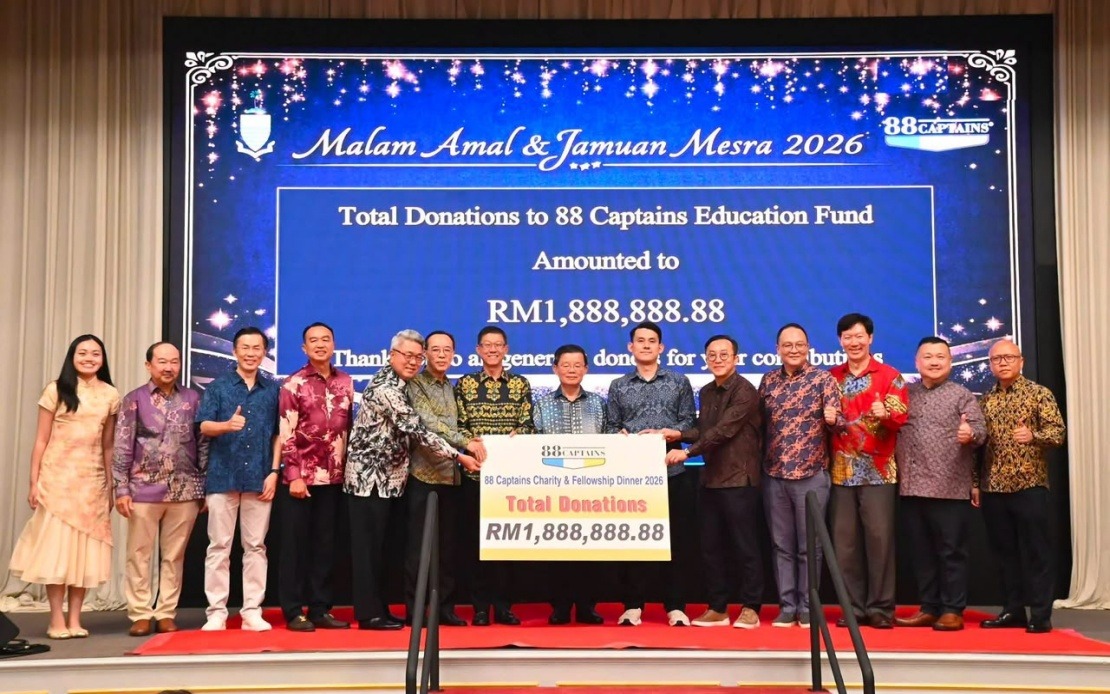
The 88 Captains charitable organisation has distributed over RM1 million in scholarships to 44 students from five educational institutions in Penang as part of a comprehensive initiative to nurture emerging talent and strengthen the region's educational landscape. The awards were announced at the 88 Captains Annual Charity Dinner 2026 in George Town, which drew prominent state figures including Penang Governor Tun Ramli Ngah Talib and Chief Minister Chow Kon Yeow.
Chairman Datuk Seri Dr Ooi Eng Hock emphasised that the scholarship scheme extends far beyond providing immediate financial relief to struggling students. Rather, the organisation views these awards as catalysts for personal transformation, designed to encourage young people to set ambitious goals, demonstrate resilience in their studies, and ultimately become contributors to Malaysian society who lead with integrity and sound values. This philosophy reflects a growing recognition among Malaysian philanthropic bodies that education funding must cultivate character alongside academic excellence.
Central to the 88 Captains strategy is its newly expanded Apprenticeship, Internship, Reskilling and Upskilling (AIRU) programme, which was launched the previous year at Universiti Sains Malaysia. This initiative directly addresses a critical disconnect between what universities teach and what employers actually demand from graduates entering the job market. The organisation has established a dedicated task force under its 88 Captain Young Fellowship, comprising high-achieving scholars from USM, ViTrox College, Tunku Abdul Rahman University of Management and Technology (TAR UMT), and INTI International University.
These young fellows serve as intermediaries between academia and industry, meeting with chief executives and company founders to understand workforce expectations while simultaneously representing the perspectives and concerns of today's university graduates. A key focus of these conversations centres on baseline salary expectations, with graduates increasingly advocating for a minimum starting salary of RM4,000. For Malaysian readers, this dialogue carries significant weight as the nation grapples with graduate employment and retention challenges, particularly in competing for talent against higher-wage neighbours like Singapore.
The Annual Charity Dinner itself generated RM1.89 million in fundraising, demonstrating sustained corporate and individual support for the organisation's mission. The presence of both the Penang Governor and Chief Minister underscores the political establishment's recognition of talent development as a cornerstone of regional competitiveness. Chow Kon Yeow specifically commended 88 Captains for aligning its work with Penang's broader economic ambitions, noting that initiatives strengthening the education-industry nexus support the state's strategic positioning in advanced manufacturing, semiconductor production, artificial intelligence, and the expanding digital economy.
Over the past four years, 88 Captains has orchestrated more than 50 distinct events and community programmes extending well beyond scholarships. The organisation has donated smart televisions to primary and secondary schools throughout the region, recognising that digital access remains unevenly distributed across Malaysian educational institutions. Equally significant is the establishment of 5G Education Digital Libraries in 88 schools, a forward-thinking infrastructure investment that prepares students for technology-dependent learning environments. The group has also supported the Special Education Integration Programme (PPKI), demonstrating commitment to inclusive education practices that extend beyond high-achieving students.
Among the most timely recent initiatives is the Joint Mental Health Development in Schools with AI Early Education for Responsible Adoption, launched earlier that week. This programme arrives at a critical juncture following the introduction of the Anti-Bullying Act 2026, addressing a legislative gap that many Malaysian educators and parents had long identified. Chief Minister Chow highlighted that while legislation provides necessary legal frameworks and consequences, the actual prevention of bullying and harmful behaviour requires coordination across schools, families, and communities. Teachers need practical tools and support; students require mentoring on digital citizenship; and parents must understand how artificial intelligence influences their children's online experiences and social interactions.
The organisation itself was established in 2022, making it a relatively young philanthropic body operating within Penang and the broader Northern Region. Its creation reflects a growing trend among successful Malaysian entrepreneurs and business leaders to institutionalise their community contributions through structured charitable organisations rather than ad hoc giving. This model allows for sustained, strategic impact and creates accountability mechanisms that build public trust.
For Malaysian policymakers and educators, the 88 Captains model offers instructive lessons about bridging persistent gaps in the education ecosystem. The emphasis on connecting academic institutions with industry players addresses employer complaints about graduate readiness, while scholarship programmes target the genuine financial barriers that prevent talented students from disadvantaged backgrounds from progressing through tertiary education. The focus on digital infrastructure and mental health support reflects contemporary challenges that traditional educational funding often overlooks, positioning Penang as a region willing to invest in holistic student development rather than purely academic metrics. As Malaysia competes regionally for talent and seeks to build knowledge-intensive industries, these multifaceted approaches to youth development increasingly define competitive advantage at the state level.

