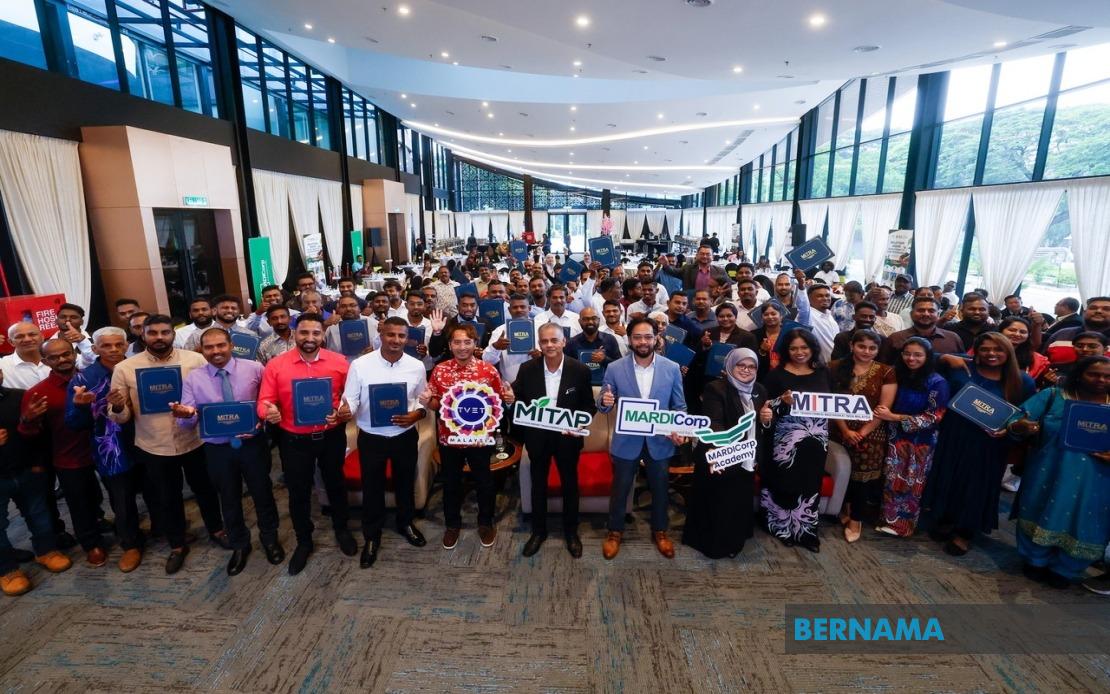
The Malaysian Indian Transformative Agri Programme has distributed Agricultural Transformation Grants totalling RM2.04 million to 68 young entrepreneurs from the Indian community, marking a significant push to deepen participation in farming and food production sectors. The grant distribution ceremony, held in Putrajaya, underscores the government's commitment to creating economic opportunities within minority communities through agricultural development.
MITAP operates as a flagship initiative under the Malaysian Indian Community Transformation Unit, partnering with MARDICorp to execute programmes that align with the broader Indian Community Socioeconomic Development Strategy. The programme's dual-track approach combines immediate financial support with long-term capacity building, recognising that entrepreneurial success in agriculture demands both capital and sustained technical guidance. By structuring support across different timeframes and delivery mechanisms, the initiative addresses the reality that agricultural ventures require careful nurturing beyond the initial investment phase.
The initiative encompasses two distinct components designed to serve different cohorts and developmental stages. The QuickWin MITRA stream provided the RM30,000 grants distributed to the 68 recipients, offering relatively rapid access to capital for those with existing agricultural knowledge or experience. Simultaneously, the Young Agropreneur Programme conducts an intensive 10-month training curriculum that develops foundational competencies in farming, business management, and market awareness, with eight participants having completed the training to date. This bifurcated approach acknowledges that not all young farmers enter with equal preparation, and tailored pathways improve overall programme effectiveness.
The focus areas for supported agricultural activities span diverse production streams reflecting both market demand and suitability to Malaysian growing conditions. Recipients are establishing operations in food crop production, dairy cattle management, beekeeping, oyster mushroom cultivation, freshwater fish farming, and food processing technology. This diversification reduces systemic risk by preventing over-concentration in any single agricultural sector and creates multiple entry points for farmers with different skills, land availability, and capital constraints. The emphasis on value-added processing also signals recognition that raw production alone often yields thin margins; incorporating processing technology enables farmers to capture greater value along the supply chain.
According to K. Raveendran Nair, director-general of MITRA, ongoing support extends well beyond the initial grant distribution. Recipients will continue receiving mentoring and technical assistance from MARDICorp staff, with pathways created for participants to access government-managed agricultural entrepreneurship programmes and national development initiatives. This continuity of support represents a critical differentiator from one-time grant schemes, as it acknowledges that first-time agricultural entrepreneurs commonly encounter unexpected challenges in pest management, market access, regulatory compliance, and scaling operations. Sustained institutional backing significantly improves survival rates and profitability among new ventures.
MARDICorp's role emphasises practical commercial development alongside technical agricultural knowledge. Managing director Mohamad Zamir Ghazali indicated that the corporation would actively facilitate market linkages, help participants develop downstream products from primary production, and transfer new agricultural technologies to grant recipients. Several participants have already formalised their status by joining relevant agricultural associations, a development that Ghazali highlighted as instrumental for scaling operations and maintaining visibility within government support ecosystems. Association membership provides farmers with collective bargaining power, access to bulk purchasing arrangements, and channels for advocating policy improvements affecting their sectors.
The programme functions simultaneously as a knowledge-transfer initiative and a networking platform, creating peer learning communities among participants in similar agricultural sub-sectors. By bringing together young farmers engaged in comparable activities—whether beekeeping, mushroom cultivation, or fish farming—MITAP facilitates horizontal knowledge exchange where participants learn from each other's experiences, troubleshooting approaches, and market discoveries. These informal networks often prove as valuable as formal training, particularly for problem-solving in real operational contexts where conditions vary significantly across individual farms and locations.
For Malaysia's broader agricultural development agenda, the initiative addresses a persistent challenge: attracting young citizens, particularly from communities underrepresented in farming, into food production sectors increasingly critical for national food security. The targeting of the Indian community reflects both demographic realities and historical participation patterns, but the model's success metrics extend beyond community-specific outcomes. Successful incubation of 68 new agricultural enterprises generates employment, increases food production capacity, and demonstrates viable pathways for youth entrepreneurship in sectors often perceived as low-status or economically marginal.
The timing of this initiative carries relevance for Southeast Asian agricultural strategies more broadly. Regional governments increasingly recognise that demographic shifts—particularly rural-to-urban migration and ageing farming populations—threaten production stability. Malaysia's approach of coupling financial incentives with intensive skills development and market linkage support offers a replicable model for neighbouring countries facing similar generational transitions in their agricultural workforces. The emphasis on processing and value-addition also reflects emerging regional trends toward higher-margin agricultural production rather than commodity export competition.
Regional context matters significantly for assessing programme sustainability and impact. Unlike some agricultural schemes that assume farmers operate in isolation, MITAP's networking emphasis acknowledges that modern agricultural success increasingly depends on integration into supply chains, collective marketing platforms, and information networks. This systemic approach improves the likelihood that participants will transition from grant-dependent status to genuinely sustainable enterprises capable of surviving market fluctuations and operational challenges without continuous external support.

