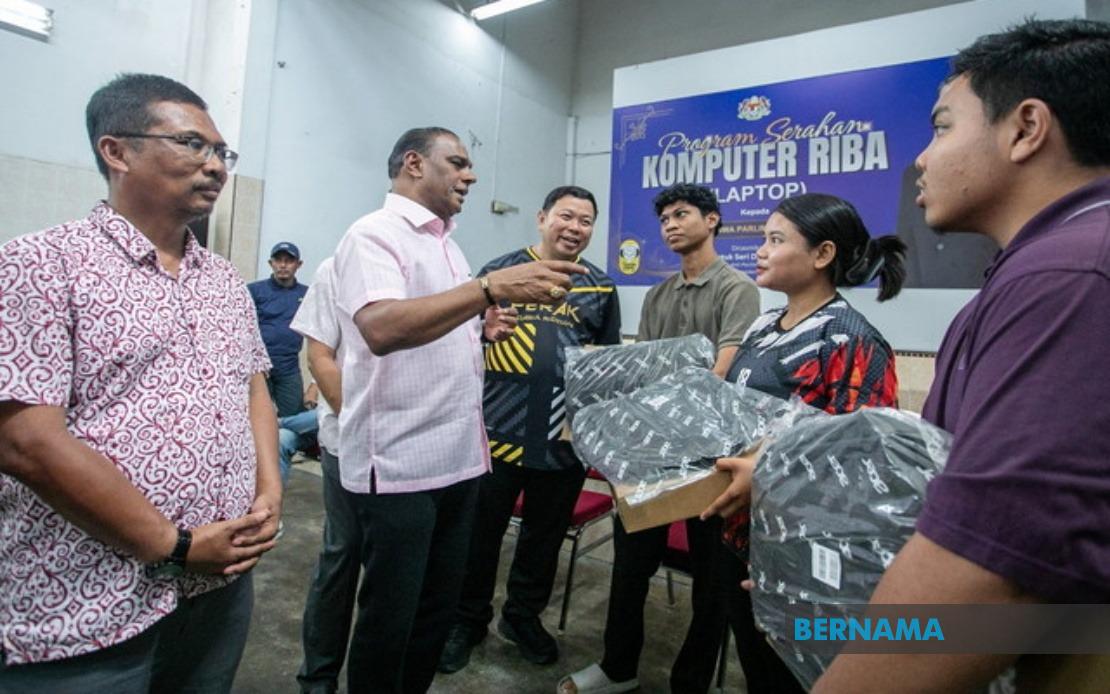
The Tapah Parliamentary Constituency Student Laptop Handover Programme distributed computers to 45 undergraduate and pre-university students from B40 households this month, marking the latest chapter in an initiative that has now placed technology into the hands of more than 1,000 learners since 2008. Datuk Seri M. Saravanan, the Tapah Member of Parliament, distributed the devices at a ceremony held at Mahatma Gandhi Hall, emphasising that digital equipment has evolved from being a mere convenience to an educational essential in an increasingly technology-driven learning landscape.
The current batch of recipients spanned the entire spectrum of Malaysian higher education pathways. Among the 45 students were 30 pursuing diplomas, five enrolled in certificate programmes, four in matriculation streams, and three at the degree level. The distribution also included individual recipients from SPM, STPM, and foundation programme levels, reflecting the programme's comprehensive reach across different educational stages. This breadth of coverage underscores the programme's holistic approach to bridging the digital divide across various qualification pathways rather than concentrating resources on any single educational tier.
Saravanan articulated the rationale underpinning the initiative during remarks to journalists, noting that students from lower-income backgrounds face particular vulnerability when educational institutions increasingly depend on digital platforms for delivery and assessment. The shift towards hybrid and online learning—accelerated notably during the COVID-19 pandemic but now embedded as a permanent feature of tertiary education—has made laptop ownership a prerequisite rather than an optional advantage. For families struggling financially, the several hundred ringgit expense of acquiring a suitable device can constitute a genuine barrier to educational participation and academic performance, creating a technology-mediated form of educational inequality that the programme directly addresses.
The selection mechanism employed by the constituency incorporates multiple layers of verification to ensure resources reach genuinely eligible households. A dedicated committee reviews each application while cross-referencing information obtained from the District Education Office (PPD) and consultations with local community leaders and grassroots figures familiar with the socioeconomic circumstances of applicants. This multi-stakeholder validation process reduces the risk of resources being directed towards families whose apparent need masks underlying capacity to purchase equipment independently, thereby maximising the programme's impact on the most vulnerable student populations.
One particularly encouraging dimension of the initiative concerns its documented impact on minority communities within the constituency. Saravanan highlighted that the past two decades have witnessed a significant expansion in the participation of Orang Asli youth from Tapah in higher education, with growing numbers entering professional occupations including medicine and law. This upward mobility trajectory, he suggested, generates positive demonstration effects for younger community members who can now envision themselves in professional roles, breaking historical patterns of educational underparticipation that had previously characterised indigenous communities in many Malaysian regions.
Aidil Iskandar Ramlan, an eighteen-year-old recipient commencing studies in Public Administration at Universiti Teknologi MARA (UiTM) Raub, Pahang, exemplifies the tangible benefit the initiative provides to individual students and their families. The former pupil of SMK Syeikh Abdul Ghani in Bidor comes from a household where his father works as a security guard and his mother manages the home, placing them squarely within the B40 income classification. For Aidil's family, the financial relief provided by receiving an appropriately specified device means avoiding a significant one-time expenditure, effectively redirecting limited household resources towards other essential needs such as accommodation, meals, and study materials during his tertiary education.
The equipment distributed through the programme facilitates the full range of contemporary academic activities that university-level study demands. Aidil noted he would utilise the laptop for assignment completion and various study-related digital tasks, activities that were once optional but have become practically mandatory in most Malaysian tertiary institutions. The capacity to work from locations beyond campus—whether dormitory rooms, public libraries, or home—expands studying flexibility and potentially improves academic outcomes by removing the constraint of institutional computer laboratory availability.
Ea Endry Iana Aslan, a nineteen-year-old pursuing a Diploma in Early Childhood Education at FELCRA College, articulated how the assistance directly lightens household financial burdens and enhances her capacity to engage fully with her course. For students enrolled in practical and professional programmes such as education or healthcare, having personal access to computing resources becomes even more critical, as coursework often involves the creation of teaching materials, research compilation, portfolio development, and multimedia project work that extend beyond traditional classroom hours.
The emotional and psychological dimensions of receiving targeted assistance deserve recognition alongside the material benefits. Both Aidil and Ea expressed gratitude specifically to Saravanan, suggesting that the personalised nature of the programme—with direct involvement from elected representatives—strengthens the connection between students and their political leadership whilst simultaneously providing tangible evidence that constituency-level politicians can deliver concrete material benefits to constituents. This relationship-building dimension may contribute to longer-term civic engagement and political participation among beneficiary cohorts.
The Tapah laptop initiative occupies an interesting position within Malaysia's broader digital inclusion landscape. Whilst the national government has launched various programmes aimed at bridging the digital divide, localised constituency-level initiatives like this one provide an alternative or complementary mechanism through which targeted support reaches students who might otherwise fall through gaps in wider programmes. The sixteen-year continuity of the Tapah scheme suggests political commitment that transcends individual election cycles, providing some assurance to families that the benefit represents an enduring programme rather than a one-off electoral gesture.
Looking forward, the expanding reliance on educational technology across Malaysian universities—coupled with the acknowledged importance of equitable access to digital tools—suggests that programmes addressing B40 student technology needs will remain pertinent for years to come. As online learning platforms, digital assessment tools, and virtual collaboration become increasingly normalised across higher education, the risk of creating a technological underclass of students unable to participate fully in their studies remains real without sustained interventions like the Tapah constituency initiative.

