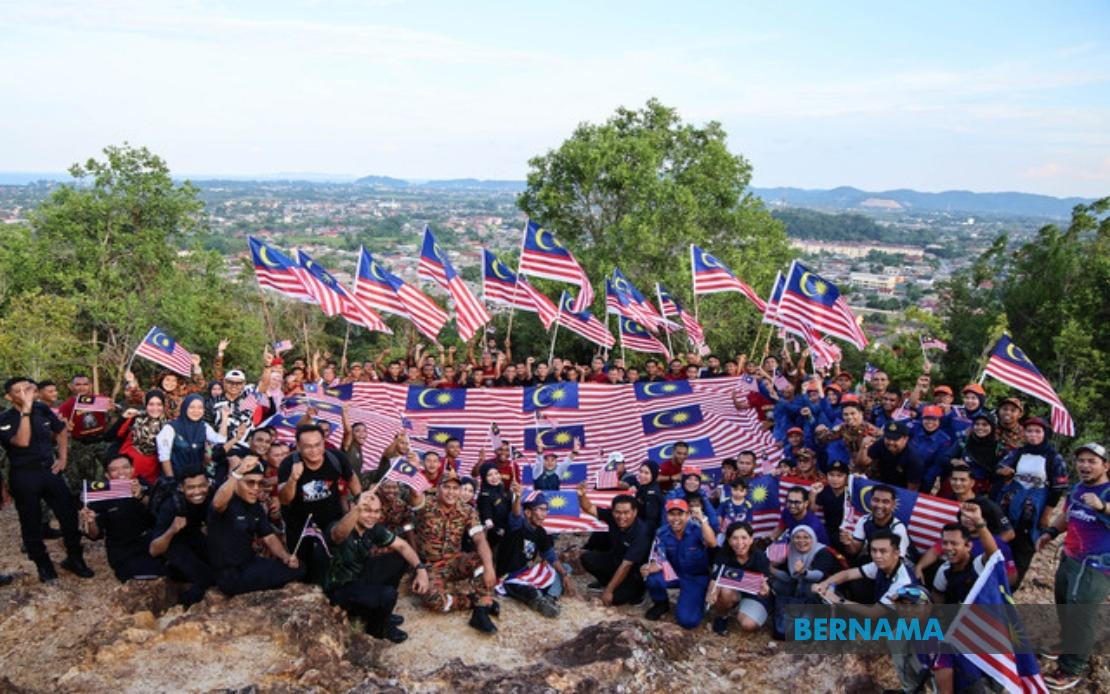
An inaugural summit hike organised by media practitioners in Kuala Terengganu on August 21 drew together 300 participants from across the security and government sectors, marking a collaborative effort to infuse Malaysia's National Month celebrations with tangible expressions of national pride. The event, orchestrated to coincide with the country's annual patriotic observance, assembled a diverse coalition spanning uniformed services, administrative agencies and journalism professionals in a demonstration of unified commitment to Malaysian values.
The gathering brought under one objective representatives from the Terengganu Fire and Rescue Department, Malaysian Armed Forces, Road Transport Department, Malaysian Anti-Corruption Commission, the state's Ministry of Domestic Trade and Cost of Living, Royal Malaysian Customs Department and Malaysia Civil Defence Force. This breadth of participation underscored the organisers' intention to transcend departmental boundaries and foster genuine collaborative spirit during the month dedicated to national reflection and celebration.
METRA president Mohd Zaid Mohd Noor articulated the underlying philosophy driving the initiative, emphasising that media organisations carry particular responsibility for cultivating and transmitting messages of patriotism through their communication channels. In an era where information dissemination shapes public consciousness, the club's leadership recognised that journalists occupy a strategic position to reinforce national values among Malaysian audiences. By personally participating in patriotic activities rather than merely reporting on them, media practitioners model the commitment they encourage in their content.
The summit ascent itself served as metaphor and mechanism simultaneously—a physical journey toward elevation that mirrored the aspirational nature of national unity and shared purpose. The symbolic unfurling of a giant flag at the summit created a visual representation of collective identity, transforming what might otherwise be a routine outdoor activity into an occasion infused with ceremonial significance. Such imagery carries particular resonance in Malaysia, where visual displays of national identity maintain cultural and political importance.
Beyond the patriotic dimensions, Mohd Zaid highlighted the event's utility as a practical platform for strengthening institutional relationships across government agencies. The relatively informal setting of a mountain hike facilitates interpersonal connections that might not emerge from standardised bureaucratic interactions. When officials from disparate departments engage in shared physical exertion toward a common goal, they develop working relationships grounded in mutual respect and personal familiarity rather than mere procedural obligation. Such bonds often translate into improved coordination when inter-agency collaboration becomes necessary during operational situations.
The organisers explicitly integrated health promotion into the event's objectives, recognising that patriotism and physical wellbeing need not constitute separate pursuits. By framing the hike as simultaneously patriotic and health-focused, the event communicated that national commitment extends to caring for one's own body and promoting fitness standards. This fusion reflects modern understanding that comprehensive national strength encompasses not merely political and military dimensions but also public health and personal responsibility.
For Terengganu specifically, the event contributed meaningfully to the state's National Month programming. As a northern East Coast state with distinct administrative and cultural characteristics, Terengganu's ability to mobilise such diverse participation demonstrates healthy institutional functioning and genuine buy-in to national observances. The event's success indicates that patriotic sentiment remains viable and actionable across Malaysia's bureaucratic and professional landscapes, even amid broader questions about institutional trust and national cohesion.
The media practitioners' role in initiating rather than merely documenting such activities reflects an evolving understanding of journalism's civic responsibilities. Rather than maintaining strict separation between observer and participant, this approach acknowledges that media professionals inhabit their societies as citizens first, and that their engagement in community and national life enriches both journalism and public discourse. The decision to invite colleagues from security and government agencies to a media-organised event similarly transcends traditional institutional silos.
The participation of uniformed personnel from multiple agencies—fire and rescue, armed forces, customs and civil defence—underscores these services' engagement with broader national projects beyond their specific operational mandates. When security forces participate in celebratory and community-building activities, they reinforce their status as institutions embedded within rather than separate from society. This matters particularly in Malaysia's diverse context, where public perception of security institutions' political neutrality and commitment to national rather than factional interests carries significant weight.
Looking forward, the inaugural status of this event suggests potential for establishment as regular programming. If the summit hike becomes an annual fixture during National Month, it could develop into a meaningful tradition that brings state-level officials and professionals into sustained dialogue. Expansion to other Malaysian states might similarly foster inter-agency cooperation and public engagement with patriotic expression. The model demonstrates that National Month celebration need not remain confined to official ceremonies and media coverage but can manifest through participatory activities that engage citizens and officials alike.

