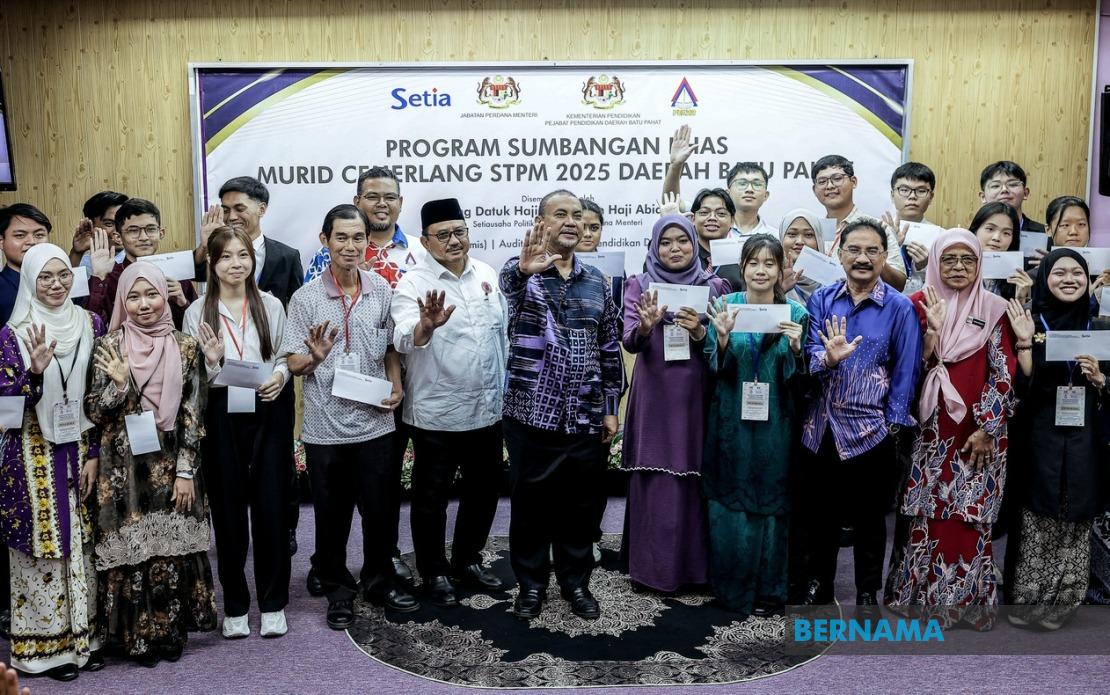
The Prime Minister's Office has distributed special financial contributions to 214 high-achieving students who sat the 2025 Sijil Tinggi Persekolahan Malaysia (STPM) examination across Batu Pahat district, marking a targeted initiative to recognise academic excellence at the secondary school level. The awards ceremony, held at the Batu Pahat District Education Office auditorium, brought together top performers from 16 secondary institutions across the district to receive formal recognition and financial support for their accomplishments.
Datuk Azman Abidin, serving as Political Secretary to the Prime Minister, oversaw the distribution and emphasised that the scheme represents more than symbolic recognition. He stressed that the government views educational achievement as a priority deserving material support, particularly at a critical juncture when students are deciding whether to pursue university education and selecting their fields of study. The programme reflects a deliberate policy choice to intervene financially at this pivotal moment in young people's academic trajectories.
The contribution carries both immediate and symbolic significance for recipients. Beyond the monetary support, which addresses genuine financial barriers that many Malaysian families face when preparing for tertiary education, the award signals official validation of academic merit. Azman indicated that recipients should leverage this recognition as motivation to maintain their scholarly standards throughout their university years and serve as positive role models within their peer groups, creating ripple effects that encourage broader academic aspiration within schools and communities.
Government officials framed the initiative as evidence of wider commitment to educational empowerment and youth development. Azman articulated that such contributions demonstrate the state's willingness to translate rhetoric about valuing education into concrete fiscal allocation. He noted that the scope of the programme remains contingent on budget availability, suggesting that expansion to additional districts and cohorts depends on securing continued funding approval. This conditionality underscores the reality that even well-intentioned educational schemes must navigate competing budgetary demands.
Among the recipients was Afida Auni Airulnizam, a 20-year-old former student of Sekolah Menengah Kebangsaan Tun Sardon in Rengit, who articulated how the contribution provided both material assistance and psychological affirmation. She described the award as validation of her efforts and as tangible encouragement to persist with her academic goals. Drawing inspiration from her older brother, who is currently pursuing university studies, Afida expressed her aspiration to follow a similar educational pathway with a focus on sports science, contingent on securing admission to a tertiary institution. Her comments highlight how such schemes can reinforce intergenerational educational mobility within families.
Similarly, Muhd Ammar Firdaus Mohd Fadzil, a 20-year-old from Sekolah Menengah Kebangsaan Tun Ismail, welcomed the initiative as a practical measure that would reduce financial stress during the university preparation phase. He emphasised the tangible relief that financial contributions provide to students and families navigating the expenses associated with tertiary education applications, entrance examinations, and initial study costs. His perspective underscores that while academic merit recognition matters psychologically, the actual financial burden of university preparation remains a substantial obstacle for many Malaysian families.
The distribution across 16 schools within Batu Pahat suggests systematic outreach rather than ad hoc recognition. This geographic spread indicates an attempt to capture excellence across diverse school environments and socioeconomic contexts within the district. The involvement of multiple institutions ensures that high achievers in less prominent or resource-constrained schools receive acknowledgement alongside their peers in better-known establishments, potentially addressing visibility gaps that sometimes leave capable students in smaller schools overlooked by centralised scholarship programmes.
For Malaysian policymakers and educators, the scheme addresses a recognised gap in post-secondary support mechanisms. While various scholarship and loan schemes exist for university-bound students, fewer programmes explicitly target the STPM cohort at the moment of transition from secondary to tertiary education. The timing of such contributions—immediately after examination results are released—positions support precisely when students are making concrete decisions about whether university education is financially viable for them.
The success of this initiative may offer lessons for other regions and districts grappling with talent retention and educational mobility. If sustained and expanded, such programmes could influence enrolment patterns in higher education by removing financial uncertainty from the decision-making process. However, the programme's reliance on discretionary funding means its continuity remains uncertain, potentially limiting its predictability for future cohorts of high achievers who might plan their educational choices around expectations of such support.
The presence of recipients from diverse school backgrounds within Batu Pahat also reflects the district's broader educational ecosystem. Sekolah Menengah Kebangsaan institutions serve as the primary pipeline for STPM students and university candidates in Malaysia, making these schools focal points for government educational policy. By recognising their top students collectively, the scheme reinforces the importance of secondary schooling while sending a message that academic excellence at this level merits official acknowledgement and material reward.
Looking forward, the programme's sustainability depends on budgetary decisions within the Prime Minister's Office and broader government fiscal planning. Educational outcomes and retention rates of recipients in tertiary institutions could provide valuable data for assessing whether such financial interventions demonstrably improve university completion rates or influence subject choices toward high-demand fields. If evidence supports positive correlation, the case for expansion becomes stronger and may attract cross-party political support.

