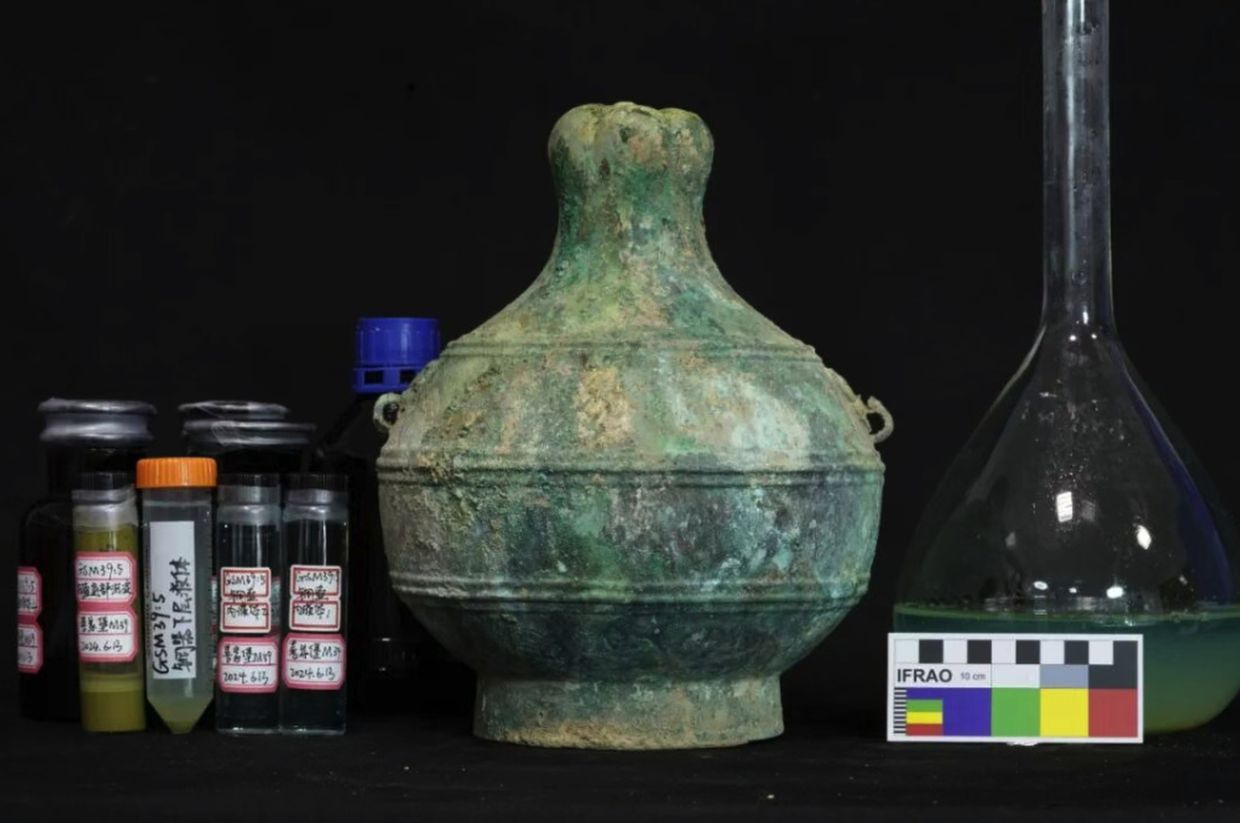
A remarkable archaeological discovery near the Great Wall in northwestern China has shed fresh light on ancient brewing practices and provides a poignant glimpse into the lives of soldiers stationed at frontier outposts more than two millennia ago. The perfectly preserved bronze wine vessel, recovered from a Warring States-era cemetery in Guyuan, Gansu Province, contained approximately 3.7 litres of ancient liquid that has been identified as grain-based wine—making it the most intact and information-rich wine artefact from the Qin period yet publicly documented in China.
The discovery was made at the Shanjiabao cemetery, situated just two kilometres from the remnants of the Warring States Qin Great Wall. Archaeologists excavated 183 tombs at the site, with 179 belonging to the Qin culture, suggesting the burial ground served as a public cemetery for garrison troops and their families who lived within the fortified passes and defensive outposts that dotted a 170-kilometre stretch of the Great Wall. Among these tombs, Tomb No. 39 proved exceptional when researchers extracted the ancient liquid residue from a distinctive bronze vessel shaped like a garlic head—a cultural hallmark of the Qin period.
What distinguished this discovery from other ancient wine finds was the sophisticated preservation technique employed by the vessel's creators. The bronze pot utilised a double-layer sealing mechanism comprising a textile inner lining and an outer coating of organic clay, a method so effective that it kept the contents largely intact across 2,300 years. Wang Xiaoyang, head of the Shanjiabao cemetery archaeological project at the Ningxia Institute of Cultural Relics and Archaeology, emphasised the significance of this finding, noting that the combination of preservation quality and richness of archaeological information makes this vessel particularly valuable to scholars studying ancient Chinese culture and daily life.
To unlock the secrets of the ancient recipe and brewing techniques, researchers sent samples to Northwest University for comprehensive chemical analysis. The laboratory work identified 24 distinct compounds within the liquid, including organic acids and their derivatives, amino acids and their derivatives, and various carbohydrates. This detailed chemical profile proved instrumental in determining not only what the substance was, but also how it was produced and what ingredients went into its creation. The distribution pattern of organic acids matched that found in artificially aged yellow wine, conclusively confirming that the vessel contained a grain-based alcoholic beverage rather than a fruit wine such as grape wine.
Starch residue analysis provided perhaps the most revealing detail about Qin-era brewing in the northern regions of ancient China. Over 92 per cent of the starch came from broomcorn millet, indicating that this hardy grain was the primary ingredient in the winemaking process. This finding is consistent with broader historical patterns of regional beverage production across ancient China. While southern regions typically utilised rice for brewing purposes, northern provinces depended on grains such as millet and foxtail millet, which grew abundantly in their climates and represented the most practical choice for fermentation and alcohol production.
The discovery fills a critical gap in scholarly understanding of winemaking practices during the Warring States period in the Ningxia region, an area that has yielded relatively limited evidence of its ancient brewing traditions compared to other parts of China. This is particularly significant given that China ranks among the world's earliest civilisations to develop and consume alcoholic beverages, with archaeological evidence of fermented drinks dating back thousands of years. In recent decades, an expanding body of discoveries of ancient alcoholic residues has generated substantial academic interest in reconstructing the origins of brewing techniques and tracking how these methods evolved across different regions and time periods.
Beyond the scientific and chemical analysis, the discovery offers a touching human dimension that bridges the millennia separating us from the Qin period. The vessel itself suggests a deeply personal story: that of a Qin soldier, or perhaps a border garrison official, stationed at a remote Great Wall outpost who held this bronze pot dear enough that his family chose to fill it with fine wine and place it in his tomb as a burial offering. In ancient Chinese cultural practice, such grave goods were intended to accompany and sustain the deceased in the afterlife, reflecting both the family's love and their understanding of what brought comfort to their departed relative. The choice to include wine specifically indicates the high esteem in which this beverage was held and its central role in daily life and ceremonial practice among those stationed at the frontier.
The technical sophistication evident in the vessel's construction also deserves emphasis. The creation of a double-seal system using textile and organic clay demonstrates that ancient Chinese craftspeople understood principles of preservation and air-tight storage centuries before the advent of modern scientific knowledge. This practical innovation allowed the bronze pot to maintain its contents in near-pristine condition, a feat of engineering that enabled 2,300 years of near-perfect preservation and now allows contemporary researchers to study authentic ancient wine in ways that would otherwise be impossible.
For Southeast Asian readers and scholars, this discovery carries broader significance in understanding pre-modern trade routes, cultural exchange, and the development of civilisation across Asia. The Qin dynasty's expansion and consolidation of territory involved the construction of defensive infrastructure like the Great Wall, which served not only military purposes but also functioned as control points for commerce and cultural interaction. The evidence of sophisticated brewing techniques and the careful treatment of alcoholic beverages suggests that wine held economic, social, and ceremonial importance beyond mere sustenance. Understanding how different regions developed distinct brewing traditions based on available resources illuminates the practical ingenuity of ancient peoples and the ways in which geography shaped cultural and economic development across the continent.

