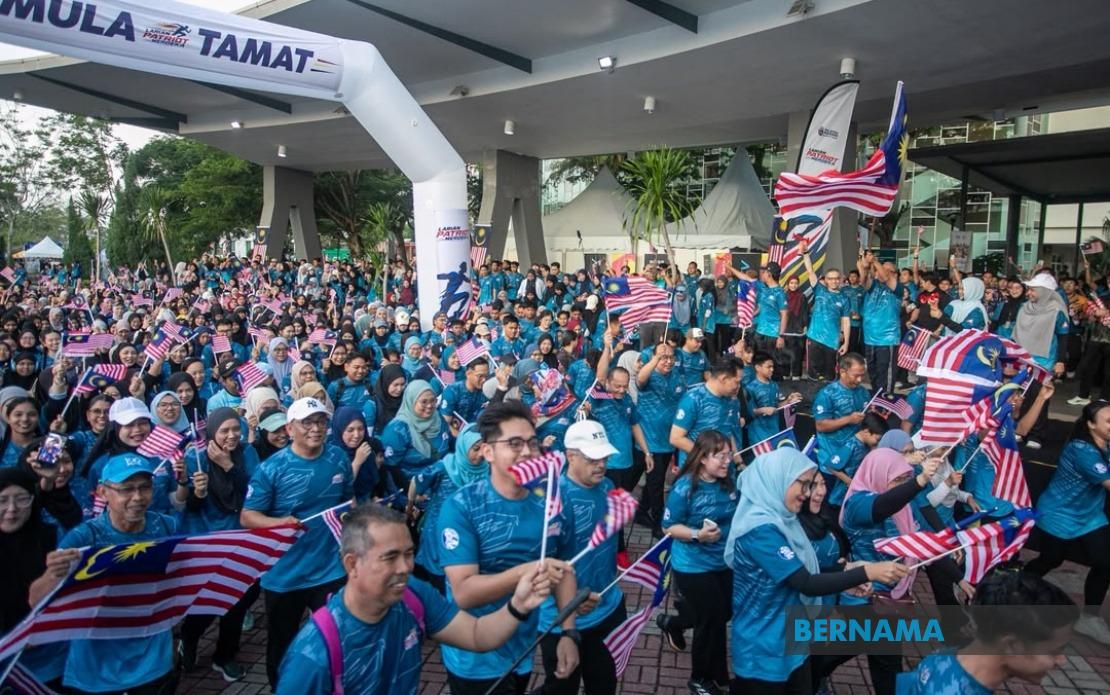
An early Friday morning in Ipoh saw the grounds of the Sultan Azlan Shah Ministry of Health Training Institute bustling with activity as roughly 2,000 participants gathered for the Patriot Merdeka Run, a community event designed to kindle national spirit ahead of the 2026 National Month and Malaysia Day celebrations. The turnout demonstrated broad public engagement, with attendees representing diverse segments of society—families with young children, individuals from different age groups and backgrounds, and community volunteers all converging to express their connection to the nation.
The event commenced with a mass aerobics session as dawn broke over the venue, setting an energetic and inclusive tone for the proceedings. This opening activity served a dual purpose: it encouraged physical wellness while simultaneously building camaraderie among participants before the main race. The sight of thousands moving together in synchronized exercise created a visual metaphor for national unity, a theme that organisers sought to emphasise throughout the morning.
At 7.30 am, Datuk Abdul Halim Hamzah, secretary-general of the Communications Ministry, officially flagged off the participants for the 2.5-kilometre fun run. Rather than a competitive race, the event was structured to accommodate walkers and runners of all fitness levels, ensuring accessibility for families and those of varying ages. The route itself became a moving testament to patriotic sentiment, with the Jalur Gemilang prominently displayed at intervals along the entire distance, creating an unmissable visual reminder of national identity.
The atmosphere throughout the event captured elements that have come to define how Malaysians express collective pride. Parents shepherded small children along the route, some participants wore clothing incorporating the red, white, yellow and blue colours of the national flag, and spontaneous cheering among groups of participants punctuated the morning air. These seemingly simple gestures—the involvement of families, the creative expressions of patriotism through attire, the mutual encouragement—collectively generated an environment of genuine goodwill rather than obligatory national observance.
Beyond its immediate patriotic messaging, the Patriot Merdeka Run functioned as an instrument for strengthening community bonds across demographic lines. The event brought together individuals who might not typically interact in their daily lives, creating shared experience around a common purpose. This community-building dimension holds particular relevance in contemporary Malaysia, where national cohesion remains a priority for policymakers and civil society alike.
Organisers framed the run explicitly as addressing dual objectives: promoting healthier lifestyles through physical activity while simultaneously nurturing deeper patriotic consciousness. The juxtaposition of these two goals reflects a broader recognition that national pride in the 21st century increasingly connects to civic engagement and shared social experiences rather than ceremonial exercises alone. By linking wellness and patriotism, the event appealed to participants across multiple registers of motivation.
The Patriot Merdeka Run occupied a strategic position in the broader calendar of 2026 National Day and Malaysia Day (HKHM 2026) commemorations. Rather than serving as the main official celebration, it functioned as an opening salvo—a grassroots activation intended to generate momentum and public conversation ahead of larger formal events. This sequential approach to national celebrations allows for building anticipation while giving ordinary citizens opportunities to participate meaningfully.
With Prime Minister Datuk Seri Anwar Ibrahim scheduled to officiate the primary launch of the 2026 celebrations at 10 am that same day, the morning's fun run served as a warm-up of sorts, grounding the subsequent formal ceremonies in the practical reality of public participation. The staggered progression from community-level events to official state functions reflected contemporary understanding that national identity requires both grassroots activation and institutional affirmation.
For Malaysian readers and Southeast Asian observers monitoring national cohesion in the region's largest Muslim-majority democracy, events like the Patriot Merdeka Run offer insights into how the nation continues negotiating expressions of national pride. The relatively strong turnout in Ipoh—a major city in the northern Klang Valley region—suggests sustained public willingness to engage in patriotic commemoration. The cross-generational and cross-community character of participation implies that such expressions remain broadly inclusive rather than fractious, a significant indicator given ongoing discussions about social division.
The 2026 National Month and Malaysia Day celebrations themselves carry particular significance as they arrive during a period when Malaysia navigates complex questions about national identity, inter-ethnic relations, and the nation's positioning in regional and global affairs. Using cultural and community events to foreground unity and shared heritage provides a counterweight to more contentious political debates, offering citizens opportunities to express patriotism through direct participation rather than passive reception.
As Malaysia moves toward these 2026 commemorations, the success of activation events like the Patriot Merdeka Run may serve as a baseline for measuring public enthusiasm. Policymakers will likely interpret strong community turnout as validation for the approach of embedding national celebrations in accessible, health-promoting, family-friendly activities rather than confining patriotic expression to formal state ceremonies. This methodology suggests an evolution in how governments approach national identity promotion—one that emphasizes voluntary participation, community agency, and the integration of patriotism into everyday wellness rather than treating it as a separate ceremonial domain.
The Fly the Jalur Gemilang Campaign (MPBKKJG 2026) that the fun run helped launch represents part of this broader strategy to democratize national pride, ensuring that expressions of patriotism become woven into the social fabric rather than existing as isolated, top-down directives. Success in such efforts ultimately depends on maintaining the voluntary, celebratory character that characterized the Ipoh event.

