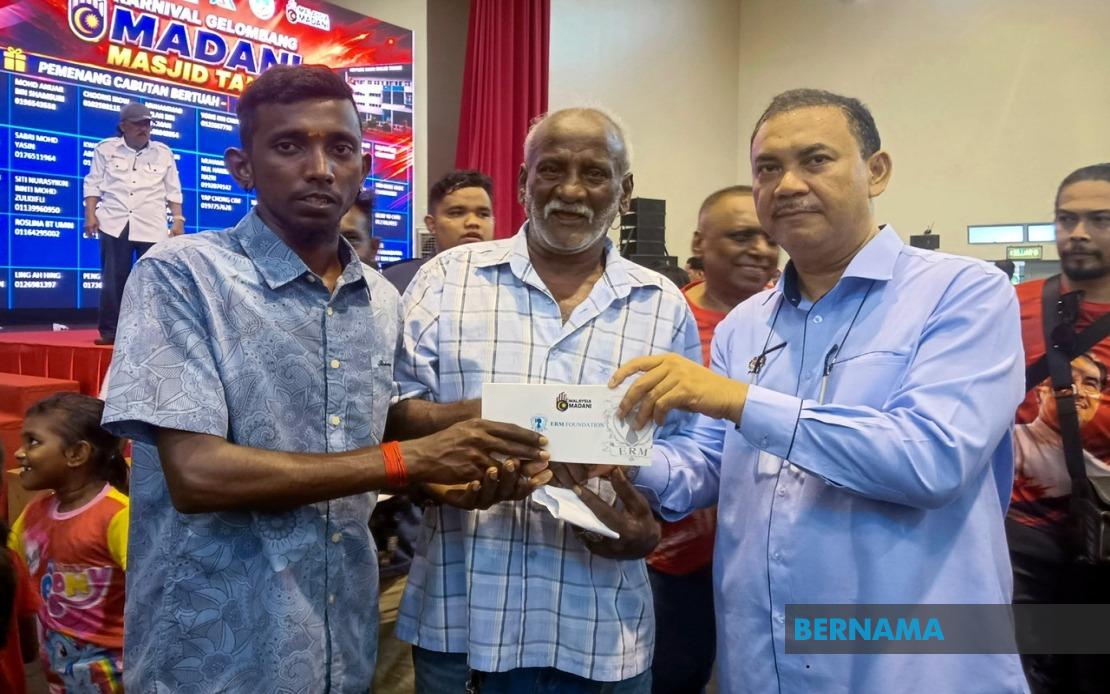
Around 2,000 vulnerable residents across the Masjid Tanah parliamentary constituency in Melaka have received financial relief through the Sentuhan MADANI Donation scheme, which was rolled out during the Gelombang MADANI Carnival held at the Masjid Tanah Sports Complex. Each beneficiary was handed RM200 in direct cash support to help alleviate immediate financial hardship, marking another phase of the government's targeted assistance programme for lower-income Malaysians.
Datak Azman Abidin, the Prime Minister's political secretary, oversaw the distribution ceremony and confirmed the breadth of the outreach effort. The initiative encompassed residents from five distinct state constituencies nested within the Masjid Tanah parliamentary division—specifically Kuala Linggi, Lendu, Tanjung Bidara, Ayer Limau, and Taboh Naning—ensuring geographically dispersed coverage across the region. This multi-constituency approach underscores the government's intent to prevent aid concentration in urban pockets and extend assistance to less visible communities in surrounding rural and semi-urban areas.
The Sentuhan MADANI programme deliberately targeted four distinct vulnerable demographic segments. Recipients included members of the B40 income group, which encompasses the bottom 40 per cent of Malaysian households by income; senior citizens facing retirement or pension constraints; persons living with disabilities who encounter additional financial pressures from healthcare and adaptive equipment costs; and low-income earners struggling to bridge the gap between earnings and living expenses. This categorical approach reflects a refined understanding that vulnerability in Malaysia stems from interconnected factors rather than income alone, acknowledging the compounding hardships faced by elderly individuals or those managing chronic conditions.
For Ramlah Othman, a 63-year-old resident from Tanjung Bidara, the RM200 represented meaningful practical relief rather than ceremonial charity. She highlighted how the contribution would directly reduce the strain on household budgets allocated to essential daily expenses such as food, utilities, and transport. Her gratitude, expressed through the Islamic phrase Alhamdulillah, reflected widespread sentiment among beneficiaries who recognized the assistance as timely support during challenging economic circumstances. Such testimonials indicate that micro-level cash transfers, while modest in absolute terms, carry significant weight in household economies operating with minimal margins for unexpected expenditure.
N. Mariappan, a 69-year-old stroke survivor from Ladang Sungai Baru, embodied another dimension of MADANI's reach—support for persons managing post-illness recovery and disability-related expenses. His case illustrated how chronic health conditions create cascading financial demands beyond typical living costs, including medication, physiotherapy, and accessibility modifications. Mariappan's observation that the scheme demonstrated government concern for both senior citizens and disabled populations suggested that recipients perceived the initiative as recognition of their specific circumstances rather than generic poverty relief.
The MADANI framework itself represents an evolution in Malaysian social assistance philosophy. Rather than treating welfare as a stigmatized handout, the initiative positions aid as a government responsibility toward citizens facing structural disadvantages or temporary hardship. The carnival setting, combining community celebration with benefit distribution, normalizes assistance-seeking and builds social cohesion around collective welfare concerns. This public, festive context contrasts with older models that sometimes obscured poverty support through bureaucratic channels.
Malaysia's B40 demographic encompasses approximately 4.4 million households, making even targeted programmes necessarily selective. The decision to focus on parliamentary constituencies reflects political constituency logic but also practical administration—federal programmes increasingly channel resources through elected representatives' offices to improve visibility and community awareness. The Masjid Tanah concentration in this instance suggests similar rollouts across other constituencies, though coordination and resource availability determine implementation pace.
The five component state constituencies vary significantly in socioeconomic composition. Kuala Linggi and Tanjung Bidara contain significant fishing and agricultural communities with seasonal income volatility, while Ayer Limau and Taboh Naning encompass more dispersed rural settlements. Lendu, positioned closer to Alor Gajah town, exhibits mixed urban-rural characteristics. This geographic diversity within the parliamentary constituency meant the programme had to address distinct poverty drivers—maritime unemployment, agricultural subsistence struggles, and informal sector precarity—through a uniform cash mechanism. Such bluntness in policy implementation, while administratively simpler, may miss constituency-specific needs that targeted sector support could address more effectively.
Cash transfer programmes globally demonstrate both strengths and limitations. Direct monetary support preserves recipient autonomy and respects human dignity by avoiding paternalistic conditionality, yet RM200 monthly or per-distribution represents marginal impact on structural poverty. Malaysian policymakers increasingly recognize that sustainable poverty reduction requires complementary interventions—skills training, entrepreneurship support, childcare access, and healthcare subsidies—that extend beyond income support. The Sentuhan MADANI initiative's role within broader anti-poverty architecture remains unclear from official communication.
The initiative's timing and scale suggest preparation for electoral dynamics. Distributing cash assistance across multiple constituencies simultaneously generates visible government activity and demonstrates responsiveness to citizen hardship, potentially reinforcing public perception of an engaged administration. In Malaysian political context, such targeted assistance programmes often intensify during election cycles, though sustained year-round provision would indicate deeper structural commitment. Beneficiary testimonies, however, suggest that regardless of political calculus, real households experience tangible improvement from the assistance, even if temporary.
Looking forward, sustainability questions emerge. Does MADANI represent recurring support or one-time relief? Are beneficiary registries maintained for ongoing assistance or reassessment? Will the programme expand to other constituencies and if so, at what fiscal cost? Southeast Asian governments broadly face pressure to expand welfare provisions as globalization and automation displace workers, yet revenue constraints limit expansion capacity. Malaysia's specific challenge involves balancing assistance expansion with debt sustainability and development investment demands.
The human impact stories from Masjid Tanah reveal that even modest cash transfers provide psychological and material relief to households operating on survival-level budgets. Ramlah and Mariappan's gratitude reflected genuine hardship rather than entitlement mentality, suggesting that needs-based assessment mechanisms had functioned reasonably effectively. For Malaysian policymakers seeking to improve living standards while maintaining fiscal discipline, such targeted cash support offers a pragmatic interim approach, though long-term poverty reduction demands structural economic transformation creating more stable livelihoods beyond welfare dependence.

