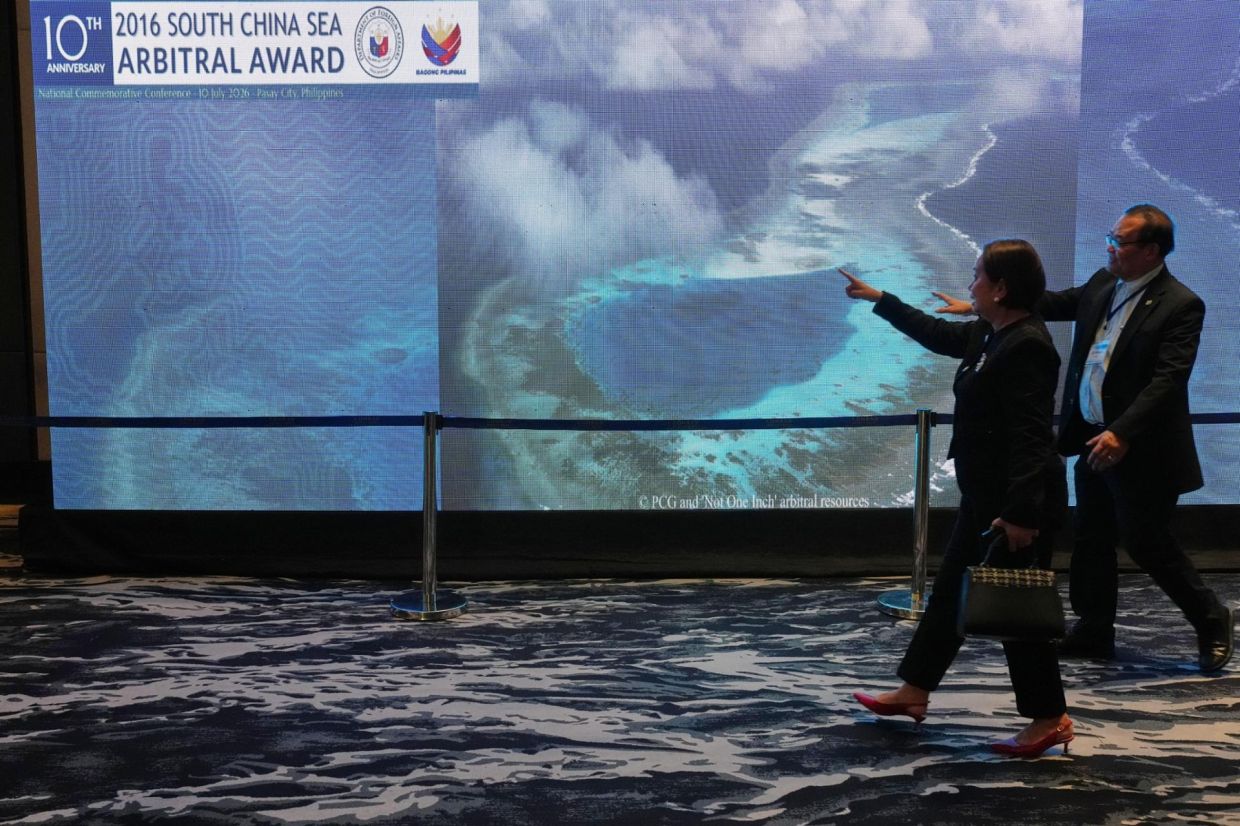
A coordinated statement from fourteen countries, including the Philippines and major Western powers, marked the tenth anniversary of a landmark arbitral tribunal decision on the South China Sea on Sunday, underscoring their collective conviction that the 2016 ruling remains legally binding and internationally enforceable. The coalition—comprising the Philippines, Australia, Canada, Estonia, Germany, Italy, Japan, Latvia, Lithuania, New Zealand, Romania, Slovenia, the United Kingdom and the United States—jointly declared their unwavering support for a rules-based international order in one of the world's most contested maritime zones, where competing territorial and maritime claims have long threatened regional stability.
The arbitral tribunal, operating under the framework established by Annex VII of the United Nations Convention on the Law of the Sea (UNCLOS), issued its decision on July 12, 2016, following a case initiated by the Philippines in 2013. The ruling represented a watershed moment in international maritime law, effectively dismantling China's historical assertion of sovereignty across nearly the entire South China Sea through its controversial "nine-dash line" claim. By invalidating Beijing's concept of "historic rights" as lacking any foundation in international law, the tribunal established a precedent that forced a recalibration of regional power dynamics and exposed fundamental disagreements over how territorial disputes should be adjudicated.
The ten-year commemoration carries particular significance for Southeast Asian readers and policymakers, as the South China Sea remains central to regional security, economic prosperity, and geopolitical balance. The waterway annually handles approximately one-third of global maritime trade, making its stability crucial to shipping routes that directly link Malaysian, Singaporean, and other Southeast Asian ports to global markets. The decision's validation of the Philippines' exclusive economic zone (EEZ) and its affirmation that features including Panganiban Reef and Ayungin Shola fall within Filipino jurisdiction established important maritime boundaries that other claimant states and international observers reference in their own negotiations and activities.
The coalition's restatement of commitment to a "free and open Indo-Pacific that is peaceful, stable, and rules-based" reflects a broader geopolitical strategy among developed democracies to reinforce the international legal framework against what they perceive as unilateral assertion of power. By explicitly invoking UNCLOS and the binding character of the arbitral award, the signatories sought to strengthen the normative environment in which maritime disputes should be contested—through law and negotiation rather than through military or paramilitary pressure. This messaging carries particular resonance given persistent reports of confrontational maritime incidents and the presence of coast guard and militia vessels in contested waters.
Central to the joint statement was a pointed criticism of tactics that signatories characterised as destabilising and coercive. The fourteen nations directly opposed "any destabilising or unilateral actions including by force or coercion" and specifically condemned the use of coast guard, military and maritime militia vessels "to harass, obstruct, or intimidate lawful operations by other States at sea or in the air." This language directly addresses patterns of behaviour documented in recent years, including incidents involving water cannons, blocking manoeuvres, and aggressive interception of civilian and government vessels—actions that signatories argued endanger personnel, disrupt fishing communities, and corrode the security architecture that underpins regional stability.
For Malaysian observers, the statement's emphasis on protecting freedom of navigation and lawful use of the sea holds immediate relevance. Malaysia maintains its own South China Sea claims and operates within the disputed waters as part of its economic interests and security posture. The affirmation that maritime disputes must be resolved peacefully in accordance with UNCLOS provides a framework that theoretically protects all claimant states' legitimate interests, regardless of their military capabilities or great power backing. The coalition's reference to "internationally lawful uses of the sea" implicitly endorses activities including commercial shipping, fishing, and hydrographic surveys—activities that Malaysian vessels regularly conduct and that require predictable, rules-based conditions.
The signatories additionally expressed strong support for ASEAN's own vision of the South China Sea as "a sea of peace, stability, cooperation, and prosperity driven by vibrant lawful commerce." This alignment signals that the coalition of fourteen nations sees its position as complementary to, rather than antagonistic toward, ASEAN-centred approaches to regional problem-solving. The reference strengthens the hand of ASEAN nations seeking to advance diplomatic negotiations, including ongoing efforts to develop a Code of Conduct for the South China Sea that would establish mutually acceptable behavioural guidelines while leaving underlying claims unresolved.
The coalition's call for all parties to abide by the 2016 arbitral award and settle remaining disputes through dialogue and lawful mechanisms represents a diplomatic effort to reinforce international legal precedent without directly escalating confrontation. By assembling a geographically diverse group spanning Europe, Asia-Pacific and North America, the signatories sought to demonstrate that support for the arbitral award transcends regional divides and reflects a commitment to universal legal principles. This breadth of support theoretically makes it more difficult for any single nation to dismiss the ruling as merely a regional or Western-backed outcome.
The ten-year anniversary statement arrives at a moment when South China Sea tensions remain at elevated levels, with recurring incidents involving Chinese and Philippine vessels, ongoing construction activities on disputed features, and persistent questions about how the region's maritime disputes will ultimately be resolved. The anniversary provides an opportunity for international attention to refocus on the enduring legal framework that undergirds regional claims and counteracts the impression that possession and military presence should determine maritime entitlements. For the Philippines, the reiteration of international support validates its decision to pursue arbitration and provides diplomatic reinforcement as it navigates complex relations with Beijing while managing its own strategic partnerships.
The anniversary also highlights an evolving reality in regional geopolitics: a growing alignment among democratic nations in affirming rules-based international order, even as authoritarian approaches to territorial assertion persist. The coalition of fourteen, deliberately including both large powers and smaller nations, European partners and Asia-Pacific partners, demonstrates that support for UNCLOS and arbitral mechanisms represents a broad international consensus rather than a narrow faction. This consensus-building effort, symbolically marked through the joint statement, aims to shape the normative environment in which future South China Sea disputes will be negotiated and resolved, even as the substantive disagreements that generated the 2016 arbitration remain unresolved.

