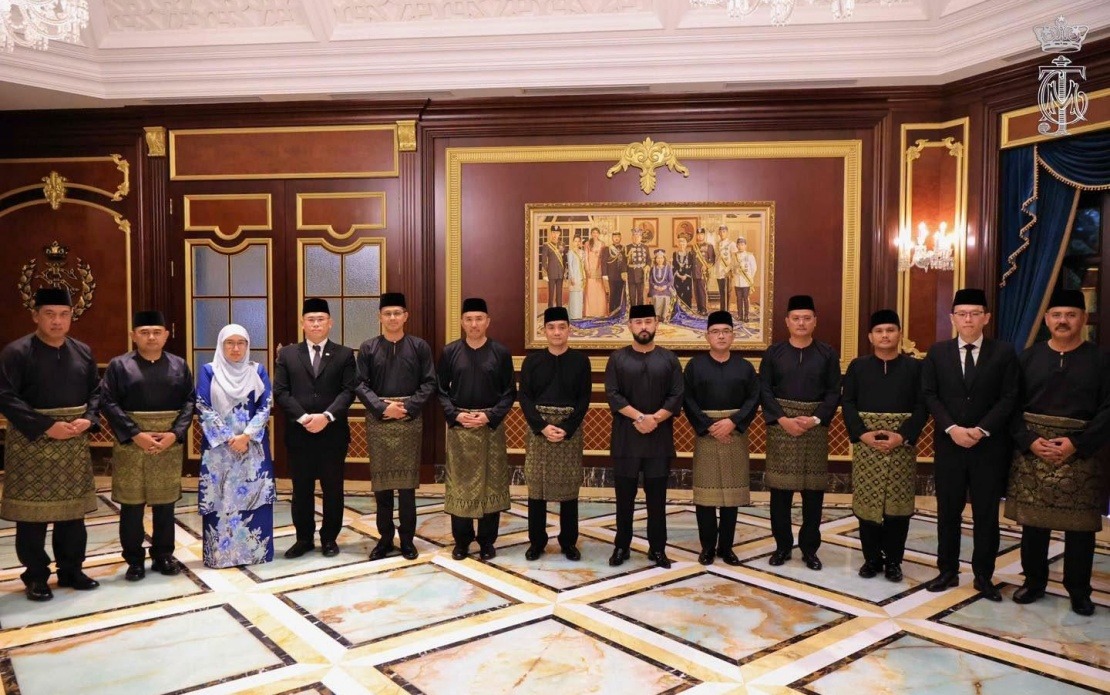
A fresh batch of ten assemblymen took their oaths as members of the Johor State Executive Council in a ceremony held at Istana Bukit Serene, with proceedings overseen by the Regent of Johor, Tunku Mahkota Ismail. The swearing-in on July 18 marked a formal transition to the administration's new executive structure, reflecting the political momentum generated by the coalition's recent electoral triumph in Malaysia's southern state.
The newly constituted Exco comprises both experienced politicians and first-time appointees to the state cabinet. Among those reappointed to ministerial rank are Mohd Hairi Mad Shah representing Larkin, Datuk Mohd Jafni Md Shukor from Bukit Permai, Mohd Fared Mohd Khalid of Semerah, Ling Tian Soon from Yong Peng, Lee Ting Han representing Paloh, and Mohamad Fazli Mohamad Salleh from Bukit Pasir. These individuals bring continuity to the state's governance following the electoral refresh.
Breaking into the state cabinet for the first time are four newcomers who will now shoulder ministerial responsibilities. Md Israk Abdullah, representing the Kukup constituency, joins alongside P. Pannir Selvam from Perling, Hasrunizah Hassan who holds the Pulai Sebatang seat, and Muhammad Naqib Md Ghazali representing Panti. Their elevation reflects efforts by the new administration to inject fresh perspectives into the executive council while broadening the coalition's representational base across the state.
The ceremony witnessed attendance by several senior state officials, including Menteri Besar Datuk Onn Hafiz Ghazi, Royal Court Council Yang Dipertua Datuk Dr Abdul Rahim Ramli, and State Secretary Datuk Mohammed Ridha Abd Kadir. The formal proceedings underscored the significance of the occasion within Johor's political establishment, with protocol observers noting the presence of key administrative and constitutional figures during the oath-taking process.
This cabinet formation arrives in the immediate aftermath of Datuk Onn Hafiz Ghazi's swearing-in as Johor Menteri Besar for a consecutive second term. The chief minister's reinstatement occurred just days prior on the preceding Sunday, following Barisan Nasional's commanding performance in the 16th Johor state election. His personal victory in the Machap constituency was particularly emphatic, with the Johor BN chairman securing a substantial majority exceeding 15,000 votes—a clear reflection of electoral confidence in his stewardship.
Barisan Nasional's overall performance in the state election delivered an undisputed mandate to govern. The coalition captured 48 of the 56 available state seats, a decisive outcome that provides substantial parliamentary numbers for policy implementation and legislative initiatives throughout the five-year term. This supermajority insulates the administration from the kind of razor-thin margins that have destabilized governments elsewhere in Malaysia, offering relative stability for medium-term planning and development programmes.
The cabinet reconstitution carries particular significance for Johor's development trajectory. As Malaysia's second-largest state by population and a crucial economic engine anchoring the southern region, the executive council's composition directly influences investment decisions, infrastructure priorities, and inter-governmental relations with neighbouring Selangor and the federal territories. The balance between continuity and renewal reflected in this Exco selection suggests the Menteri Besar intends to maintain proven administrative competence whilst injecting new energy into specific portfolios through the appointed newcomers.
For Malaysian political observers, the swearing-in demonstrates the consolidation of Barisan Nasional's regional strength following the coalition's successful rehabilitation of electoral fortunes over recent electoral cycles. Johor's continued BN allegiance contrasts sharply with the political volatility evident in other states, establishing the southern territory as an institutional anchor within the coalition's broader national architecture. The state's stability remains important to federal-level politics given its economic significance and population weight.
The appointment composition also reflects deliberate efforts toward demographic representation. The inclusion of lawmakers from varied ethnic and geographic backgrounds across Johor's parliamentary constituencies—spanning areas from the relatively urbanised Yong Peng to the rural Kukup waterfront region—suggests the administration's intent to project inclusive governance across different community interests. This geographical and communal spread within the Exco structure carries implications for the distribution of state resources and the prioritization of regional development initiatives across the state's diverse constituencies.
Looking forward, the newly formed State Executive Council faces considerable administrative demands. Beyond routine governance, the cabinet must address longstanding infrastructure gaps, coordinate with federal authorities on economic initiatives tied to regional development corridors, and navigate the complexities of federal-state fiscal relationships. The combination of experienced ministers and newcomers will presumably see workload distribution reflecting both seniority and specialization, though the specific portfolio allocations remain to be publicly detailed.
The cabinet's inaugural phase will prove telling regarding the administration's policy direction and execution capacity. Observers across Southeast Asia watch such regional power transitions closely, given Johor's cross-border economic integration with Singapore and its influence on Malaysian federal dynamics. The state's governance quality and investor confidence levels directly reverberate through broader ASEAN economic networks, making the effectiveness of this particular Exco composition relevant beyond state boundaries.

